Spring constant, abbreviated as \(k_s\), also called spring force constant, is the stiffness or elasticity of a spring. It is a measure of how much force is required to stretch or compress a spring by a certain amount.
Spring Constant formula |
||
|
\( k_s \;=\; - \;F \cdot d_s \) (Spring Constant) \( F \;=\; - \; \dfrac{ k_s }{ d_s } \) \( d_s \;=\; - \; \dfrac{ k_s }{ F } \) |
||
| Symbol | English | Metric |
| \( k_s \) = Spring Force Constant | \(lbf\) | \(N\) |
| \( F \) = Spring Force | \(lbf\) | \(N\) |
| \( d_s \) = Spring Displacement | \(in\) | \(mm\) |
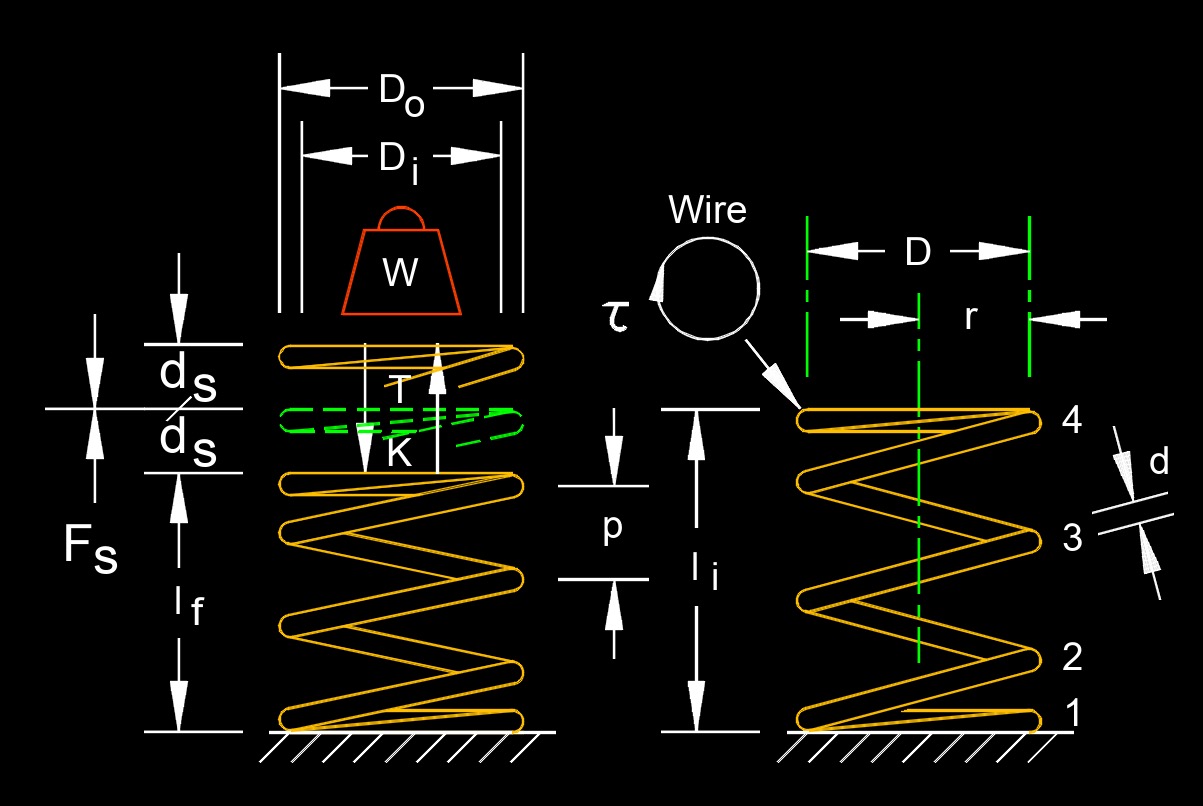 Hooke's law states that the force exerted by a spring is directly proportional to the amount it is stretched or compressed from its equilibrium position, with the spring constant determining the proportionality constant. A higher spring constant indicates a stiffer spring, meaning it requires more force to produce a given displacement, while a lower spring constant indicates a softer spring, requiring less force for the same displacement.