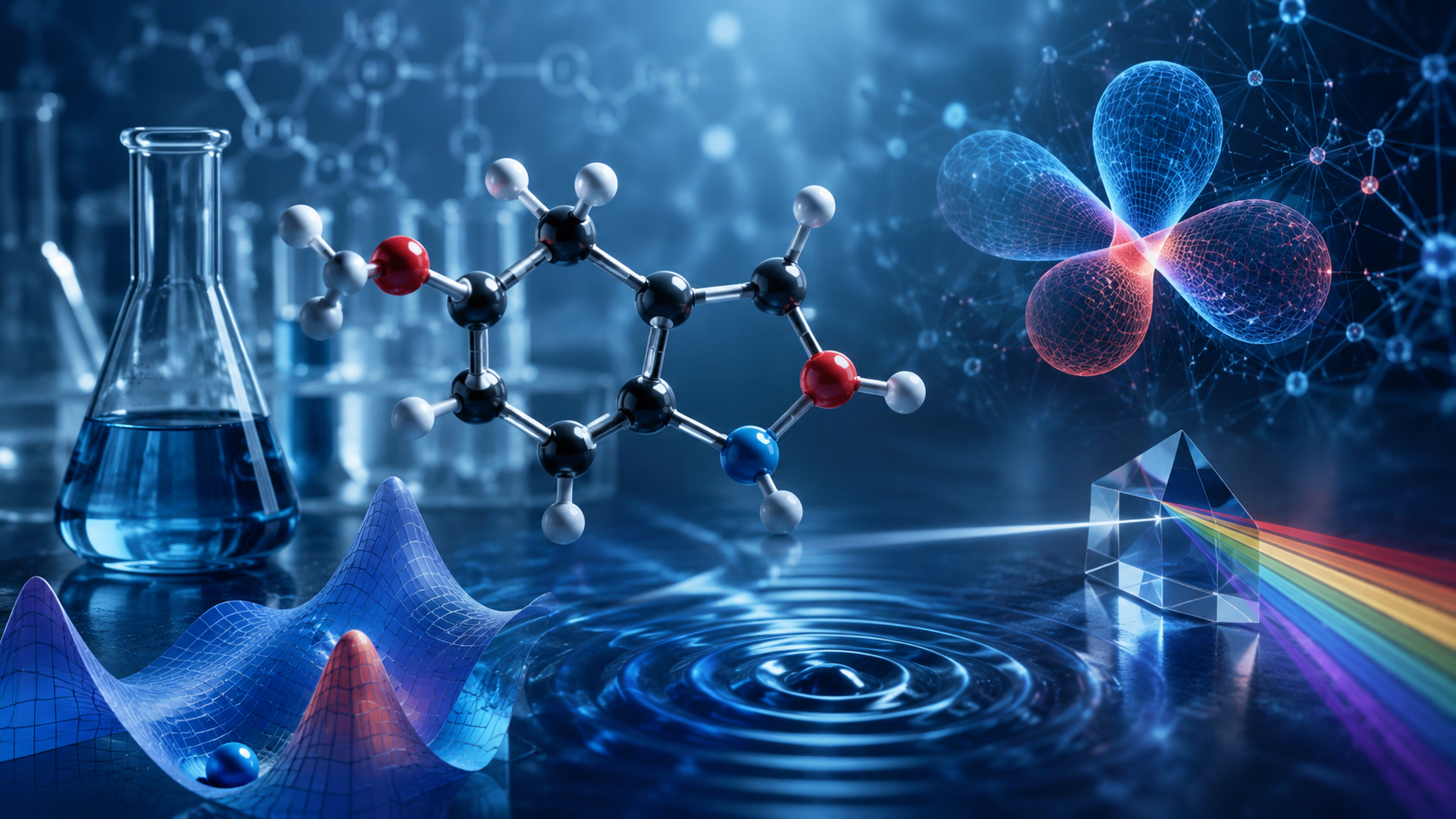
 Physical chemistry studies the basic physical principles governing chemical systems and chemical transformations. It focuses on understanding how the laws and models of physics, particularly thermodynamics, quantum mechanics, and statistical mechanics explain the behavior, structure, and energy changes of atoms, molecules, and chemical reactions. By integrating concepts like energy, entropy, and wave-particle duality, physical chemistry provides a quantitative framework for predicting how matter interacts and transforms, bridging the gap between pure chemistry and physics. This field is foundational for advancements in areas like materials science, biochemistry, and nanotechnology, and its principles are derived from experimental observations and theoretical models that have been rigorously tested and validated over time. Rather than primarily identifying or synthesizing substances, physical chemistry seeks to describe and quantify the mechanisms and energetics that control chemical processes.
Chemical Kinetics - This studies the rates of chemical reactions, the factors that influence those rates (such as concentration, temperature, catalysts, and surface area), and the mechanisms by which reactions occur.
Chemical Thermodynamics - The study of the interrelation of heat and work with chemical reactions or physical changes of state, governed by the laws of thermodynamics, enabling predictions about reaction spontaneity and equilibrium. It applies mathematical and experimental methods to assess energy transformations, such as enthalpy, entropy, and Gibbs free energy, in chemical systems.
Electrochemistry - The interrelationship between electrical energy and chemical changes, focusing on reactions involving electron transfer, such as oxidation-reduction processes in electrochemical cells like batteries or electrolysis setups. It encompasses the conversion of chemical energy into electrical energy (as in galvanic cells) or the use of electrical energy to drive non-spontaneous chemical reactions (as in electrolytic cells), governed by principles like Faraday's laws.
Photochemistry - Studies the chemical reactions, isomerizations, and physical changes induced by the absorption of light, particularly ultraviolet, visible, or infrared radiation, leading to processes like photoexcitation where molecules reach excited states. It focuses on the effects of radiant energy in producing chemical transformations, governed by principles such as the Grotthuss-Draper law (light must be absorbed for a reaction) and the Stark-Einstein law (one photon activates one molecule).
Quantum Chemistry - It applies the principles of quantum mechanics to chemical systems, focusing on the calculation of electronic structures, molecular properties, and behaviors at the atomic and molecular levels through methods like solving the Schrödinger equation. It enables predictions about chemical reactions, stability of compounds, and interactions with light by modeling wave functions and energy distributions of electrons in atoms and molecules.
Spectroscopy - That studies the interaction of matter with electromagnetic radiation, including absorption, emission, and scattering, to analyze the structure, composition, and properties of atoms and molecules. It enables the determination of energy levels, electronic transitions, and molecular dynamics through spectra, distinguishing it by measuring responses as a function of wavelength or frequency.
Statistical Mechanics - It applies statistical methods and probability theory to large ensembles of microscopic particles, such as atoms and molecules, to predict and explain macroscopic thermodynamic properties like temperature, pressure, and entropy. It provides a theoretical foundation for understanding equilibrium states and phase transitions in chemical systems by averaging over molecular configurations and energies.
Surface Chemistry - The studies the physical and chemical phenomena, including reactions and processes, occurring at the interfaces between two phases, such as solid-liquid, solid-gas, liquid-gas, or solid-vacuum. It encompasses areas like adsorption, catalysis, and colloid formation, providing insights into surface properties and interactions that differ from bulk material behavior.