Surveying
Surveying, Engineering, Civil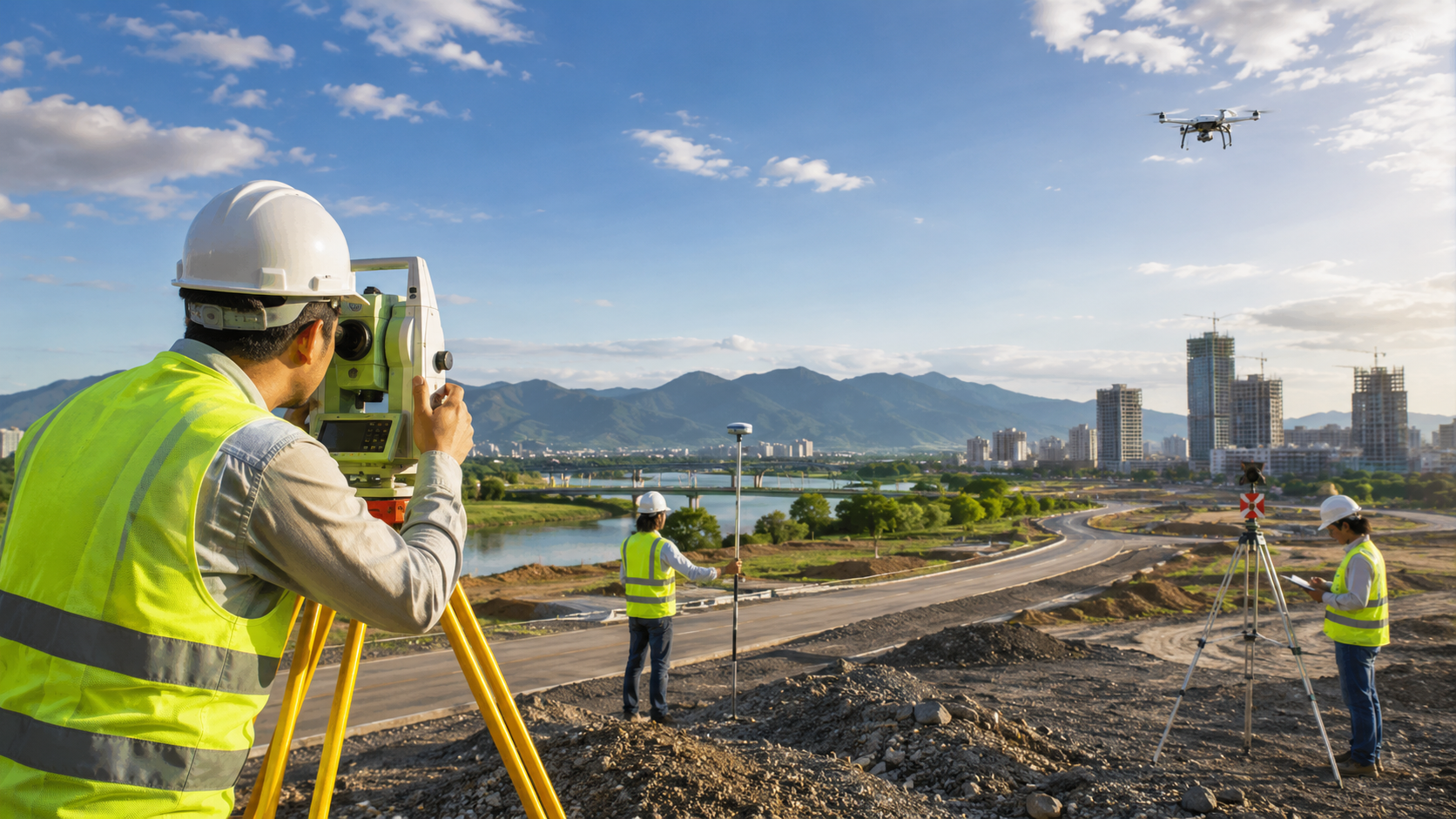 Surveying focuses on the measurement, mapping, and analysis of the Earth's surface and the built environment. Surveying engineers use a variety of tools and techniques to collect and analyze data about the Earth's features, including its topography, vegetation, and man made structures. The work of a surveying engineer typically involves using high precision instruments, such as total stations, GPS receivers, and laser scanners, to collect data about the location, size, and shape of objects on the Earth's surface. They may also use aerial or satellite imagery to gather data about large areas of land or to map features that are difficult to access on foot.
Surveying engineers work in a variety of industries, including construction, mining, transportation, and environmental engineering. They are responsible for creating accurate maps and models of the Earth's surface, which are used to plan and design infrastructure projects, monitor changes to the environment, and ensure public safety. In addition to measuring the Earth's surface, surveying engineers are also responsible for managing and analyzing large datasets, using geographic information systems (GIS) and other software tools to process and interpret data. They may also work on projects related to land use planning, property boundary disputes, and natural resource management.
| Science |
| Applied Science |
| Engineering |
| Civil Engineering |
| Surveying |
This engineering disipline is an important field that plays a critical role in many aspects of modern society. By collecting and analyzing data about the Earth's surface, surveying engineers help to ensure that infrastructure projects are designed and built safely and efficiently, while also preserving the environment for future generations.
Surveying Branches
Astronomical Surveying - Determines positions on the Earth by observing celestial bodies such as the Sun, Moon, stars, and planets. Historically, it was important for determining latitude, longitude, azimuth, and time.
Cadastral Surveying - Also called boundary or land surveying, establishes, re-establishes, and documents legal property boundaries, land ownership divisions, easements, and parcel descriptions.
Construction Surveying - Focused on transferring design plans and dimensions from drawings onto the ground so structures can be built in the correct location and elevation.
Control Surveying - Focused on establishing precise horizontal and vertical reference points, called control points, which serve as the framework for other surveying activities.
Geodetic Surveying - Surveying that accounts for the curvature and shape of the Earth. It is used for large areas, national mapping systems, and high-precision control networks. Geodetic surveying relies on advanced mathematics, satellite positioning systems, and reference datums.
GIS and Geospatial Surveying - Integrating surveying data with Geographic Information Systems (GIS), spatial databases, satellite positioning, and digital mapping technologies for spatial analysis and management.
Hydrographic Surveying - Measures and maps bodies of water such as oceans, rivers, lakes, and harbors. It determines depths, shorelines, underwater topography, tides, and navigational hazards.
LiDAR Surveying - Using Light Detection and Ranging (LiDAR) technology to create highly accurate three-dimensional surface models and terrain data.
Marine Surveying - Coastal and offshore measurements, including shoreline mapping, harbor development, offshore structures, and marine navigation support.
Mine Surveying - Applied to surface and underground mining operations. It establishes mine boundaries, tunnel alignments, excavation measurements, and volume calculations for mineral extraction.
Photogrammetric Surveying - Obtains measurements and maps from photographs, especially aerial or satellite imagery. It is widely used for mapping, terrain modeling, and geographic information systems.
Plane Surveying - Assumes the Earth’s surface is flat over small areas. It is commonly used for ordinary engineering, construction, land development, and property boundary work where Earth curvature effects are negligible.
Remote Sensing Surveying - Collects information about the Earth’s surface without direct contact, commonly using satellites, drones, aircraft sensors, radar, or LiDAR systems.
Topographic Surveying - Concerned with determining the natural and artificial features of land, including elevations, contours, rivers, roads, buildings, and terrain relief. The results are commonly shown on topographic maps.
Satellite or GNSS Surveying - Global Navigation Satellite Systems such as GPS, GLONASS, Galileo, and BeiDou to determine precise positions, elevations, and coordinates on the Earth’s surface.
Underground Surveying - Concerned with surveys conducted below the Earth’s surface, including tunnels, subways, utilities, caverns, and underground infrastructure systems.