Tortuosity, abbreviated as \( \tau \) (Greek symbol tau), a dimensionless number, calculates the extent to which fluid flow paths, diffusion paths, or electrical conduction paths through porous media such as soils, rocks, or other construction materials deviate from a straight-line trajectory. It describes the sinuous or convoluted nature of the interconnected pore spaces that control transport processes in these materials. Tortuosity is formally defined as the ratio of the actual effective length of the flow path (or streamline) between two points within the medium to the straight-line Euclidean distance between those same points. This ratio is always greater than or equal to 1.0, with a value of exactly 1.0 representing perfectly straight, unobstructed pathways and higher values indicating increasing levels of twisting, branching, and obstruction imposed by the microstructure of the material
Tortuosity Formula |
||
|
\( \tau \;=\; \dfrac{ l }{ C }\) (Tortuosity) \( l \;=\; \tau \cdot C \) \( C \;=\; \dfrac{ l }{ \tau }\) |
||
| Symbol | English | Metric |
| \( \tau \) (Greek symbol tau) = Tortuosity | \(dimensionless\) | \(dimensionless\) |
| \( l \) = Curve Length | \(in\) | \(mm\) |
| \( C \) = Distance Between the Ends of the Curve | \(in\) | \(mm\) |
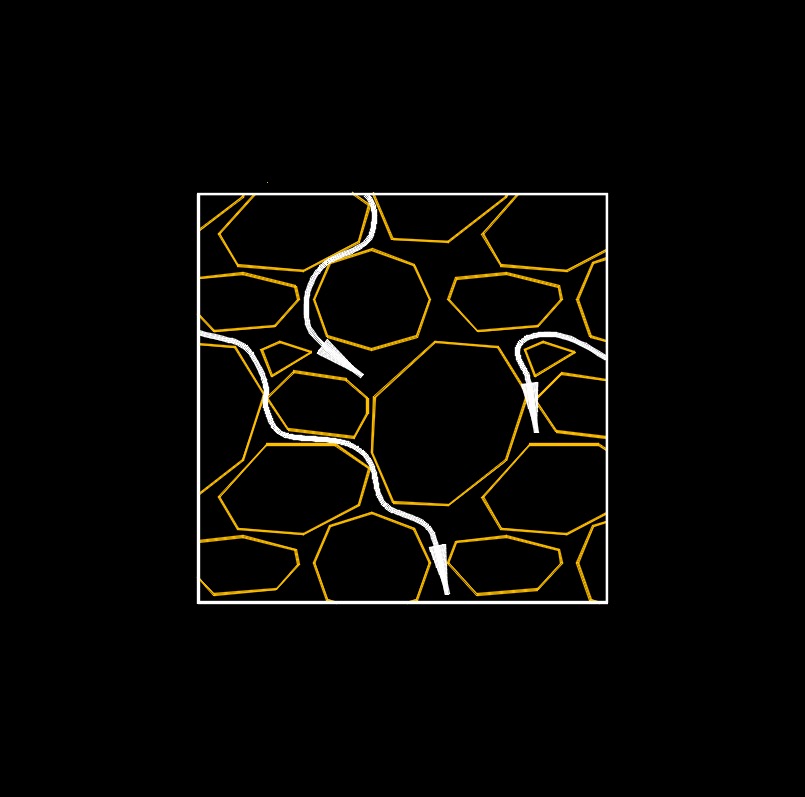
Tortuosity describes the transport processes such as permeability, diffusion, and electrical conductivity in porous media. Higher tortuosity generally reduces the efficiency of transport because it increases the distance and resistance encountered by the moving fluid or particles.
Key Points about Soil Tortuosity