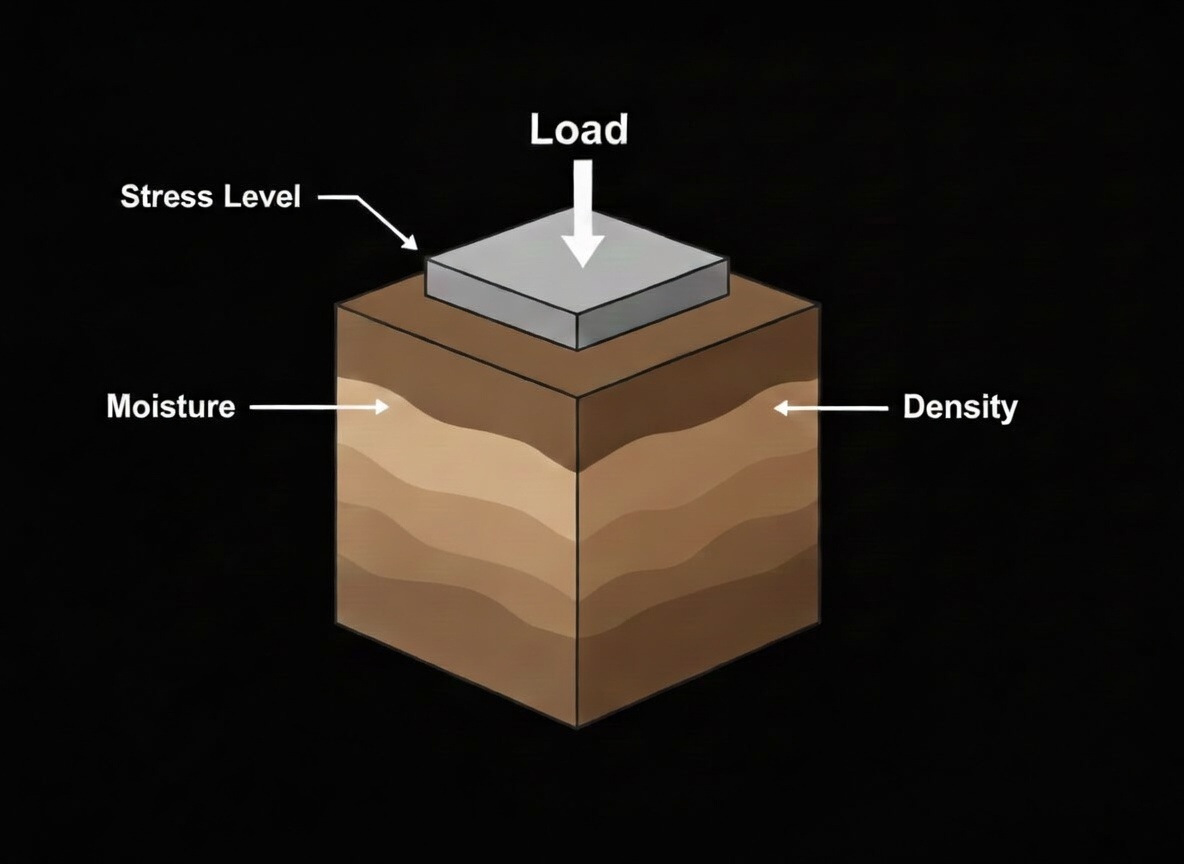
 Bearing Capacity is the maximum contact stress that a soil or rock mass can sustain from a foundation without undergoing shear failure. It is a geotechnical strength parameter that defines the load-carrying capability of the supporting ground at the soil–foundation interface. In formal terms, bearing capacity corresponds to a limit equilibrium condition in which the applied stresses mobilize the available shear strength of the soil along a failure surface beneath the footing.
In shallow foundation analysis, the ultimate bearing capacity is governed by three primary contributions: soil cohesion, surcharge (overburden pressure at foundation level), and the self-weight of the soil within the failure mechanism. The resulting expressions are derived from limit equilibrium theory and assume defined boundary conditions, soil homogeneity, and specified loading geometry.