Euler’s buckling, abbreviated as \( P_{cr} \), also called Euler’s critical load or Euler’s buckling load, is when a long, slender structural member (such as a column) suddenly bends sideways and becomes unstable when subjected to a compressive axial load that exceeds a certain critical value.
Euler's buckling formula |
||
|
\( P_{cr} \;=\; \dfrac{ \pi \cdot E \cdot I }{ ( K \cdot L )^2 } \) (Euler's Buckling) \( E \;=\; \dfrac{ P_{cr} \cdot ( K \cdot L )^2 }{ \pi^2 \cdot I } \) \( I \;=\; \dfrac{ P_{cr} \cdot ( K \cdot L )^2 }{ \pi^2 \cdot E } \) \( K \;=\; \dfrac{ 1 }{ L } \cdot \sqrt{ \dfrac{ \pi^2 \cdot E \cdot I }{ P_{cr} } } \) \( L \;=\; \dfrac{ 1 }{ K } \cdot \sqrt{ \dfrac{ \pi^2 \cdot E \cdot I }{ P_{cr} } } \) |
||
| Symbol | English | Metric |
| \( P_{cr} \) = Euler's Buckling | \(lbf\) | \(N\) |
| \( \pi \) = Pi | \(3.141 592 653 ...\) | \(3.141 592 653 ...\) |
| \( E \) = Young's Modulus | \(lbf\;/\;in^2\) | \(Pa\) |
| \( I \) = Second Moment of Area | \(ft^4\) | \(m^4\) |
| \( K \) = Effective Length Factor | \(dimensionless\) | \(dimensionless\) |
| \( L \) = Physical Length of the Column | \(ft\) | \(m\) |
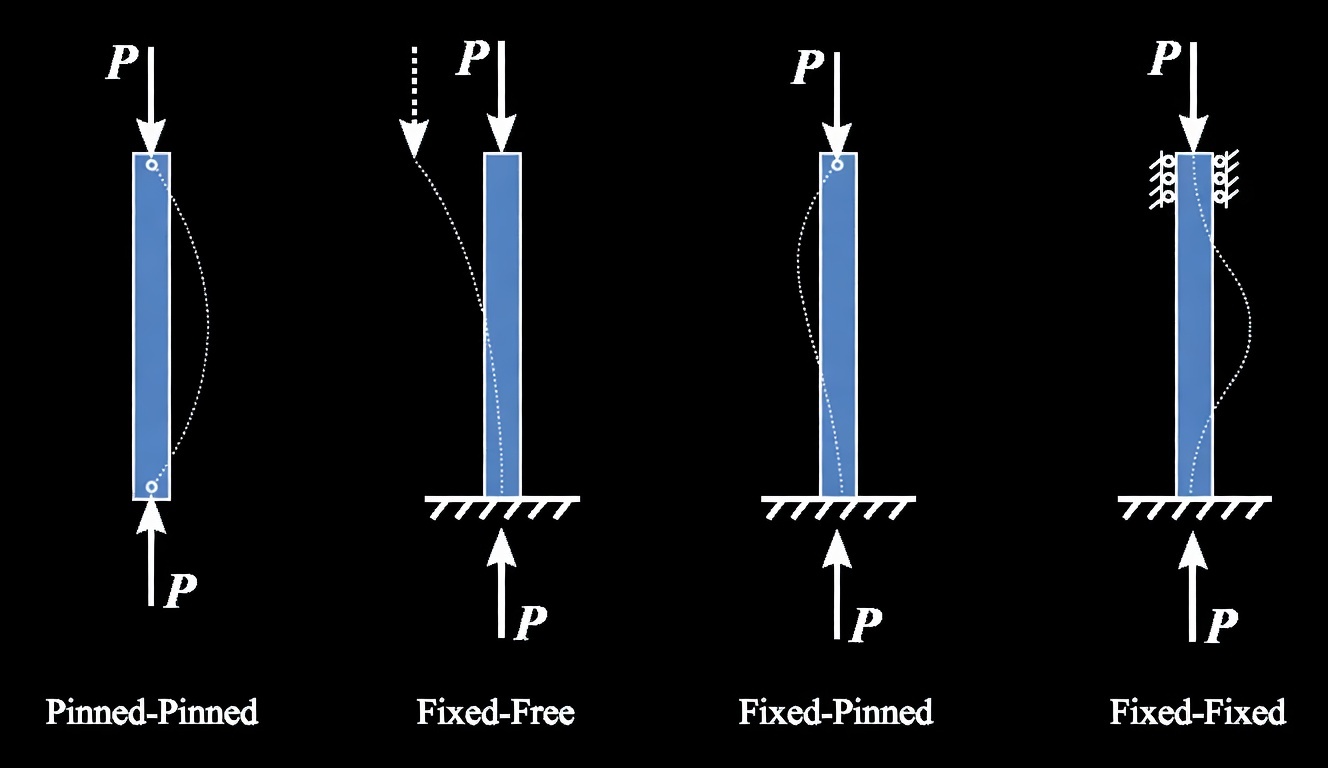
Rather than failing by crushing, the member fails by lateral deflection due to instability. This behavior is described by Euler’s buckling theory, which provides a formula for the critical load at which buckling occurs, showing that the load depends on the material stiffness (Young’s modulus), the column’s cross-sectional geometry (moment of inertia), its unsupported length, and the end support conditions. Euler’s buckling is most applicable to slender columns that remain within the elastic range before buckling. Euler’s buckling is most applicable to the column's length, its cross-sectional shape (moment of inertia), and the stiffness of the material.