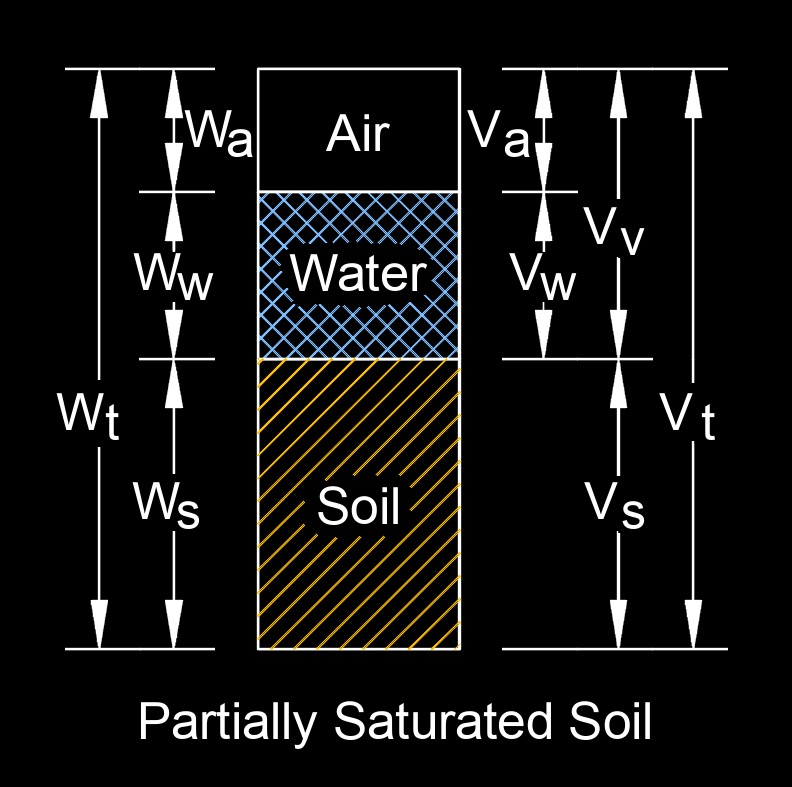
Air content, abbreviated as \(a_c\), a dimensionless number, is the volume or proportion of air voids within a given volume of soil. It represents the amount of space or voids that are filled with air rather than water or solids. Air content is an important parameter in soil engineering as it directly affects the soil's properties and behavior. The presence of air voids in soil affects its density, compressibility, permeability, and shear strength. It can also influence the soil's ability to retain and transmit water. Air content is typically expressed as a percentage of the total volume of soil being considered. It is determined by conducting laboratory tests on soil samples using techniques such as the gravimetric method or the volumetric method.
air content Formula |
||
|
\( a_c \;=\; \dfrac{ V_a }{ V_v }\) (Air Content) \( V_a \;=\; a_c \cdot V_v \) \( V_v \;=\; \dfrac{ V_a }{ a_c }\) |
||
| Symbol | English | Metric |
| \( a_c \) = Air Content | \(dimensionless\) | \(dimensionless\) |
| \( V_a \) = Volume of Air | \(ft^3\) | \(m^3\) |
| \( V_v \) = Volume of Void | \(ft^3\) | \(m^3\) |