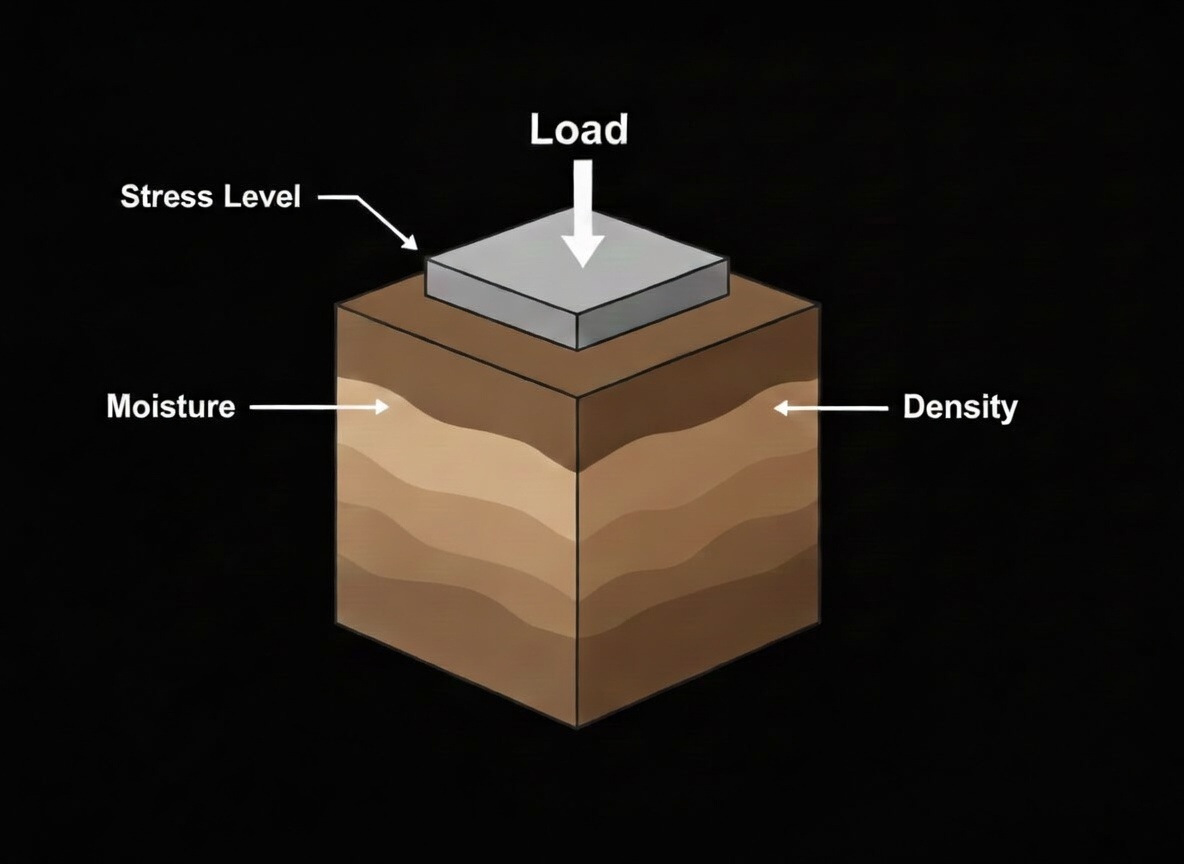
Ultimate bearing capacity, abbreviated as \( q_u \), Is defined as the maximum pressure per unit area that soil can sustain at the base of a foundation before shear failure occurs in the supporting soil mass. When the applied stress from a structure exceeds this limit, the soil beneath the foundation fails and the foundation may experience excessive settlement or collapse. In practical design, engineers do not allow structures to approach this limit, instead, the allowable bearing capacity is used, which is the ultimate bearing capacity divided by a factor of safety.
Ultimate Bearing Capacity formula |
||
|
\( q_u \;=\; ( c \cdot N_c) + (\gamma \cdot D_f \cdot N_q) + (0.5 \cdot \gamma \cdot W_f \cdot N_{\gamma}) \) (Ultimate Bearing Capacity) \( c \;=\; \dfrac{ q_u - (\gamma \cdot D_f \cdot N_q) - (0.5 \cdot \gamma \cdot W_f \cdot N_{\gamma}) }{ N_c } \) \( N_c \;=\; \dfrac{ q_u - (\gamma \cdot D_f \cdot N_q) - (0.5 \cdot \gamma \cdot W_f \cdot N_{\gamma}) }{ c } \) \( \gamma \;=\; \dfrac{ q_u - c \cdot N_c }{ ( D_f \cdot N_q) + (0.5 \cdot W_f \cdot N_{\gamma}) } \) \( D_f \;=\; \dfrac{ q_u - ( c \cdot N_c ) - (0.5 \cdot \gamma \cdot W_f \cdot N_{\gamma}) }{ \gamma \cdot N_q } \) \( N_q \;=\; \dfrac{ q_u - ( c \cdot N_c ) - (0.5 \cdot \gamma \cdot W_f \cdot N_{\gamma}) }{ \gamma \cdot D_f } \) \( W_f \;=\; \dfrac{ 2 \cdot [ \; q_u - ( c \cdot N_c ) - ( \gamma \cdot D_f \cdot N_q )\; ] }{ \gamma \cdot N_{\gamma} } \) \( N_{\gamma} \;=\; \dfrac{ 2 \cdot [ \; q_u - ( c \cdot N_c ) - ( \gamma \cdot D_f \cdot N_q )\; ] }{ \gamma \cdot W_f } \) |
||
| Symbol | English | Metric |
| \( q_u \) = Ultimate Bearing Capacity | \(lbf\;/\;in^2\) | \(Pa\) |
| \( c \) = Cohesion (Internal Molecular Attraction) | \(lbf\;/\;in^2\) | \(Pa\) |
| \( N_c \) = Shape Factor | \(dimensionless\) | \(dimensionless\) |
| \( D_f \) = Foundation Depth | \(ft\) | \(m\) |
| \( N_q \) = Depth Factor | \(dimensionless\) | \(dimensionless\) |
| \( \gamma \) (Greek symbol gamma) = Unit Weight of Soil | \(lbf\) | \(N\) |
| \( W_f \) = Foundation Width | \(ft\) | \(m\) |
| \( N_{\gamma} \) = Inclination Factor | \(dimensionless\) | \(dimensionless\) |