
Annular capacity, abbreviated as \(AC\), also called annular volume, is a volumetric measure used primarily in drilling, wellbore, and piping applications to describe how much fluid the annular space can hold. The annulus is the ring-shaped gap formed between two concentric cylindrical surfaces, such as between a drill pipe and the surrounding wellbore or casing.
Annular Capacity Formula |
||
|
\( AC \;=\; \dfrac{ D_h^2 - D_{pod}^2 }{ 1029.4 } \) (\(bbl\;/\;ft\)) \( AC \;=\; \dfrac{ D_h^2 - D_{pod}^2 }{ 24.51 } \) (\(gal\;/\;ft\)) \( AC \;=\; \dfrac{ D_h^2 - D_{pod}^2 }{ 1,273,240 } \) (\(m^3\;/\;m\)) \( AC \;=\; \dfrac{ D_h^2 - D_{pod}^2 }{ 1,273.24 } \) (\(l\;/\;m\)) |
||
| Symbol | English | Metric |
| \( AC \) = Annular Capacity | - | - |
| \( D_h \) = Drill Hole Size | \(in\) | - |
| \( D_{pod} \) = Casing / Drill Pipe OD | \(in\) | - |
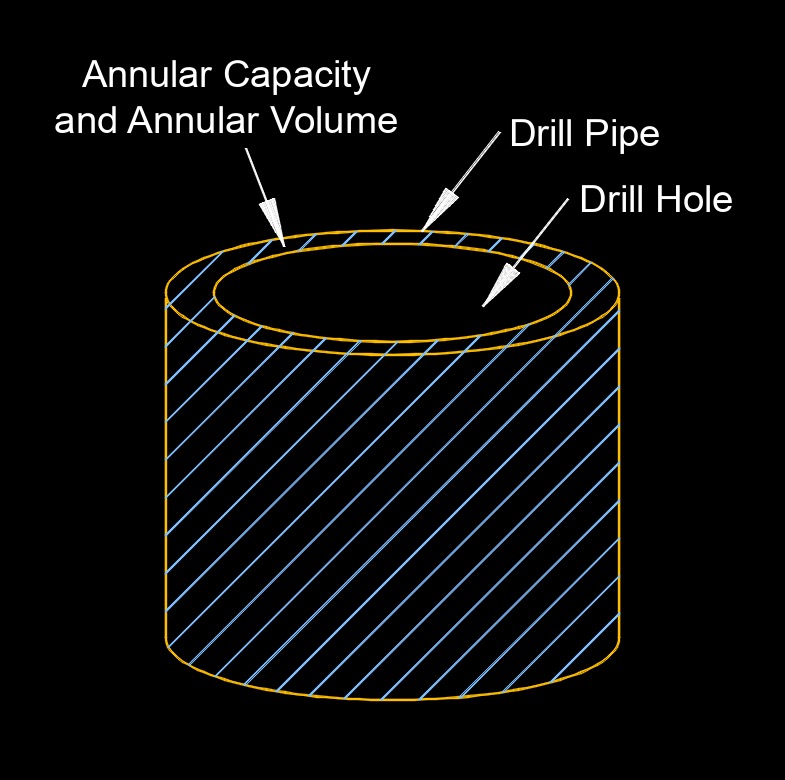 Annular capacity represents the volume of this space per unit length (commonly expressed as volume per foot or per meter) and is critical for determining how much drilling fluid, cement, or other fluids are required to fill or circulate through the annulus. Accurate knowledge of annular capacity is essential for maintaining proper hydrostatic pressure, ensuring effective cuttings transport, preventing well control issues, and planning cementing and displacement operations.