Void ratio, abbreviated as \(e\), a dimensionless number, is the ratio of the volume of voids to the volume of solids. It is a measure of how much space is occupied by voids relative to the solid particles in a given volume of soil.
Void Ratio Formula |
||
|
\( e \;=\; \dfrac{ V_v }{ V_s }\) (Void Ratio) \( V_v \;=\; e \cdot V_s \) \( V_s \;=\; \dfrac{ V_v }{ e }\) |
||
| Symbol | English | Metric |
| \( e \) = Void Ratio | \(dimensionless\) | \(dimensionless\) |
| \( V_v \) = Volume of Voids | \(ft^3\) | \(m^3\) |
| \( V_s \) = Volume of Solids | \(ft^3\) | \(m^3\) |
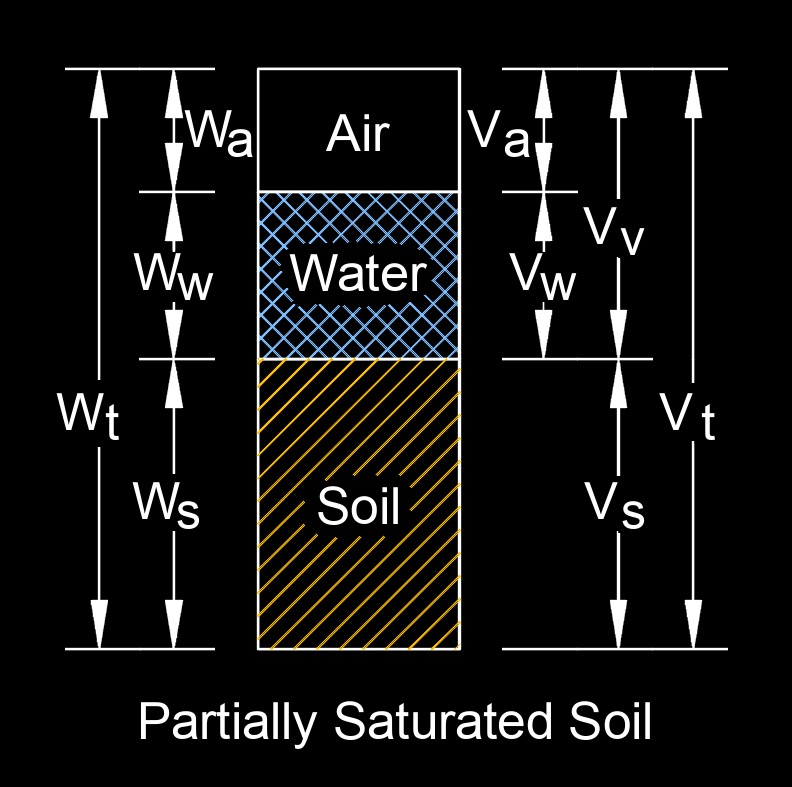 The void ratio is a property of soil that influences its behavior, including its compressibility, permeability, and shear strength. It is often used to classify and characterize different types of soils, such as sands, silts, and clays. In general, a low void ratio indicates that the soil is denser, with fewer voids and more solid particles, while a high void ratio suggests that the soil is looser or less dense, with more voids and fewer solid particles.
The void ratio is an important parameter in geotechnical engineering for analyzing and designing structures and foundations, estimating soil settlement, and evaluating soil stability. It helps engineers understand the behavior of soils under different loading and environmental conditions and provides insights into the compaction, permeability, and drainage characteristics of the soil.
Void Ratio Interpretation
e = 0 - Would mean a perfectly solid material with no voids (never occurs in real soil).
Low e (e.g., 0.3–0.6) - Densely packed particles, typical of well-graded sands/gravels in a dense state.
Moderate e (e.g., 0.6–1.0) - Typical of medium-dense sands or normally consolidated clays.
High e (e.g., > 1.0, sometimes > 2–4) - Loosely packed or highly porous soils, typical of soft clays, organic soils, or peat.
Void ratio is soil-specific, the same numeric value means different things for sand versus clay, because particle shape, gradation, and mineralogy control the natural packing range.
Engineering Significance
Compressibility - Higher e generally indicates higher compressibility potential (more room for particle rearrangement under load) — relevant to settlement prediction.
Permeability - Higher e is usually (though not always, especially across different soil types) associated with higher permeability in granular soils.
Shear Strength - For sands, lower e (denser packing) correlates with higher friction angle and dilative behavior; higher e correlates with contractive, potentially liquefiable behavior.
Liquefaction Assessment - Relative density derived from e is a key input for evaluating liquefaction susceptibility of saturated sands under cyclic loading.
Settlement Analysis - Initial void ratio (e0) is a required input in classical one-dimensional consolidation settlement equations (Terzaghi consolidation theory).