Bulk unit weight of soil, abbreviated as \(\large{ \gamma_t }\) (Greek symbol gamma), also called total unit weight or moist unit weight, is a physical property in geotechnical engineering that represents the total weight of a soil mass per unit of total volume.
Bulk Unit weight Formula |
||
|
\( \gamma_t \;=\; \dfrac{ W_t }{ V_t }\) (Bulk Unit Weight) \( W_t \;=\; \gamma_t \cdot V_t \) \( V_t \;=\; \dfrac{ W_t }{ \gamma_t }\) |
||
| Symbol | English | Metric |
| \( \gamma_t \) (Greek symbol gamma) = Bulk Unit Weight | \( lbm \;/\; ft^3 \) | \( N \;/\; m^3\) |
| \( W_t \) = Total Weight of Soil | \(lbf\) | \(N\) |
| \( V_t \) = Total Volume of Soil | \(ft^3\) | \(m^3\) |
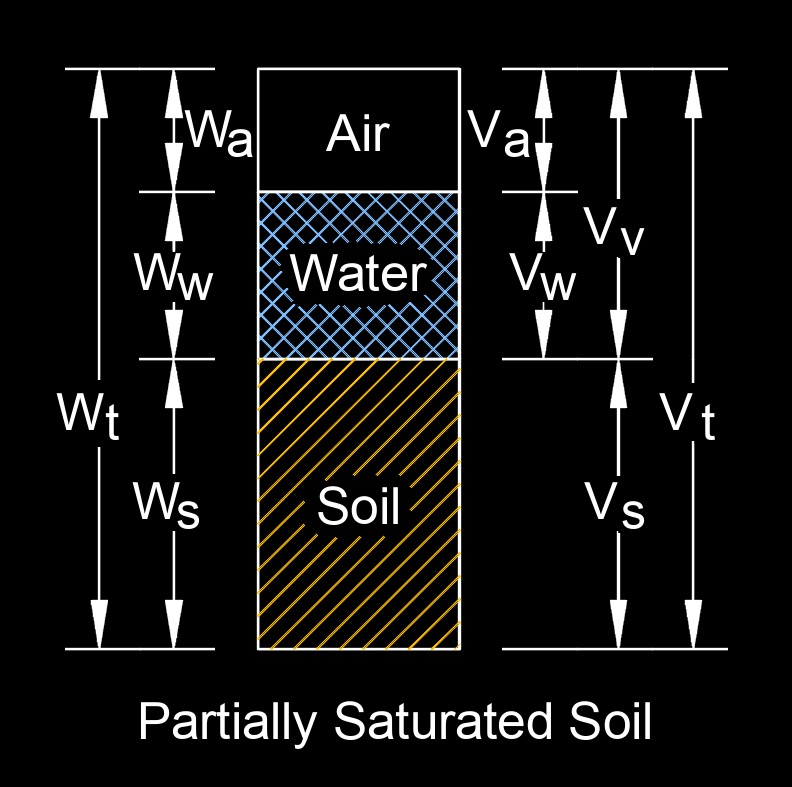 It is mathematically expressed by the ratio of the total weight of the soil, which includes both the solid mineral grains and the water contained within the pore spaces, to the total volume occupied by the solids, water, and air. This parameter is used for calculating the overburden pressure and the lateral earth pressures acting against retaining structures. Because the bulk unit weight accounts for the moisture present in the soil at its current state, it varies significantly depending on the degree of saturation and the void ratio of the material.