Absolute roughness, abbreviated as \(\epsilon\) (Greek symbol epsilon), is a physical property of a solid surface that quantifies the average height of surface irregularities (asperities) relative to an ideal, perfectly smooth surface. In fluid mechanics, it is most commonly used to describe the internal surface condition of pipes and conduits. It represents a characteristic roughness height based on empirical measurements of commercially available materials such as steel, cast iron, concrete, or plastic pipe.
Absolute Roughness
|
| Type of Pipe |
Absolute Roughness in Feet |
Absolute Roughness in Inches |
| Drawn Tubing (glass, brass, plastic) |
0.000005 |
0.00006 |
| Commercial Steel or Wrought Iron (new) |
0.00015 |
0.0018 |
| Commercial Steel or Wrought Iron (existing) |
0.0005 |
0.006 |
| Cast Iron (asphalt dipped) |
0.0004 |
0.0048 |
| Galvanized Iron |
0.0005 |
0.006 |
| Cast Iron (uncoated) |
0.00085 |
0.0102 |
| Wood Stave |
0.0006 to 0.0003 |
0.0072 to 0.0036 |
| Concrete |
0.001 to 0.01 |
0.012 to 0.12 |
| Riveted Steel |
0.003 to 0.03 |
0.036 to 0.36 |
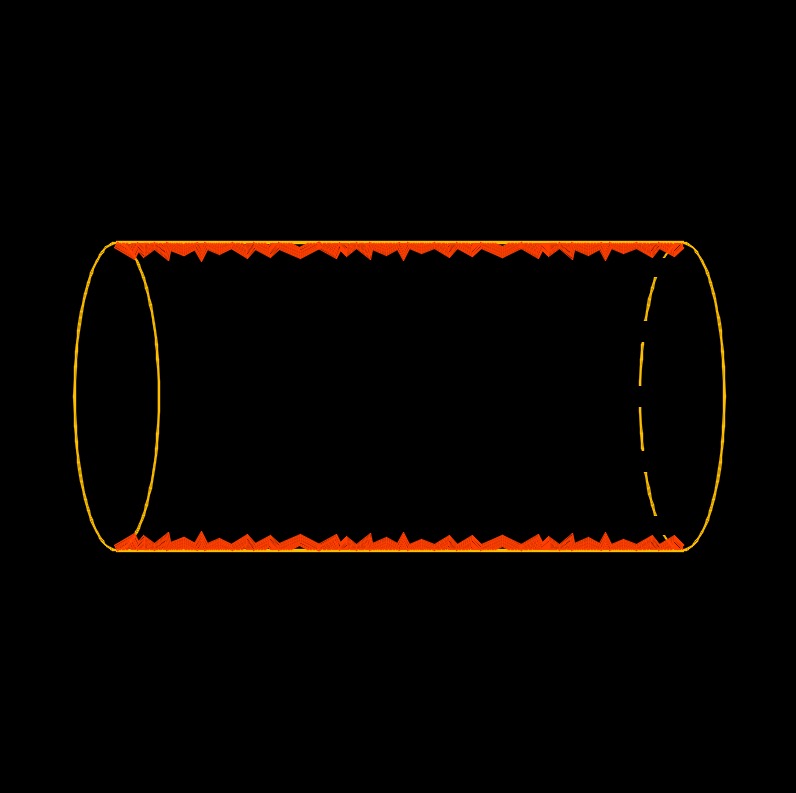
In internal flow analysis, absolute roughness determines wall shear stress and head loss due to friction. It is not used alone, but in combination with pipe diameter to form the relative roughness. Relative roughness is dimensionless and is the governing roughness parameter in the determination of the Darcy friction factor for turbulent flow. The relationship between friction factor, Reynolds number, and relative roughness is represented implicitly by the Colebrook–White equation and graphically by the Moody diagram.
Absolute roughness values are obtained experimentally and are tabulated for different materials based on standardized testing and long-standing empirical data. For example, new commercial steel pipe, cast iron pipe, and drawn tubing each have characteristic roughness values determined through measurement and back-calculation from pressure-loss data. Because it is a physical surface characteristic, absolute roughness is independent of flow conditions; however, its influence on friction depends on the flow regime. In laminar flow, surface roughness has no effect on friction factor. In fully rough turbulent flow, friction factor becomes independent of Reynolds number and depends only on relative roughness.
Factors to Consider when Determining Absolute Roughness
Pipe or Conduit Material - Absolute roughness is material-dependent. Established values exist for materials such as commercial steel, cast iron, galvanized steel, concrete, copper, and plastics (e.g., PVC). These values are based on experimental measurements and long-term empirical data used in fluid mechanics.
Manufacturing Process - The fabrication method (e.g., seamless drawing,
welding, casting, extrusion) directly affects internal surface finish. Drawn tubing has significantly lower roughness than cast iron or concrete due to differences in surface formation.
Surface Condition (New vs. In-Service) - Published roughness values typically distinguish between new pipe and aged pipe.
Corrosion, scaling, and deposition increase effective roughness over time. Engineering references provide different tabulated values for “new” and “old” conditions.
Internal Surface Treatment or Coating - Linings such as cement mortar, epoxy coatings, galvanization, or bituminous coatings alter the internal surface profile and therefore change the measured absolute roughness.
Measurement Method - Absolute roughness values are derived either from: direct surface profilometry (measurement of asperity height), or back-calculation from
pressure loss experiments using established turbulent flow correlations. The method used affects the reported value.
Representative Averaging of Surface Irregularities - Absolute roughness represents a characteristic average height of surface projections, not a maximum peak value. Proper statistical averaging of asperity height is required to produce a representative value.
Standardized Reference Data - Engineering practice relies on tabulated roughness values published in authoritative fluid mechanics and hydraulic engineering references. Selection should be based on documented, experimentally validated data rather than assumption.
Absolute Roughness Interpretation
The ratio of the absolute roughness (\(\epsilon\)) to the
hydraulic diameter of the pipe (\(d_h\))
is often used to categorize fluid flows into different regimes.Smooth Pipes (\(\large{\frac{\epsilon}{d_h}}\) < 0.001) - In this regime, the flow is considered to be in the hydraulically smooth region, where the effects of pipe roughness on flow are minimal.
Transition Flow (0.001 < \(\large{\frac{\epsilon}{d_h}}\) < 0.01) - In this range, the flow is in transition between laminar and turbulent, and the effects of pipe roughness become more significant.
Fully Turbulent Flow (\(\large{\frac{\epsilon}{d_h}}\)
> 0.01) - In this regime, the flow is considered fully
turbulent, and pipe roughness has a substantial impact on flow characteristics.
Engineering Significance
Absolute roughness is used in pipe-flow calculations to estimate friction factor, pressure loss, and pumping power, especially in turbulent flow. Engineers usually combine \(\epsilon\)
with pipe diameter and Reynolds number in tools like the Moody chart or
Darcy–Weisbach framework. In design, choosing a smaller roughness material can reduce energy cost, while corrosion, scaling, or wear can increase roughness over time and worsen performance.
Common Misconceptions
A common misconception is that absolute roughness alone determines friction; in reality, friction depends on roughness, diameter, Reynolds number, and flow regime together. Another misconception is that the listed \(\epsilon\) values are exact material constants; many sources note they are estimated, experimentally inferred, or given as ranges that vary with manufacturing and surface condition. A final limitation is that roughness models simplify complex surfaces into a single equivalent length, so they are useful for engineering calculation but do not capture every geometric detail of a real surface.