Change in Temperature
Change in Temperature Formula |
||
|
\( \Delta T \;=\; T_f - T_i \) (Change in Temperature) \( T_f \;=\; \Delta T + T_i \) \( T_i \;=\; T_f - \Delta T \) |
||
| Symbol | English | Metric |
| \( \Delta T \) = Change in Temperature | \(^\circ F\) | \(^\circ C\) |
| \( T_f \) = Final Temperature | \(^\circ F\) | \(^\circ C\) |
| \( T_i \) = Initial Temperature | \(^\circ F\) | \(^\circ C\) |
Change in Temperature Formula |
||
|
\( \Delta T \;=\; \dfrac{ Q }{ c \cdot m} \) (Change in Temperature) \( Q \;=\; \Delta T \cdot c \cdot m \) \( c \;=\; \dfrac{ Q }{ m \cdot \Delta T} \) \( m \;=\; \dfrac{ Q }{ c \cdot \Delta T} \) |
||
| Symbol | English | Metric |
| \( \Delta T \) = Change in Temperature | \(^\circ F\) | \(^\circ C\) |
| \( Q \) = Specific Heat Capacity | \(Btu \;/\; lbm-F\) | \(kJ \;/\;kg-K\) |
| \( c \) = Specific Heat | \(Btu \;/\; lbm-F\) | \(kJ \;/\;kg-K\) |
| \( m \) = Object Mass | \(lbm\) | \(kg\) |
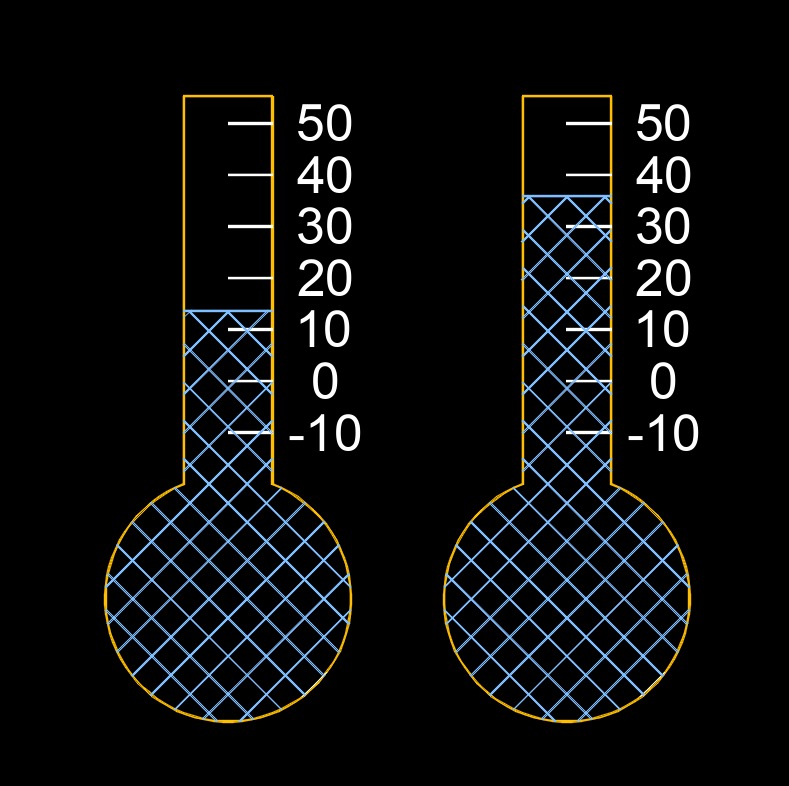
Change in temperature, abbreviated as \(\Delta T\), is how much the temperature increases or decreases between two points in time or between two different locations. It represents the difference between a final temperature and an initial temperature, showing whether the system has warmed up, cooled down, or stayed nearly constant. Understanding the change in temperature is important in areas such as thermodynamics, heating and cooling processes, material expansion, and energy calculations, because temperature differences drive heat flow and affect how systems behave.

Change in Temperature Formula |
||
|
\( \Delta T \;=\; \dfrac{ P \cdot t }{ c \cdot m } \) (Change in Temperature) \( P \;=\; \dfrac{ \Delta T \cdot c \cdot m }{ t } \) \( t \;=\; \dfrac{ \Delta T \cdot c \cdot m }{ P } \) \( c \;=\; \dfrac{ P \cdot t }{ m \cdot \Delta T } \) \( m \;=\; \dfrac{ P \cdot t }{ c \cdot \Delta T } \) |
||
| Symbol | English | Metric |
| \( \Delta T \) = Change in Temperature | \(^\circ F\) | \(^\circ K\) |
| \( P \) = Power | \(W\) | \(W\) |
| \( t \) = Time | \(sec\) | \(s\) |
| \( c \) = Specific Heat | \(Btu \;/\; lbm-F\) | \(kJ \;/\;kg-K\) |
| \( m \) = Object Mass | \(lbm\) | \(kg\) |
A positive \( \Delta T \) indicates that the temperature has increased (the object or system has warmed up), while a negative \( \Delta T \) means the temperature has decreased (the object or system has cooled down). Change in temperature is a fundamental in thermodynamics, heat transfer, and everyday weather observations. For example, if a cup of coffee cools from \(80 ^\circ C\) to \(60 ^\circ C\), the change in temperature is \(60^\circ C - 80^\circ C = -20^\circ C\), meaning it has dropped by \(20^\circ C\). Similarly, when a substance absorbs heat during a phase change (like melting or boiling) at constant pressure, its temperature may remain constant (\(\Delta T = 0\)) even though energy is being added, because the heat is used to break intermolecular bonds instead of raising kinetic energy of the molecules.
On the other hand, temperature differential, abbreviated as \( \Delta T \), is the difference in temperature between two separate points, objects, or systems at the same moment in time. It compares one temperature to another, such as indoor vs. outdoor temperature, or the temperature on one side of a wall compared to the other. It is used to understand heat flow, performance of insulation, and temperature gradients in physical systems. In this sense, a temperature differential describes a spatial difference between two temperatures.

Change in Temperature Formula |
||
|
\( \Delta T \;=\; \dfrac{ p_f \cdot V - p_i \cdot V }{ n \cdot R } \) (Change in Temperature) \( p_f \;=\; \dfrac{ \Delta T \cdot n \cdot R }{ V } + p_i \) \( V \;=\; \dfrac{ \Delta T \cdot n \cdot R }{ p_f - p_i } \) \( p_i \;=\; p_f - \dfrac{ \Delta T \cdot n \cdot R }{ V } \) \( n \;=\; \dfrac{ V \cdot ( p_f - p_i ) }{ \Delta T \cdot R } \) \( R \;=\; \dfrac{ V \cdot ( p_f - p_i ) }{ \Delta T \cdot n } \) |
||
| Symbol | English | Metric |
| \( \Delta T \) = Change in Temperature | \(^\circ R\) | \(^\circ K\) |
| \( p_f \) = Final Pressure | \(lbf \;/\; in^2\) | \(Pa\) |
| \( V \) = Volume | \(ft^3\) | \(m^3\) |
| \( p_i \) = Initial Pressure | \(lbf \;/\; in^2\) | \(Pa\) |
| \( n \) = Number of Moles of the Gas | \(dimensionless\) | \(dimensionless\) |
| \( R \) = Specific Gas Constant (Gas Constant) | \(ft-lbf\;/\;lbm-R\) | \(J\;/\;kg-K\) |
Change in Temperature Formula |
||
|
\( \Delta T \;=\; \dfrac{ \Delta L }{ \overrightarrow{\alpha_l} \cdot L_o } \) (Change in Temperature) \( \Delta L \;=\; \Delta T \cdot \overrightarrow{\alpha_l} \cdot L_o \) \( \overrightarrow{\alpha_l} \;=\; \dfrac{ \Delta L }{ \Delta T \cdot L_o } \) \( L_o \;=\; \dfrac{ \Delta L }{ \overrightarrow{\alpha_l} \cdot \Delta T } \) |
||
| Symbol | English | Metric |
| \( \Delta T \) = Change in Temperature | \(^\circ F\) | \(^\circ C\) |
| \( \Delta L \) = Change in Length | \(ft\) | \(m\) |
| \( \overrightarrow{\alpha_l} \) (Greek symbol alpha) = Linear Thermal Expansion Coefficient | \(in \;/\; in\;F\) | \(mm \;/\; mm\;C\) |
| \( L_o \) = Origional Length | \(ft\) | \(m\) |
Change in Temperature Formula |
||
|
\( \Delta T \;=\; \dfrac{ \Delta V }{ \beta_v \cdot V_o } \) (Change in Temperature) \( \Delta V \;=\; \Delta T \cdot \beta_v \cdot V_o \) \( \beta_v \;=\; \dfrac{ \Delta V }{ \Delta T \cdot V_o } \) \( V_o \;=\; \dfrac{ \Delta V }{ \beta_v \cdot \Delta T } \) |
||
| Symbol | English | Metric |
| \( \Delta T \) = Change in Temperature | \(^\circ F\) | \(^\circ C\) |
| \( \Delta V \) = Change in Volume | \(ft^3\) | \(m^3\) |
| \( \beta_v \) = Volumetric Thermal Expansion Coefficient | \(in^3 \;/\; in^3\;F\) | \(mm^3 \;/\; mm^3\;C\) |
| \( V_o \) = Origional Volume | \(ft^3\) | \(m^3\) |
