Temperature differential, abbreviated as \( \Delta T \), is the difference in temperature between two points, regions, materials, or moments in time, and it represents the driving force for heat transfer.
Temperature Differential Formula |
||
|
\( \Delta T \;=\; \dfrac{ Q_{cd} \cdot L }{ k \cdot A_c } \) (Temperature Differential) \( Q_{cd} \;=\; \dfrac{ \Delta T \cdot k \cdot A_c }{ L } \) \( L \;=\; \dfrac{ \Delta T \cdot k \cdot A_c }{ Q_{cd} } \) \( k \;=\; \dfrac{ Q_{cd} \cdot L }{ \Delta T \cdot A_c } \) \( A_c \;=\; \dfrac{ Q_{cd} \cdot L }{ \Delta T \cdot k } \) |
||
| Symbol | English | Metric |
| \( \Delta T \) = Temperature Differential | \(^\circ F\) | \(^\circ C\) |
| \( Q_{cd} \) = Heat Transfer by Conduction | \(Btu\;/\;hr\) | \(W\) |
| \( L \) = Material Thickness | \(in\) | \(mm\) |
| \( k \) = Material Thermal Conductivity | \(Btu\;/\;hr-ft-F\) | \(W\;/\;m-K\) |
| \( A_c \) = Area Cross-section | \( in^2 \) | \( mm^2 \) |
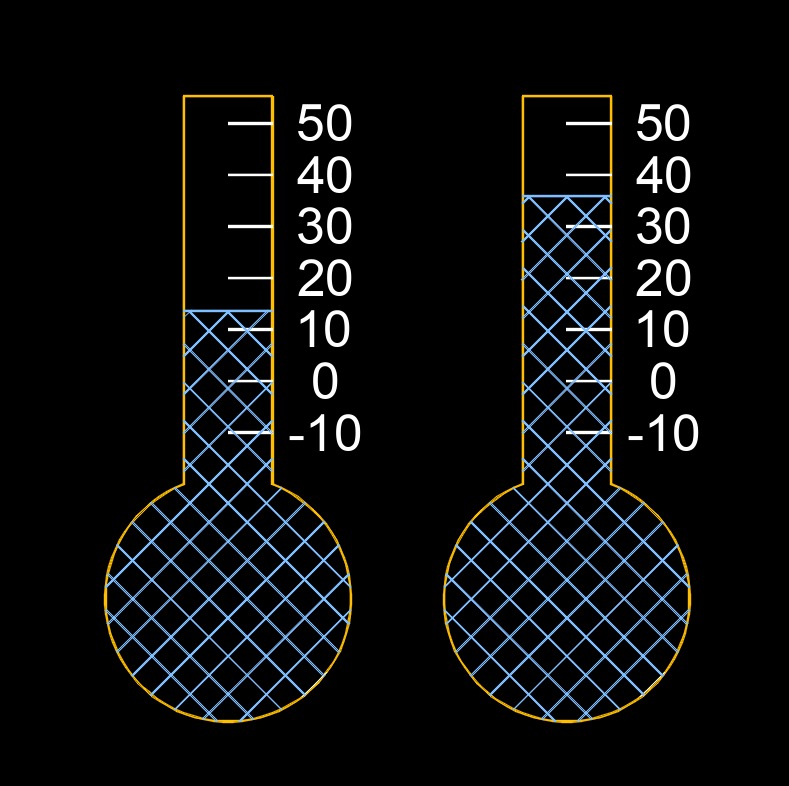
In physical systems, a temperature differential causes heat to flow naturally from the hotter area to the cooler area until thermal equilibrium is reached. This is fundamental in thermodynamics and heat transfer, as the magnitude of the temperature differential directly influences the rate of heat transfer in processes such as conduction, convection, and radiation, as well as the performance of devices like heat exchangers, engines, and refrigeration systems.

Temperature Differential Formula |
||
|
\( \Delta T \;=\; \dfrac{ Q_{cv} }{ h \cdot A_c } \) (Temperature Differential) \( Q_{cv} \;=\; \Delta T \cdot h \cdot A_c \) \( h \;=\; \dfrac{ Q_{cv} }{ \Delta T \cdot A_c } \) \( A_c \;=\; \dfrac{ Q_{cv} }{ h \cdot \Delta T } \) |
||
| Symbol | English | Metric |
| \( \Delta T \) = Temperature Differential | \(^\circ F\) | \(^\circ C\) |
| \(\large{ Q_{cv} }\) = Heat Transfer by Convection | \(Btu\;/\;hr\) | \(W\) |
| \( h \) = Heat Transfer Coefficient | \(Btu\;/\;hr-ft^2-F\) | \(W\;/\;m^2-K\) |
| \( A_c \) = Area Cross-section | \( in^2 \) | \( mm^2 \) |