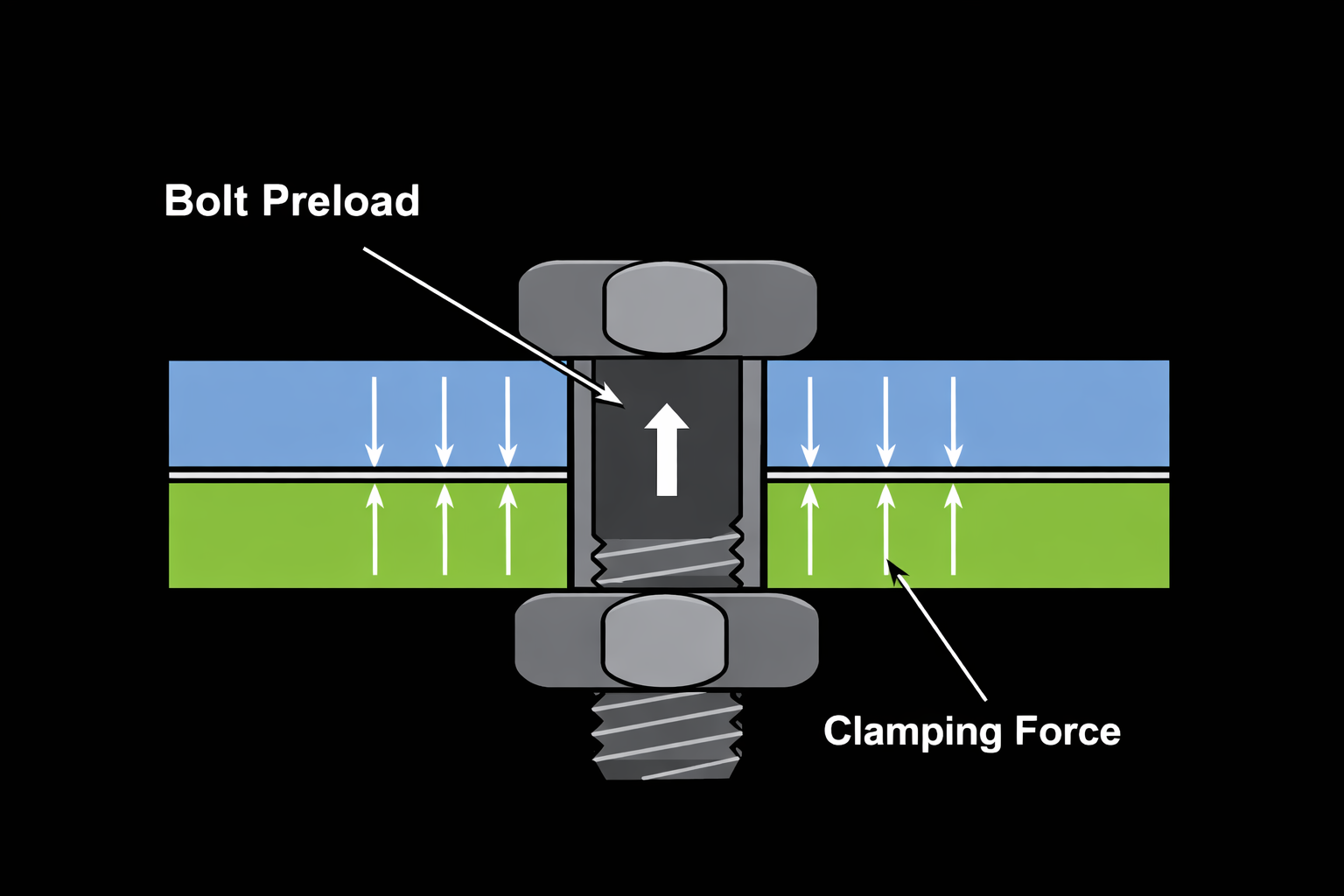
Clamping force, abbreviated as \(F\), is the force applied to hold two or more objects together in a fixed position, typically by using mechanical means like clamps, bolts, or other fastening devices. This force is used in a wide range of applications, particularly in manufacturing, automotive assembly, and tooling, to ensure that parts stay securely in place while undergoing machining, assembly, or other operations. The magnitude of the clamping force can affect the stability, accuracy, and safety of a process. Achieving the right clamping force is critical to avoid damage to components or insufficient holding strength, which could lead to product failure.
Clamping Force Formula |
||
|
\( F \;=\; \dfrac{ \tau }{ K \cdot d }\) (Clamping Force) \( \tau \;=\; F \cdot K \cdot d \) \( K \;=\; \dfrac{ \tau }{ F \cdot d }\) \( d \;=\; \dfrac{ \tau }{ F \cdot K }\) |
||
| Symbol | English | Metric |
| \( F \) = Preload (Clamping Force in the Bolt) | \(lbf\) | \(N\) |
| \( \tau \) (Greek symbol tau) = Tightening Torque | \(lbf-ft\) | \(N-m\) |
| \( K \) = Torque Coefficient (Nut Factor) | \(dimensionless\) | \(dimensionless\) |
| \( d \) = Bolt Diameter | \(in\) | \(mm\) |
Factors that Influence Clamping Force