
Threaded flange, abbreviated as TRHF,, also called a screwed flange, is a type of pipe flange that has internal threads (female threads) machined into its bore so it can be screwed directly onto a pipe with matching external threads. Unlike weld neck, slip-on, or socket weld flanges, a threaded flange is installed without welding under normal conditions. Once the pipe is threaded into the flange, the flange can be bolted to a mating flange using bolts, nuts, and a gasket to create a pressure-tight joint.
Threaded Flange Datasheets
| |||
|---|---|---|---|
| Class | Flat Face | Raised Face | Ring Type Joint |
| ANSI 150 | THD Flange ANSI 150 FF (in) | THD Flange ANSI 150 RF (in) | THD Flange ANSI 150 RTJ (in) |
| ANSI 300 | THD Flange ANSI 300 FF (in) | THD Flange ANSI 300 RF (in) | THD Flange ANSI 300 RTJ (in) |
| ANSI 400 | THD Flange ANSI 400 FF (in) | THD Flange ANSI 400 RF (in) | THD Flange ANSI 400 RTJ (in) |
| ANSI 600 | THD Flange ANSI 600 FF (in) | THD Flange ANSI 600 RF (in) | THD Flange ANSI 600 RTJ (in) |
| ANSI 900 | THD Flange ANSI 900 FF (in) | THD Flange ANSI 900 RF (in) | THD Flange ANSI 900 RTJ (in) |
| ANSI 1500 | THD Flange ANSI 1500 FF (in) | THD Flange ANSI 1500 RF (in) | THD Flange ANSI 1500 RTJ (in) |
| ANSI 2500 | THD Flange ANSI 2500 FF (in) | THD Flange ANSI 2500 RF (in) | THD Flange ANSI 2500 RTJ (in) |
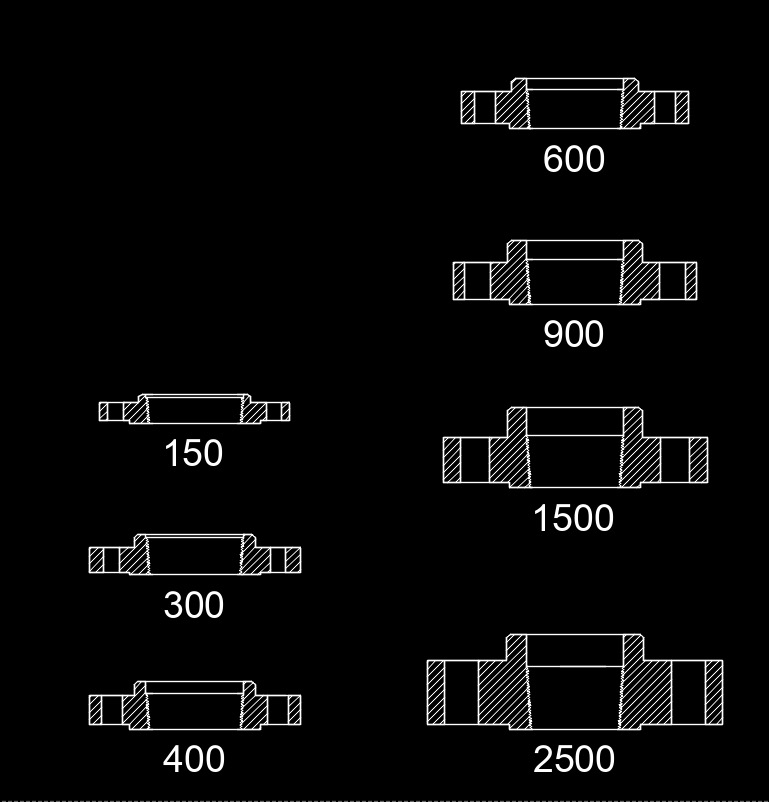
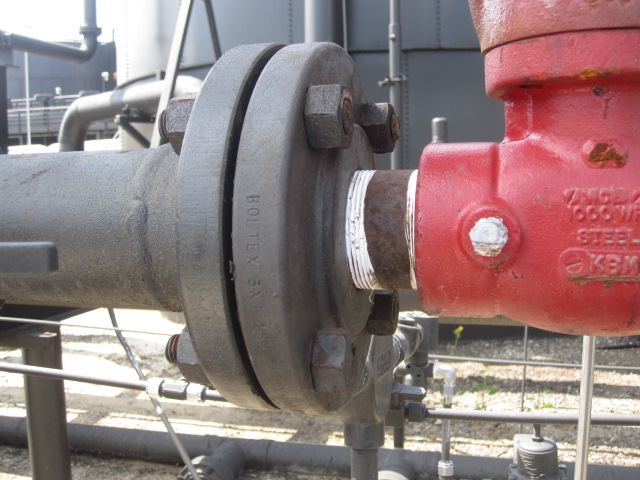
Threaded flanges are primarily used in piping systems where welding is undesirable, impractical, or prohibited. Because installation only requires threading the pipe into the flange, assembly and disassembly can often be completed more quickly than with welded flanges.
These flanges are generally intended for small-diameter piping systems, typically in nominal pipe sizes where threaded pipe is commonly used. They are most often found in low pressure and moderate temperature services, although the specific pressure and temperature limits depend on the applicable flange pressure class, material, thread design, and the governing engineering code. In many industrial applications, threaded flanges are not recommended for severe cyclic loading, vibration, or large temperature fluctuations because the threaded connection can be more susceptible to loosening or fatigue than a properly welded joint.
The principal advantages of threaded flanges include the elimination of welding, ease of installation, suitability for hazardous locations where welding is restricted, and the ability to disconnect the piping without cutting the pipe. Their disadvantages include lower resistance to vibration and fatigue than welded connections, potential leakage if threads are improperly assembled or damaged, and practical limitations for larger pipe sizes and more demanding pressure or temperature conditions.