Hydraulic depth, abbreviated as \(d_h\), also called mean depth or hydraulic mean depth, is a practical measure used in open-channel hydraulics, the study of water flowing freely in rivers, canals, storm drains, or partially filled pipes with an open surface. It's defined simply as the cross-sectional area of the flowing water, divided by the top width of the water surface. This gives a value that represents what the depth would be if you spread the same volume of water evenly over the surface width, like an average depth weighted by the channel's shape.
Hydraulic Depth Formula |
||
|
\( d_h \;=\; \dfrac{ A_c }{ P_w }\) (Hydraulic Depth) \( A_c \;=\; d_h \cdot P_w \) \( P_w \;=\; \dfrac{ A_c }{ d_h }\) |
||
| Symbol | English | Metric |
| \( d_h \) = Hydraulic Depth | \( ft \) | \( m \) |
| \( A_c \) = Flow Area Cross-section | \( ft^2 \) | \( m^2 \) |
| \( P_w \) = Channel Wetting Perimeter | \( ft \) | \( m \) |
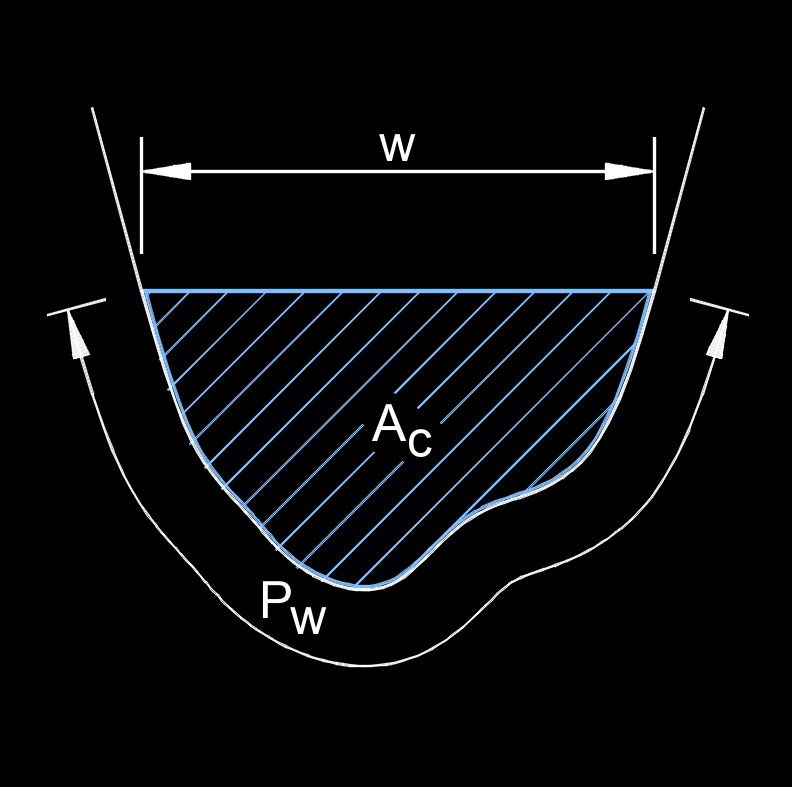
This measure is especially valuable because real-world channels are seldom neat rectangles with straight, vertical sides and a flat bottom. Measuring the physical water depth at just one spot (say, in the middle) can be misleading if the channel is wide and shallow, narrow and deep, or has an irregular bed like a natural river with varying slopes and banks. Hydraulic depth accounts for the overall geometry by incorporating both the flow area and the surface width, providing a more accurate picture of how the water "feels" to the flow dynamics.
Engineers rely on hydraulic depth in key calculations, particularly for understanding wave behavior and flow regimes. For example, it's used directly in the Froude number (a dimensionless number that indicates whether flow is slow and tranquil, fast and shooting, or right at the transition point). In wide rectangular channels, where the sides have little influence, the hydraulic depth is essentially identical to the actual measured water depth. But in narrower, irregular, or trapezoidal channels, it differs and gives a better representation of how the flow area and surface interact, which is critical for analyzing things like critical flow (the point where the flow switches between subcritical and supercritical regimes), stability, and even wave propagation or energy conditions.
In short, hydraulic depth bridges the gap between simple depth measurements and real-world flow performance, making it a go-to parameter for reliable open-channel analysis and design.