Wetting perimeter, abbreviated as \(P_w\), is used in fluid mechanics and hydraulics to describe how a fluid interacts with the boundary of a conduit or channel. It is the length of the surface that is actually in contact with the fluid when you take a cross-section perpendicular to the flow direction. This cross-section is a slice through the pipe or channel that lets you see the shape of the flowing section from the side. The wetted perimeter includes only those parts of the boundary that touch the fluid, not the free surface of the fluid exposed to air. For example, in an open channel of water, the wetted perimeter consists of the bottom and the side walls that are underwater; in a circular pipe flowing full, it is the entire inside circumference of the pipe.
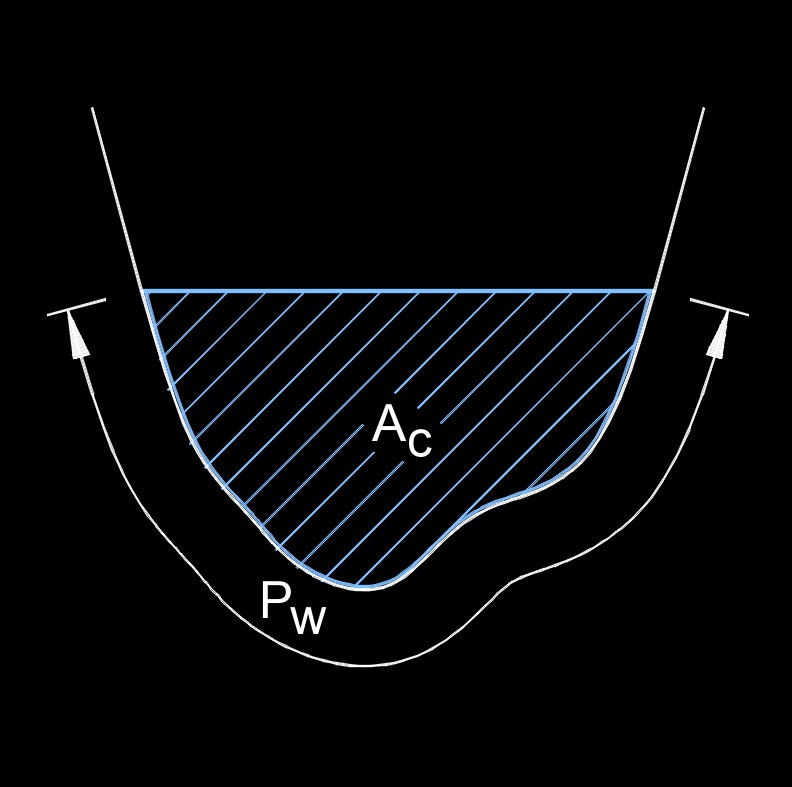
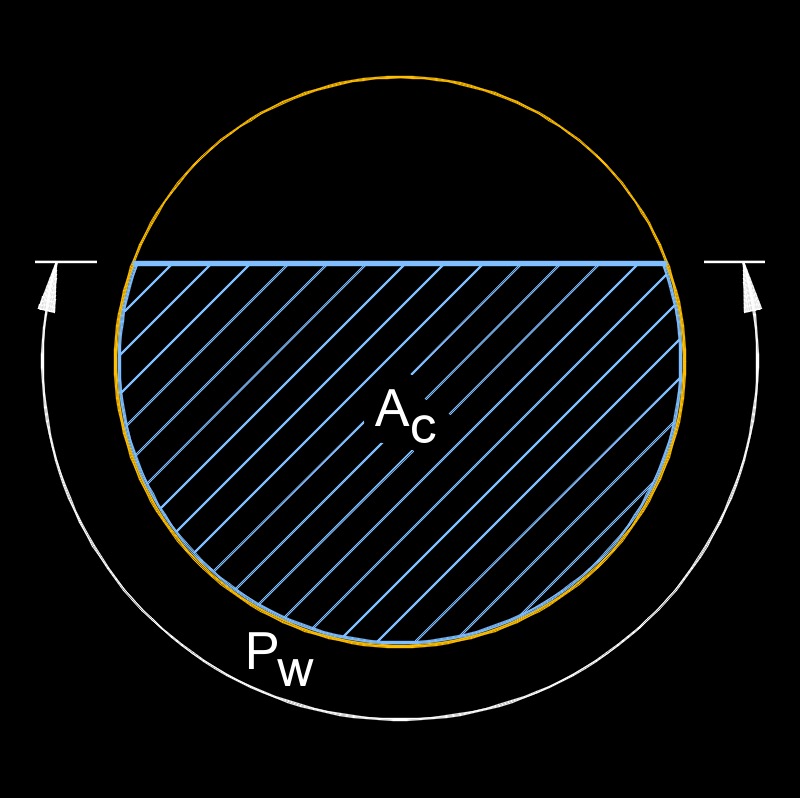 Engineers use the wetted perimeter because it directly affects how flow behaves, especially how much friction the fluid experiences against the channel or pipe walls. A larger wetted perimeter generally means more surface area in contact with the fluid, which increases frictional resistance and influences factors such as energy loss and flow efficiency. In hydraulic calculations (like those using the Manning or Darcy–Weisbach equations), the wetted perimeter is used along with the cross-sectional area of flow to compute the hydraulic radius, a key parameter in estimating velocity, discharge, and energy losses in open channels and pipes.