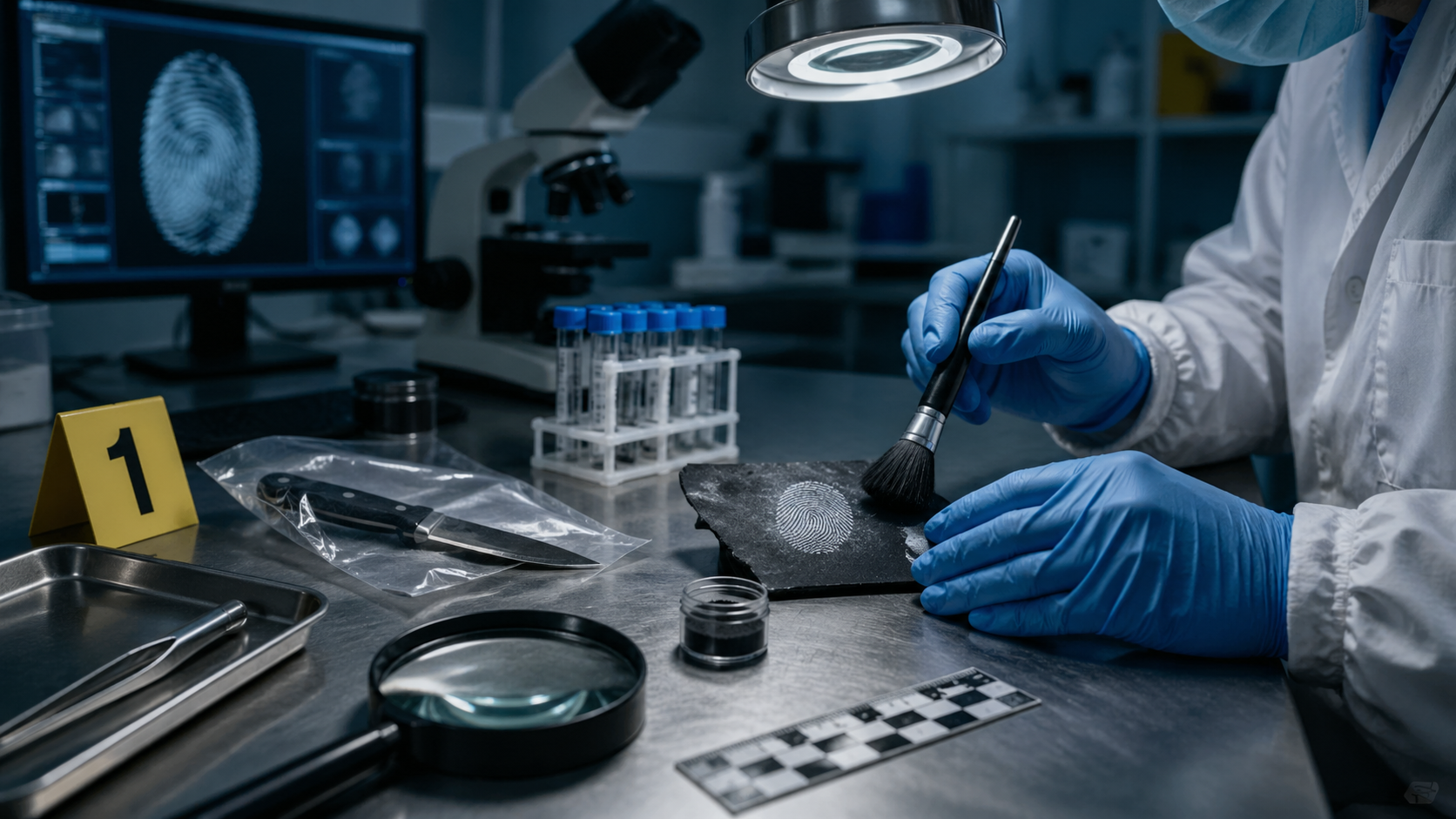
 Forensics is the application of scientific methods and techniques to the investigation of crimes, civil disputes, or other legal matters, with the goal of establishing facts that can be presented as evidence in a court of law. Forensics encompasses a wide range of scientific disciplines, such as biology, chemistry, physics, and digital analysis used systematically to collect, preserve, analyze, and interpret physical or digital evidence so that it can be presented in a court of law.
The purpose of forensics is to establish factual information that is reliable, objective, and admissible under legal standards. This involves adhering to rigorous procedural protocols, including chain-of-custody documentation, validated analytical methods, and reproducibility of results. Each subfield applies domain-specific scientific knowledge but is unified by its ultimate function: to assist legal decision-making by transforming empirical evidence into scientifically grounded conclusions.
Forensic practices have evolved significantly with advancements in technology, from early fingerprint classification systems to contemporary techniques like DNA profiling introduced and next generation sequencing today. The core principle across all forensic work is objectivity, conclusions must be based on empirical data, testable methodologies, and peer-reviewed validation rather than opinion alone.
Anthropology - Focuses on the analysis of human skeletal remains to determine identity, age, sex, ancestry, and trauma in legal contexts.
Ballistics - Involves the examination of bullets, firearms, and trajectories to reconstruct shooting events.
Biology - The examination of biological materials such as blood, semen, saliva, and DNA for identification purposes.
Chemistry - The identification and analysis of chemical substances, including drugs, explosives, and trace materials.
Criminalistics - Involves the examination, identification, and comparison of physical evidence such as trace materials, impression evidence (fingerprints, footwear, tire tracks), firearms and toolmarks, and other crime scene evidence.
Document Examination - The study of handwriting, signatures, inks, and paper to determine authenticity.
Engineering - The analysis of structural or mechanical failures related to accidents or crimes.
Entomology - The use of insect activity to estimate time since death and other forensic factors.
Forensics - The recovery, preservation, and examination of data from computers, mobile devices, and digital storage.
Geology - The examination of soils, minerals, and geological materials as evidence.
Linguistics - The study of language use in documents, speech, or communications to aid investigations.
Odontology - Uses dental records, bite mark analysis, and dental anatomy for human identification and bite mark comparison in legal investigations.
Pathology - The medical investigation of deaths, particularly to determine cause and manner of death through autopsy and clinical analysis.
Psychology - The assessment of mental states, behavior, and competency in legal proceedings.
Toxicology - Analyzes biological samples for the presence and effects of drugs, poisons, alcohol, and other toxic substances in living or deceased individuals.