
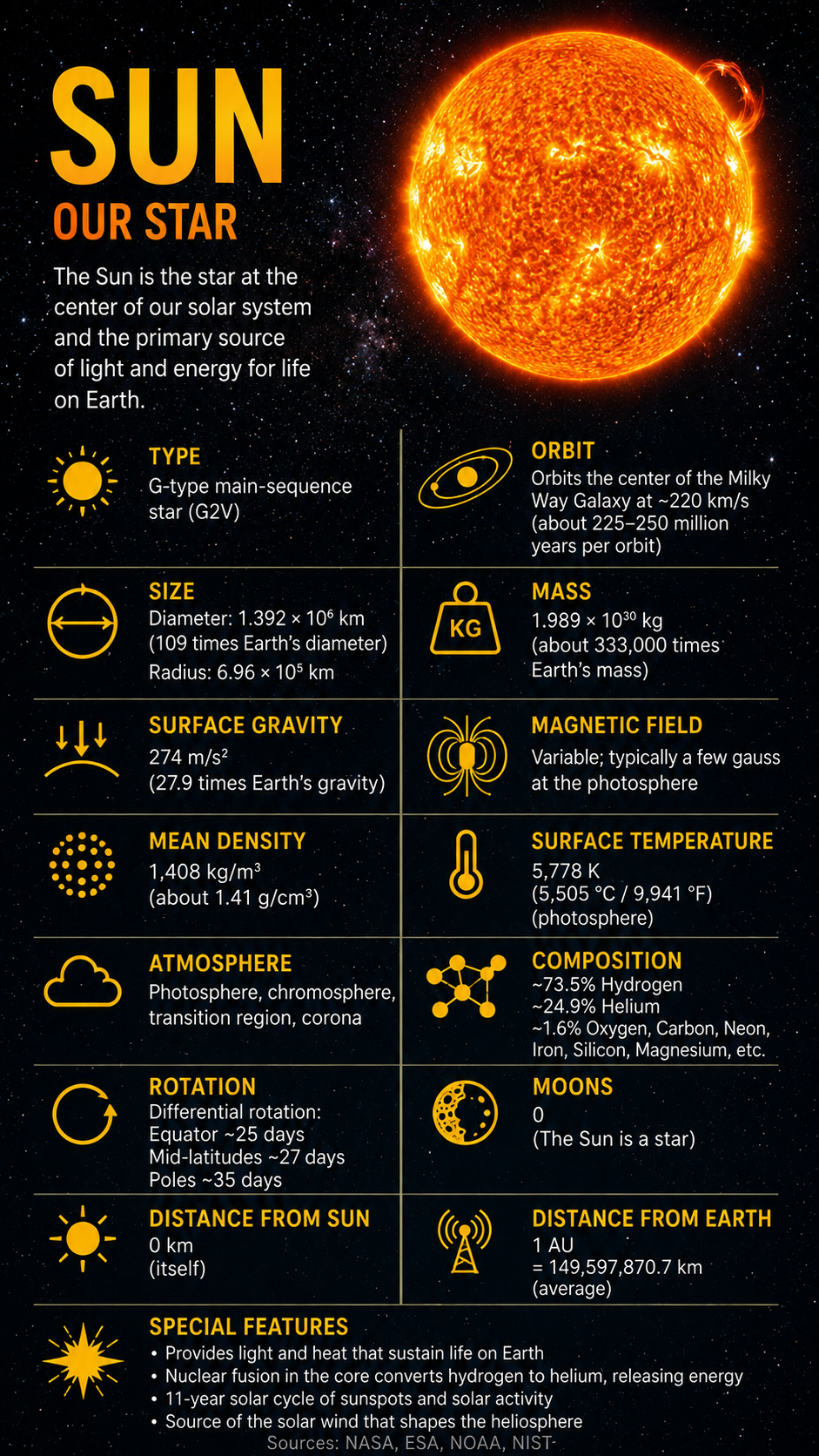
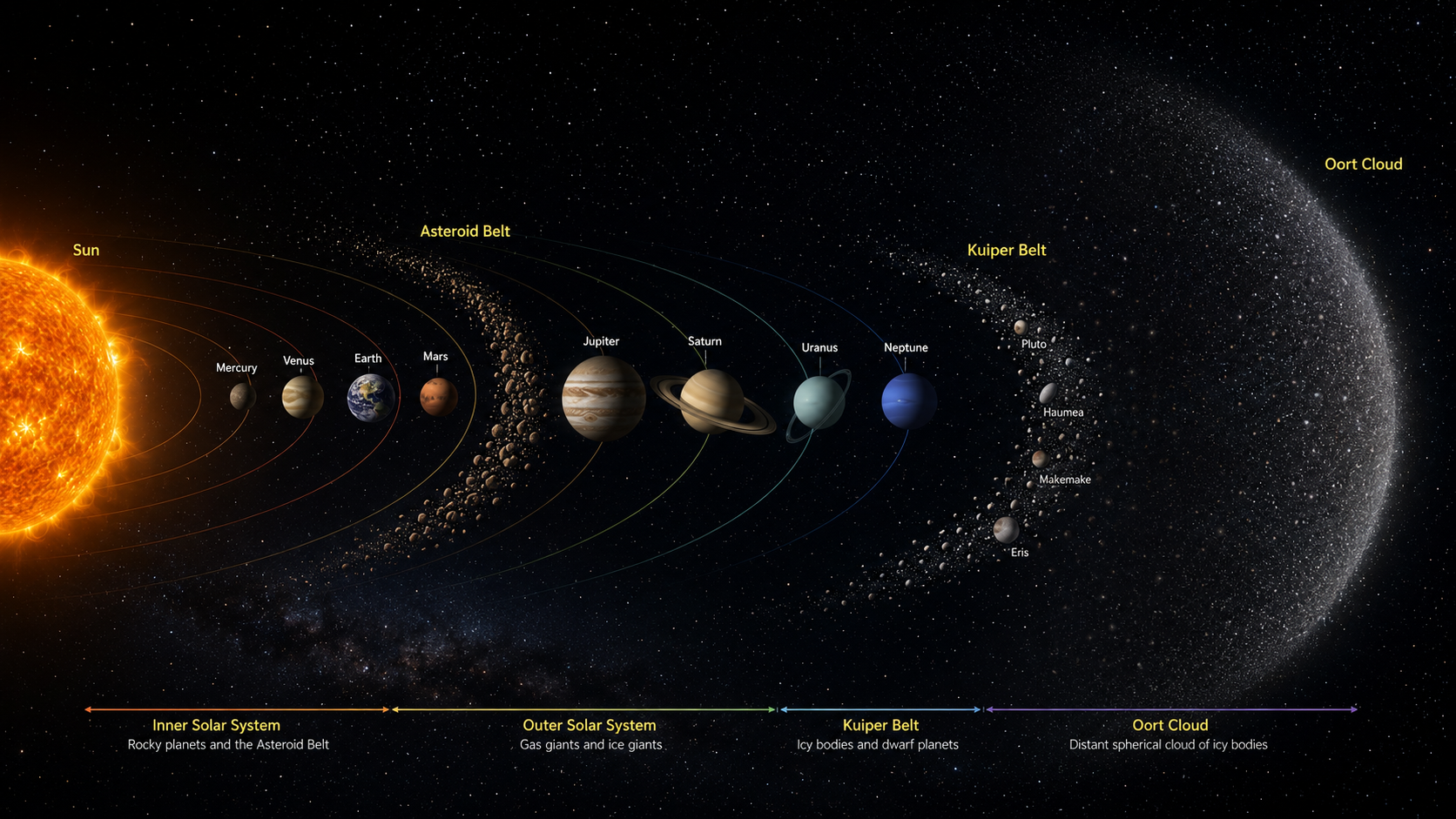
Sun is the star at the center of the Solar System. It is a nearly spherical body of hot plasma composed primarily of hydrogen and helium, held together by its own gravity. The Sun contains approximately 99.8 percent of the total mass of the Solar System, making it by far the dominant object within it. Its gravitational force governs the motions of the planets, dwarf planets, asteroids, comets, and other bodies that orbit it.
 The Sun formed about 4.6 billion years ago from the gravitational collapse of a region within a large molecular cloud of gas and dust. As the cloud contracted, most of the material accumulated at the center, where increasing pressure and temperature eventually initiated nuclear fusion. This process continues today in the Sun’s core, where hydrogen nuclei combine to form helium. The fusion reactions release enormous amounts of energy in accordance with the principles of nuclear physics and mass-energy conversion. This energy is the source of the Sun’s heat and light.
The Sun is structured in several distinct layers. At its center is the core, where temperatures reach approximately 15 million kelvin (27 million F) and nuclear fusion occurs. Surrounding the core is the radiative zone, where energy moves outward primarily through radiation. Beyond this is the convective zone, where energy is transported by large-scale motions of hot plasma. The visible surface of the Sun is called the photosphere, which has an average temperature of about 5,800 kelvin (9980 F). Above the photosphere lie the chromosphere and the corona, the Sun’s outer atmosphere. The corona extends millions of kilometers into space and reaches temperatures much higher than the visible surface. The Sun continuously emits electromagnetic radiation across a broad spectrum, including visible light, infrared radiation, ultraviolet radiation, X-rays, and radio waves. This radiation provides nearly all of the energy that drives Earth’s climate and weather systems and supports nearly all life through photosynthesis. The Sun also emits a stream of charged particles known as the solar wind. This flow of particles interacts with planetary magnetic fields and atmospheres, producing phenomena such as auroras on Earth.
The Sun is classified as a G-type, medium sized star, often referred to as a “yellow dwarf.” It is currently in the stable phase of its life cycle during which hydrogen fusion occurs in the core. Astronomical observations and stellar evolution models indicate that the Sun has been in this phase for billions of years and is expected to remain in it for several billion more. Eventually, after most of the hydrogen in its core is depleted, the Sun will evolve into a red giant, later shed its outer layers, and leave behind a dense remnant known as a white dwarf. These stages are consistent with well-established theories of stellar evolution and observations of similar stars.
The Sun’s diameter is approximately 1.39 million kilometers (863,700 miles), making it about 109 times wider than Earth. Its mass is approximately 1.989 x 10\(^{30}\) kilograms (4.385 x 10\(^{30}\) lbs). The Sun’s energy output, known as luminosity, is approximately 3.8 x 10\(^{26}\) watts. Light from the Sun takes about 8 minutes and 20 seconds to travel the average distance between the Sun and Earth, which is about 149.6 million kilometers (92,957,000 miles), a distance defined as one astronomical unit (AU).
Stars Special Classes
Stars (suns) are classified using several well-established systems based on their observable and physical properties. These are the most widely used classification methods:
- Spectral Class (Temperature Classification) - Stars are classified according to the absorption lines in their spectra, which are closely related to surface temperature. Standard temperatures are in Kelvin.
- O - Blue, hottest stars, surface temperatures greater than about > 30,000 K.
- B - Blue-white stars, about 10,000–30,000 K.
- A - White stars, about 7,500–10,000 K.
- F - Yellow-white stars, about 6,000–7,500 K.
- G - Yellow stars, about 5,200–6,000 K.
- K - Orange stars, about 3,700–5,200 K.
- M - Red stars, about 2,400–3,700 K.
- Additional classes L, T, and Y are used for very cool stellar and substellar objects.
- L - Sub-red stars, about 1,300–2,400 K.
- T - Brown dwarf stars, about 700–1,300 K.
- Y - Sub-brown stars, about < 700 K.
- Luminosity Class (Size and Brightness Classification) - Stars are also classified by their luminosity and surface gravity:
- Ia - Luminous supergiants.
- Ib - Less luminous supergiants.
- II - Bright giants.
- III - Giants.
- IV - Subgiants.
- V - Main-sequence (dwarf) stars.
- VI - Subdwarfs.
- VII - White dwarfs.
- Mass Classification - Stars are often grouped by mass: Astronomers classify stars based on mass by comparing them directly to our Sun, where 1 solar mass (\(M_{\odot }\)) equals the mass of our Sun (about 1.989 x 10\(^{30} \;kg\)).
- Low-mass stars. \( <\;0.4\;\) \(M_{\odot }\)
- Intermediate-mass stars. \( <\;0.4\;\) \(M_{\odot }\) to \( \;4\;\) \(M_{\odot }\)
- High-mass stars. \( \;4\;\) \(M_{\odot }\) to \( \;8\;\) \(M_{\odot }\)
- Very high-mass stars. \( >\;8.0\;\) \(M_{\odot }\)