Gravity, abbreviated as \(g\), also called gravitation, is one of the four fundamental interactions of nature and is the interaction that causes objects with mass and energy to attract one another. It is the natural force of attraction between any two objects with mass. It is the force that pulls all objects towards each other, and is responsible for keeping the planets in our solar system in orbit around the sun, and for keeping objects on the Earth's surface from floating away into space. The strength of gravity between two objects depends on their masses and the distance between them. The larger the masses of the objects, the greater the gravitational force between them. The closer the objects are to each other, the greater the gravitational force between them.
Gravity Formula |
||
|
\(\ g \;=\; \dfrac{ PE }{ m \cdot h } \) (Gravity) \( PE \;=\; g \cdot m \cdot h \) \( m \;=\;\dfrac{ PE }{ g \cdot h } \) \(\ h \;=\; \dfrac{ PE }{ g \cdot m } \) |
||
| Symbol | English | Metric |
| \( g \) = Gravity | \(ft \;/\; sec^2\) | \(m \;/\; s^2\) |
| \( PE \) = Potential Energy | \( ft-lbf \) | \( J \) |
| \( m \) = Mass | \( lbm \) | \( kg \) |
| \( h \) = Height | \( ft \) | \( m \) |
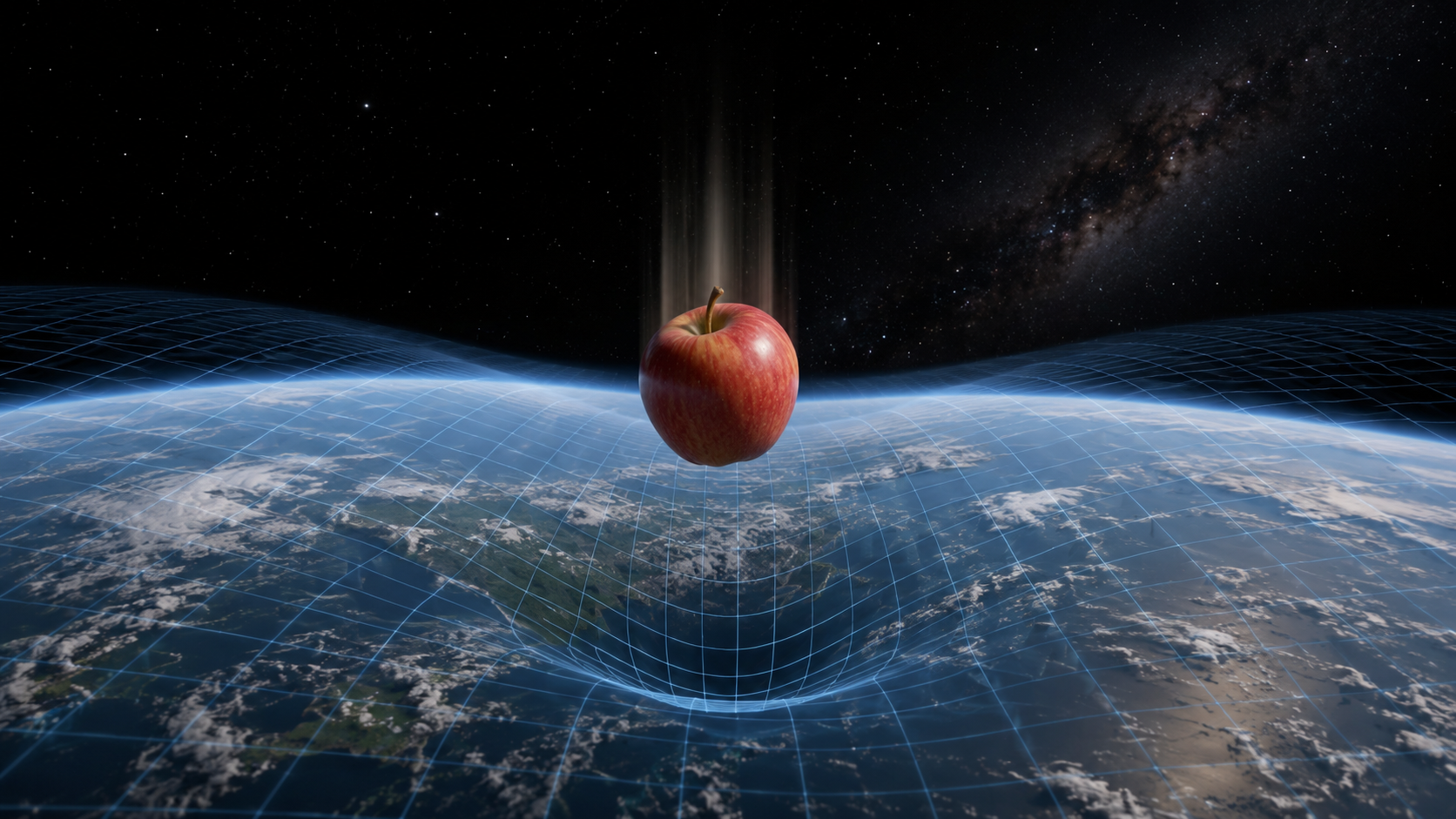
In classical physics, gravity is described by Newton's law of universal gravitation. Newton proposed that every object with mass attracts every other object with a force that is directly proportional to the product of their masses and inversely proportional to the square of the distance between their centers. This equation accurately predicts the motions of planets, moons, satellites, falling objects, and many engineering applications where gravitational fields are relatively weak and objects move much slower than the speed of light.
Modern physics provides a more complete description through Einstein's General Theory of Relativity. In this theory, gravity is not considered a conventional force acting across empty space. Instead, mass and energy cause spacetime, the four-dimensional combination of space and time to curve. Objects moving solely under the influence of gravity follow the straightest possible paths, called geodesics, through this curved spacetime. For example, Earth orbits the Sun because the Sun's mass curves the surrounding spacetime, and Earth follows that curvature.
Gravity is responsible for the formation and long-term stability of astronomical systems. Within stars, gravity compresses matter until temperatures and pressures become high enough for nuclear fusion to begin. The balance between the inward pull of gravity and the outward pressure produced by fusion determines a star's structure and lifetime. When fusion ceases, gravity dominates the star's evolution, potentially producing white dwarfs, neutron stars, or black holes, depending on the star's original mass.
Gravity governs orbital motion. An orbit occurs when an object moves forward fast enough that, as it continuously falls toward a larger body due to gravity, the surface of that body curves away beneath it. This balance between forward velocity and gravitational acceleration produces stable orbits such as Earth's orbit around the Sun, the Moon's orbit around Earth, and satellites orbiting Earth.
Gravity affects time as well as space. According to General Relativity, clocks located in stronger gravitational fields run more slowly than clocks located in weaker gravitational fields. This is known as gravitational time dilation. It is also an essential correction used by the Global Positioning System (GPS). Without accounting for both gravitational and velocity related relativistic effects, GPS positioning errors would accumulate by several kilometers each day.