
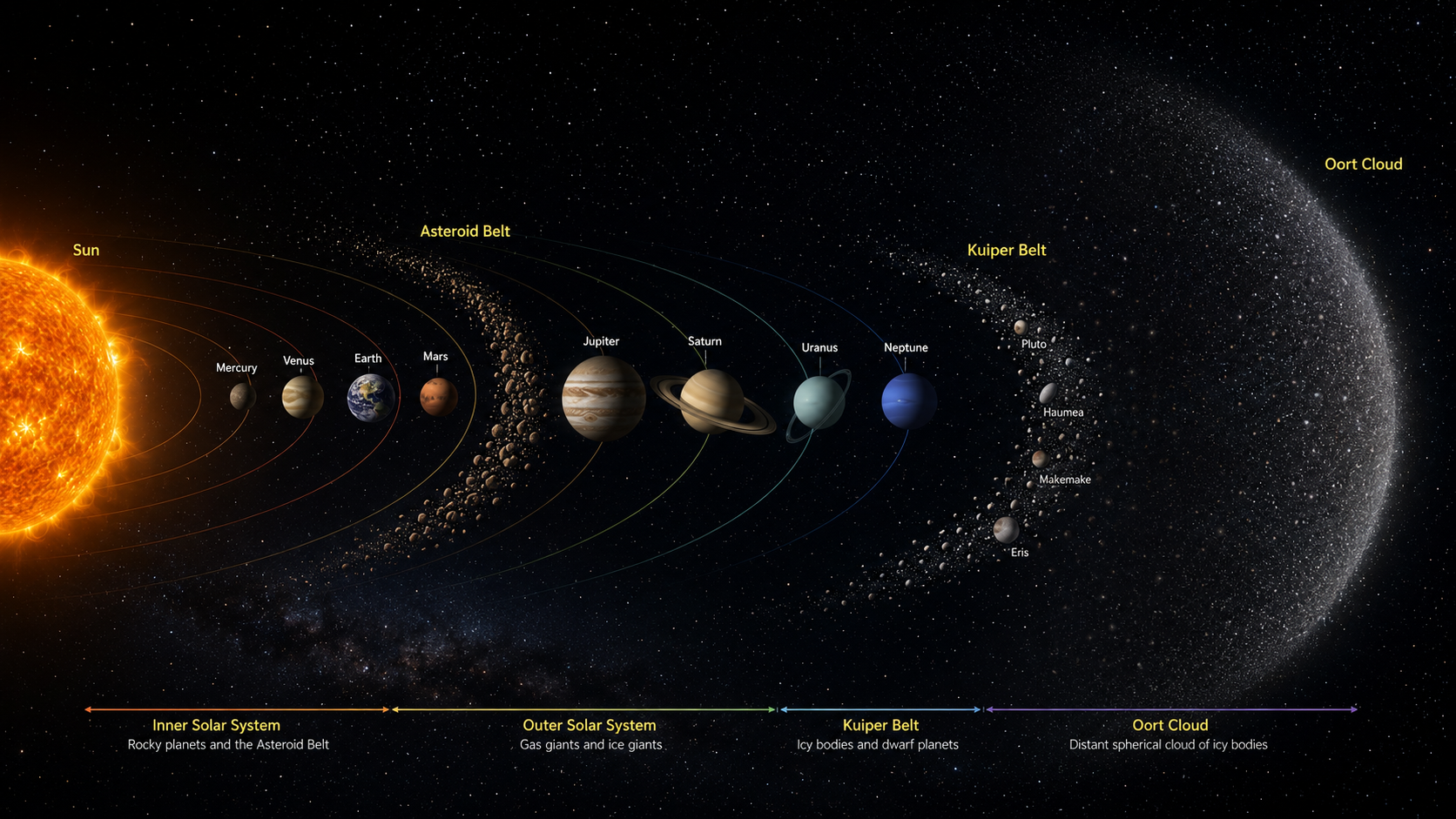
Neptune is the eighth and farthest known major planet from the Sun in the Solar System. It is classified as an ice giant, a category distinct from the larger gas giants Jupiter and Saturn. Neptune was the first planet whose existence was predicted through mathematical calculations before it was directly observed. Irregularities in the orbit of Uranus led astronomers to predict the presence of another massive body, and Neptune was subsequently observed in 1846. It is named after the Roman god of the sea.
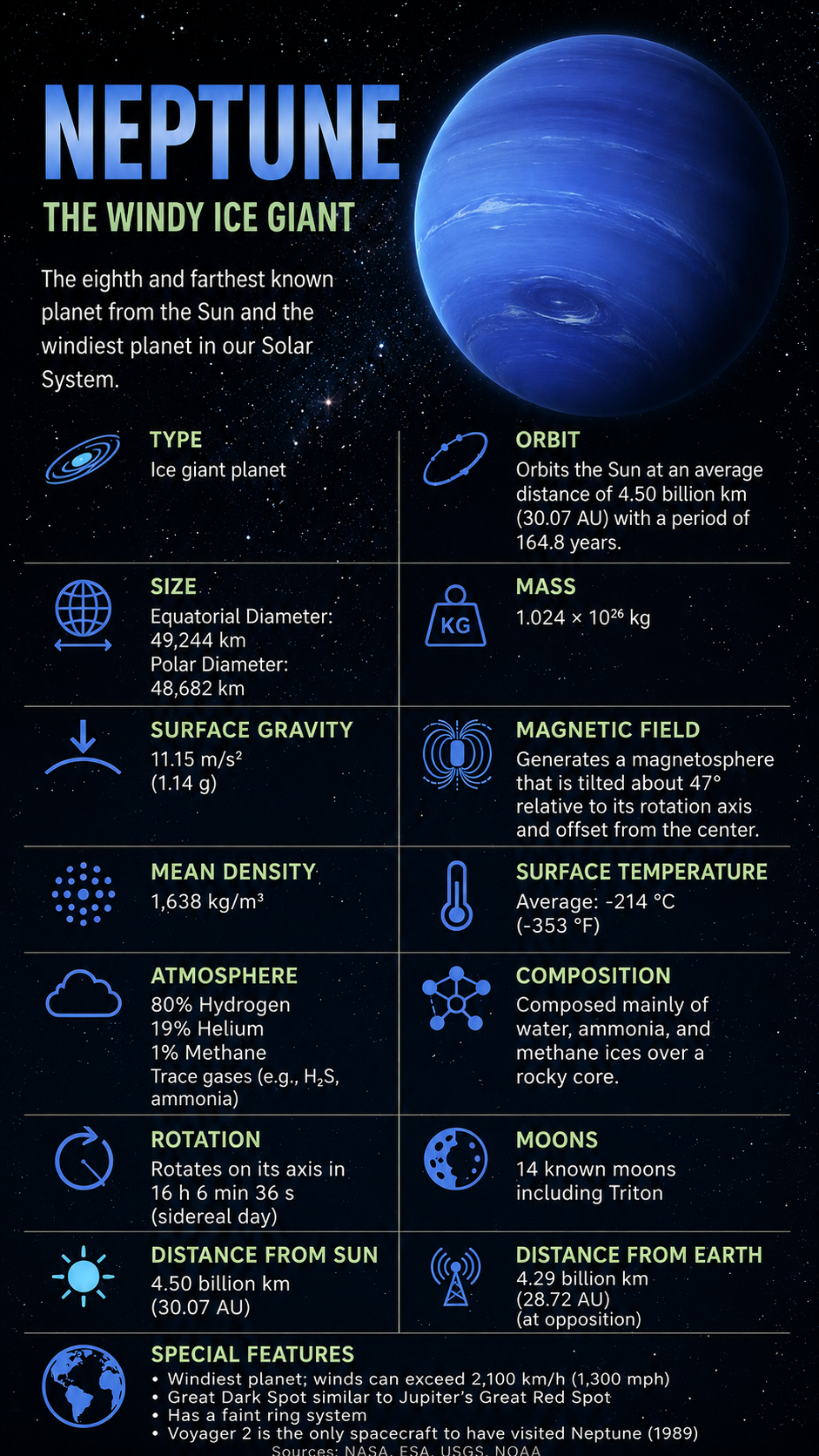
 Neptune has a diameter of approximately 49,244 kilometers (30,598 miles), making it the fourth-largest planet by diameter and the third-most-massive planet in the Solar System. Its mass is about 17 times that of Earth. The planet is composed primarily of hydrogen, helium, and methane, along with larger amounts of water, ammonia, and other volatile substances than are found in the gas giants. The methane in Neptune's upper atmosphere absorbs red wavelengths of sunlight and reflects blue wavelengths, giving the planet its characteristic deep blue appearance.
The atmosphere of Neptune is one of the most active in the Solar System. It contains large storm systems, high-altitude clouds, and extremely strong winds. Wind speeds exceeding 2,000 kilometers per hour (about 1,200 miles per hour) have been measured, making them among the fastest planetary winds known. Neptune is also an internal heat source; it radiates significantly more energy into space than it receives from the Sun. The exact mechanism responsible for this excess heat is not fully understood, but the existence of the excess heat itself is well established through observation.
Beneath its atmosphere, Neptune is believed to contain a deep mantle composed largely of water, ammonia, and methane under extremely high pressures and temperatures. At greater depths lies a central core composed primarily of rock and metal. Direct observation of the interior is not possible, so knowledge of its internal structure is derived from measurements of mass, gravity, magnetic fields, and theoretical modeling.
Neptune possesses a complex magnetic field that is strongly tilted relative to its rotational axis and offset from the planet's center. The planet rotates rapidly, completing one rotation in approximately 16 hours. Like all four giant planets, Neptune is not a solid body; different latitudes of its atmosphere rotate at slightly different rates.
Neptune has a system of faint rings composed mainly of dust particles and icy material. These rings are much less prominent than those of Saturn but have been confirmed through spacecraft observations and Earth-based studies. Neptune also has numerous natural satellites. Its largest moon, Triton, is unusual because it orbits Neptune in a retrograde direction, meaning it moves opposite the planet's rotation. This strongly suggests that Triton was captured by Neptune's gravity rather than forming alongside the planet. Triton is one of the coldest known objects in the Solar System and possesses a thin atmosphere and active geyser-like eruptions of nitrogen observed by spacecraft.