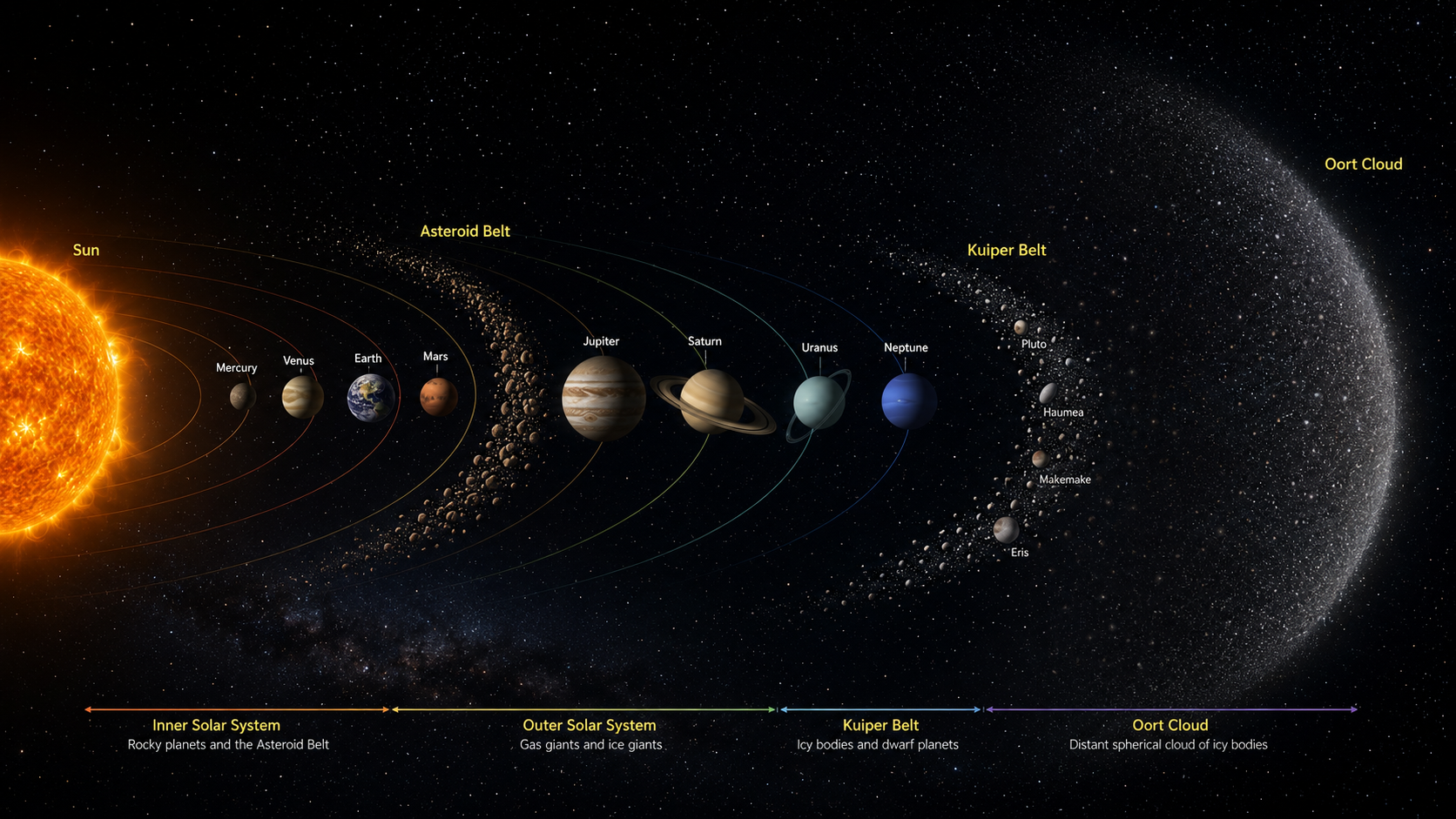
Venus is the second planet from the Sun and is one of the four terrestrial planets in the Solar System. It orbits the Sun at an average distance of about 108.2 million kilometers (67.2 million miles) and completes one orbit approximately every 224.7 Earth days. Venus is similar to Earth in overall size, mass, and composition, which is why it is often described as Earth’s “sister planet.” Venus has a mean diameter of about 12,104 kilometers (7,521 miles), making it slightly smaller than Earth, and it possesses a dense atmosphere and a solid rocky surface.
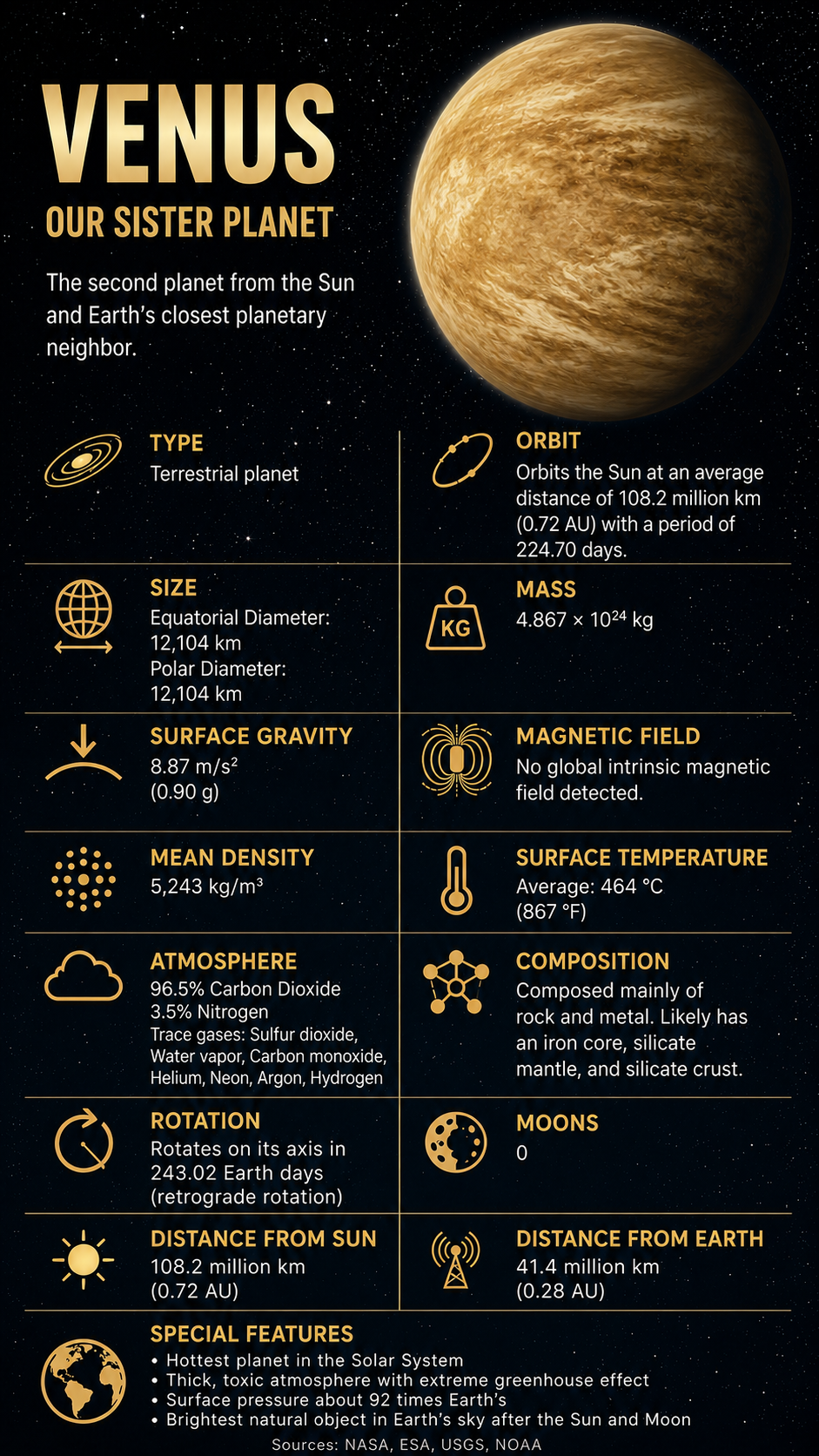
 The atmosphere of Venus is composed primarily of carbon dioxide, with smaller amounts of nitrogen and trace gases. Thick clouds of sulfuric acid completely cover the planet, preventing direct observation of the surface in visible light from space. The atmospheric pressure at the surface is about 92 times that of Earth's sea-level pressure, equivalent to the pressure found nearly 900 meters (about 3,000 feet) underwater on Earth. Venus also experiences an extreme greenhouse effect because its dense carbon dioxide atmosphere traps heat very efficiently. As a result, the average surface temperature is approximately 465°C (869°F), making Venus the hottest planet in the Solar System, even hotter than Mercury, despite Mercury being closer to the Sun.
Venus rotates very slowly and in a retrograde direction, meaning it spins opposite to the direction of its orbit around the Sun. One rotation of Venus takes about 243 Earth days, which is longer than its orbital period. Consequently, a Venusian day, defined by its rotation relative to the stars, is longer than a Venusian year. The planet has no known natural moons and no known planetary ring system.
Venus has been observed by humans since antiquity and is one of the brightest natural objects in Earth's sky after the Sun and Moon. Depending on its position relative to Earth and the Sun, it appears either as the "morning star" before sunrise or the "evening star" after sunset. Because Venus lies closer to the Sun than Earth does, it exhibits phases similar to those of the Moon when viewed through a telescope.