
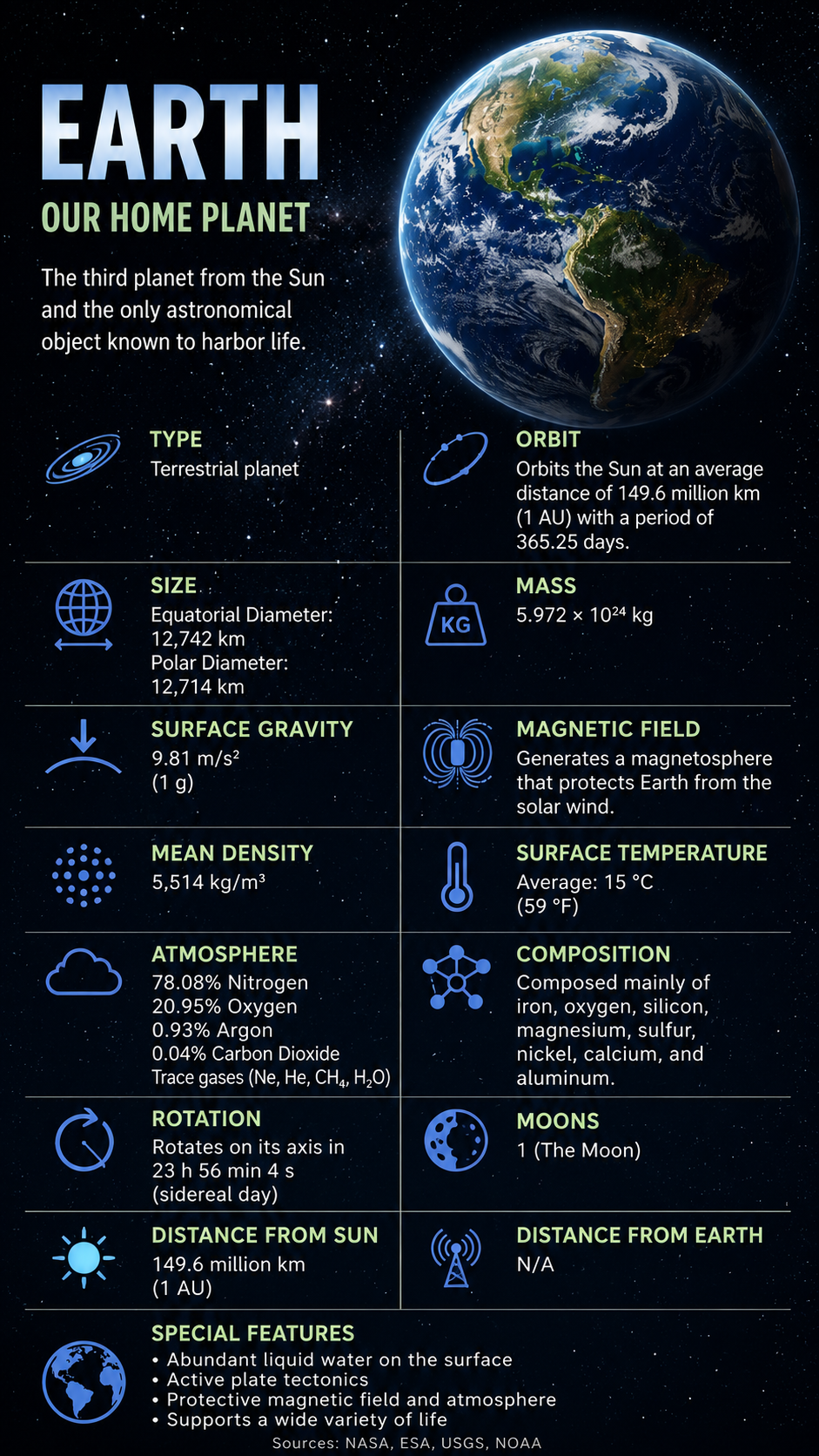
Earth is the third planet from the Sun and the only known astronomical body that supports life. It formed approximately 4.54 billion years ago from material within the protoplanetary disk that surrounded the young Sun. Earth is classified as a terrestrial planet, meaning it is composed primarily of rock and metal. It has a nearly spherical shape that is slightly flattened at the poles and bulged at the equator due to its rotation. The planet has an average diameter of about 12,742 kilometers (7,918 miles) and a mass of approximately 5.97 x 10\(^{24}\) kilograms.
 Earth consists of several major layers. The outermost layer is the crust, which varies in thickness beneath continents and oceans. Beneath the crust lies the mantle, a thick region of hot rock that slowly flows over geological timescales. At the center of the planet is the core, which is divided into a liquid outer core and a solid inner core composed primarily of iron and nickel. The movement of molten metal within the outer core generates Earth's magnetic field, which helps protect the planet from charged particles emitted by the Sun. Earth's surface is dynamic and continuously reshaped by geological processes. The crust is divided into tectonic plates that move slowly over the mantle. Interactions between these plates produce earthquakes, volcanic activity, mountain building, and the formation of ocean basins. These processes are collectively described by the scientific theory of plate tectonics, which is a fundamental framework for understanding Earth's geology.
Approximately 71 percent of Earth's surface is covered by liquid water in the form of oceans, seas, lakes, rivers, and other bodies of water. The remaining surface consists of continents and islands. The presence of abundant liquid water is one of Earth's most important characteristics because it is essential for all known forms of life. Water continuously circulates through the atmosphere, oceans, land, and living organisms in what is known as the water cycle. Earth possesses an atmosphere composed mainly of nitrogen and oxygen, along with smaller amounts of argon, carbon dioxide, water vapor, and trace gases. This atmosphere provides the gases required by many living organisms, helps regulate temperature, and shields the surface from much of the Sun's harmful ultraviolet radiation. The atmosphere is divided into layers, including the troposphere, stratosphere, mesosphere, thermosphere, and exosphere.
The planet rotates on its axis approximately once every 24 hours, producing the cycle of day and night. Earth also revolves around the Sun approximately once every 365.25 days, producing the yearly cycle. The tilt of Earth's rotational axis relative to its orbital plane causes the seasons. Earth is orbited by one natural satellite, the Moon, whose gravitational influence contributes to ocean tides and has played an important role in the planet's long term evolution.
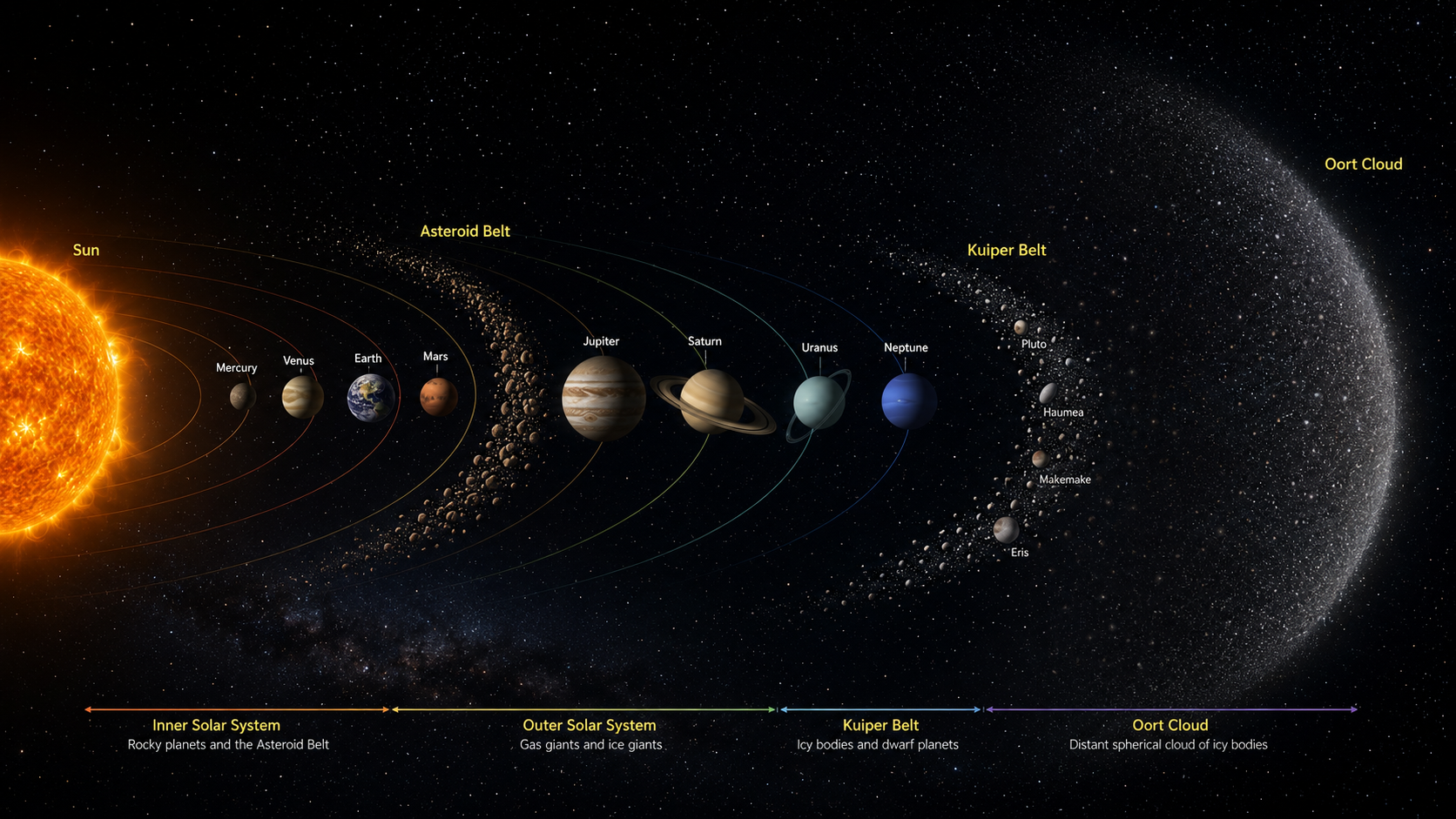
Earth is also part of a larger system that includes the atmosphere, hydrosphere, cryosphere, biosphere, and geosphere. These components interact continuously through physical, chemical, and biological processes. The biosphere encompasses all known living organisms, ranging from microscopic life to complex plants and animals. From an astronomical perspective, Earth is one of eight recognized planets in the Solar System and orbits the Sun at an average distance of about 149.6 million kilometers (93 million miles), a distance known as one astronomical unit. This position places Earth within a range of solar energy that allows liquid water to exist on its surface under present atmospheric conditions.