Kuiper Belt is a vast, donut shaped region of the Solar System located beyond the orbit of Neptune. It extends from approximately 30 astronomical units (AU) from the Sun, which is about the distance of Neptune's orbit, to roughly 50 AU. The Kuiper Belt contains millions of icy bodies, rocky-icy objects, and debris that are remnants from the formation of the Solar System about 4.6 billion years ago.
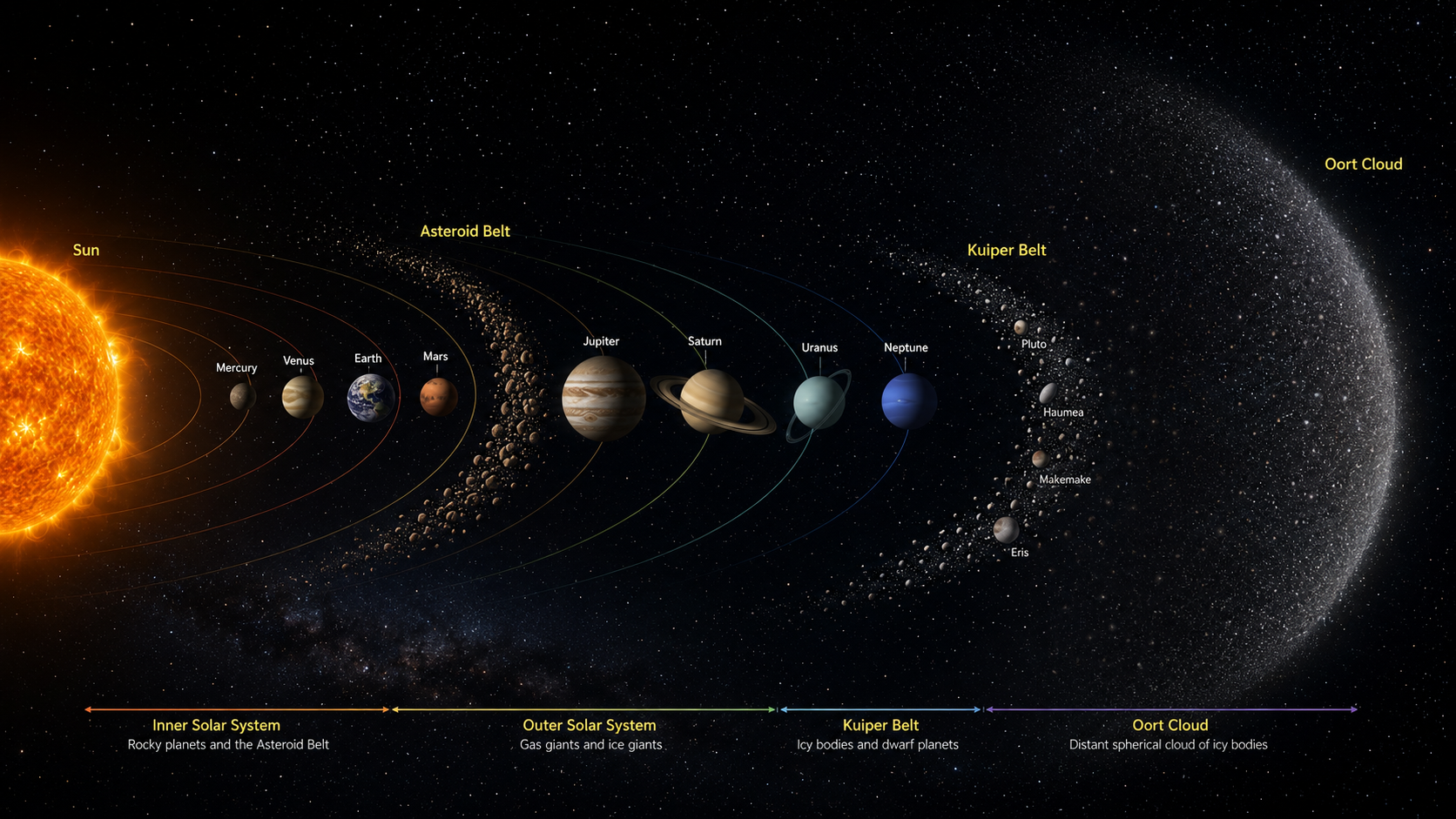 The Kuiper Belt is similar in concept to the Asteroid Belt located between Mars and Jupiter, but it is much more massive, and composed primarily of frozen volatile substances such as water ice, methane ice, ammonia ice, and other frozen compounds rather than predominantly rocky material. These objects are often referred to as Kuiper Belt Objects (KBOs) or trans-Neptunian objects (TNOs). Because temperatures in this distant region are extremely low, these volatile materials remain frozen.
One of the most important discoveries related to the Kuiper Belt was the realization that it is the source of many short period comets, particularly those with orbital periods of less than about 200 years. Gravitational interactions with the giant planets, especially Neptune, can alter the orbits of Kuiper Belt objects and send some of them toward the inner Solar System, where they may become visible as comets when solar heating causes their ices to vaporize. The Kuiper Belt contains several dwarf planets. The best known is Pluto, which was discovered in 1930 and classified as the ninth planet until 2006. Pluto is now recognized as one of the largest known Kuiper Belt objects and is accompanied by several moons, including Charon. Other dwarf planets located in the Kuiper Belt include Haumea and Makemake.
The Kuiper Belt is scientifically important because its objects are considered relatively primitive remnants of the early Solar System. Unlike planets, which underwent extensive geological and thermal evolution, many Kuiper Belt objects have changed comparatively little since their formation. As a result, they preserve information about the materials and conditions that existed when the Solar System formed.