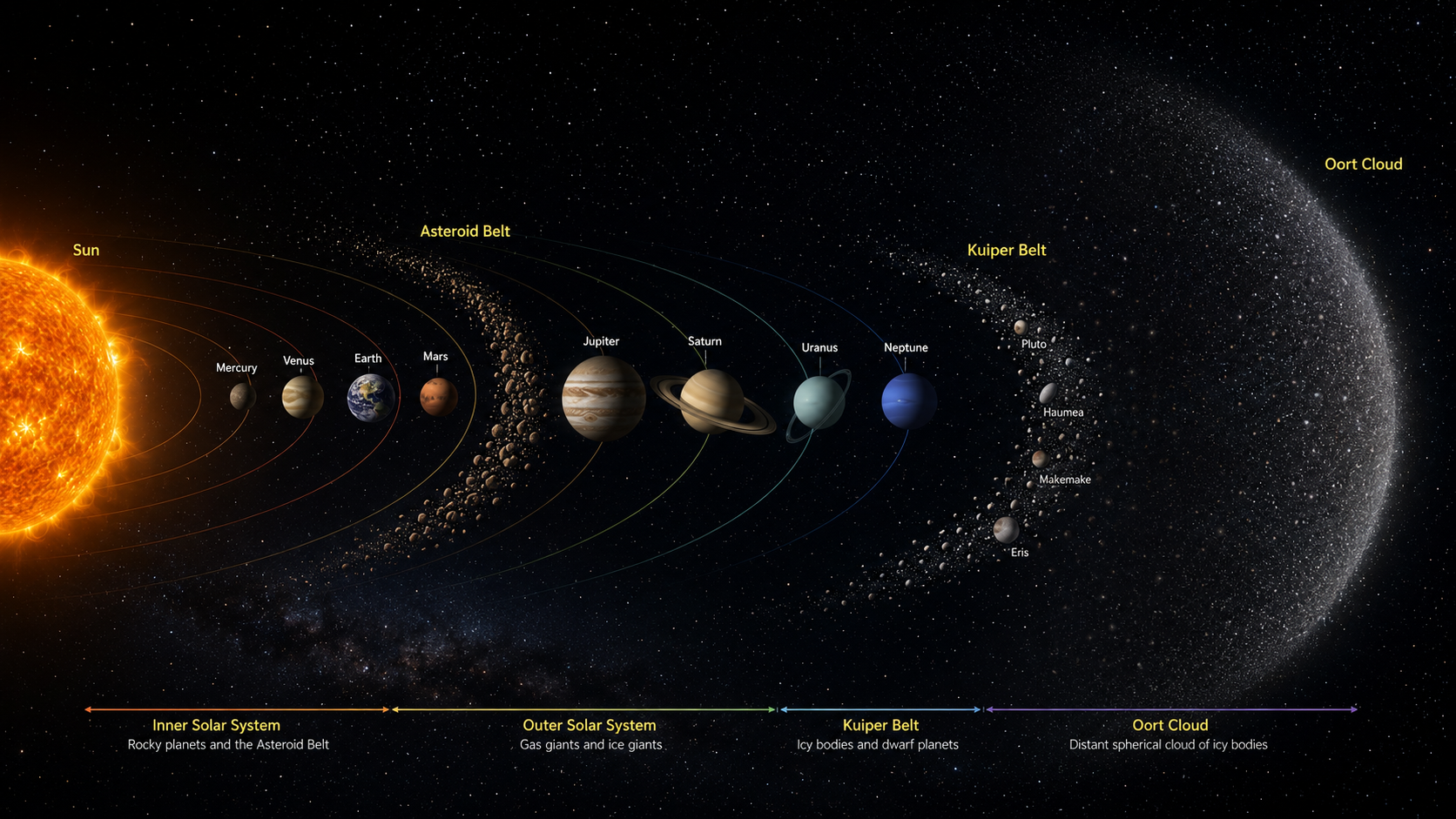
Saturn is the sixth planet from the Sun and the second-largest planet in the Solar System, after Jupiter. It is classified as a giant planet and is composed predominantly of hydrogen and helium. Saturn has no solid surface in the ordinary sense; instead, its visible appearance is formed by the upper layers of a deep atmosphere. Beneath the atmosphere, pressure and temperature increase dramatically with depth, leading to layers of compressed hydrogen and other materials surrounding a dense central core. Saturn orbits the Sun at an average distance of approximately 1.4 billion kilometers (about 886 million miles) and completes one orbit in about 29.5 Earth years.
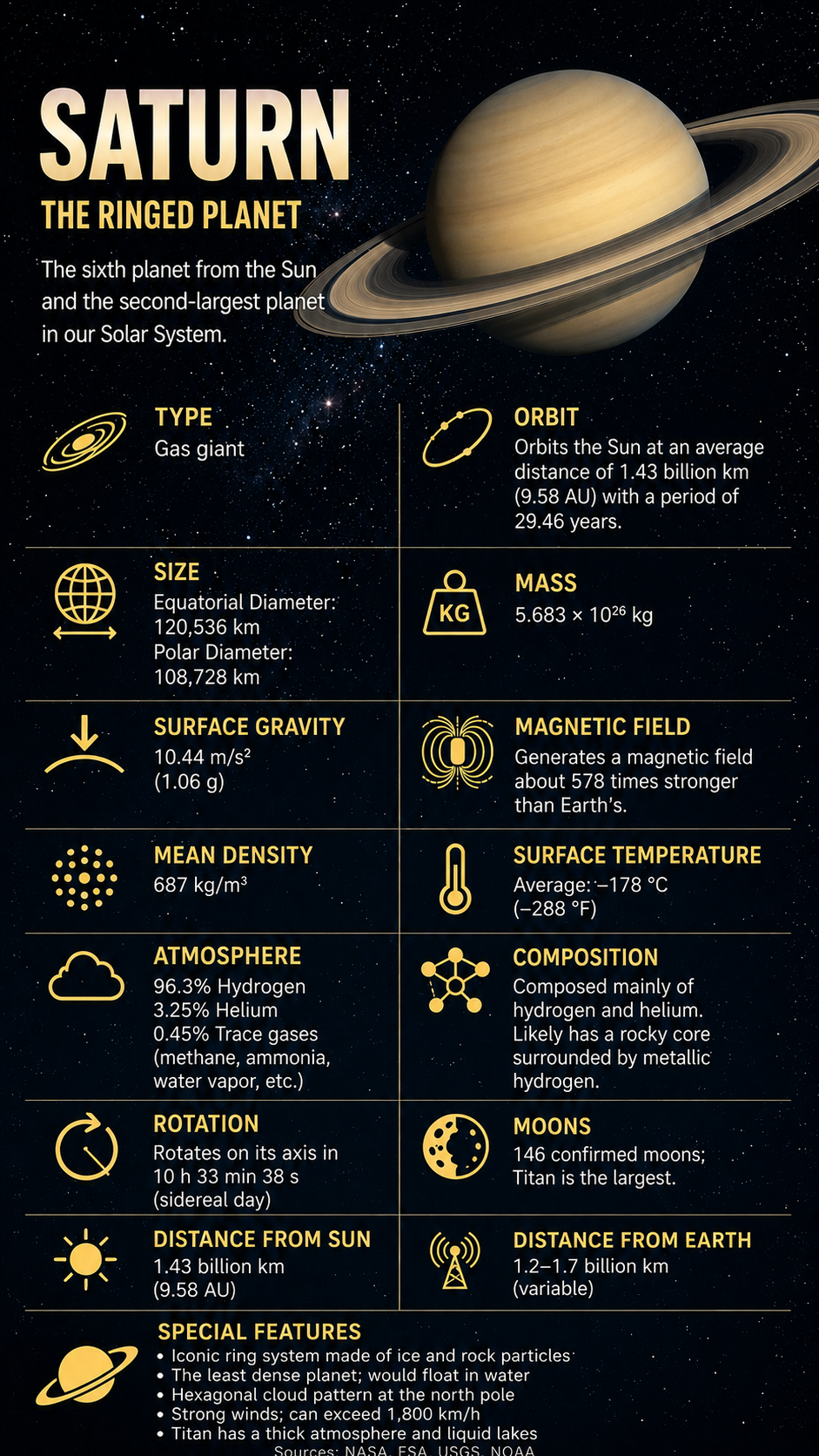
 Saturn is best known for its extensive ring system, which is the most prominent and complex ring system of any planet in the Solar System. Although other giant planets also possess rings, Saturn's rings are far larger, brighter, and more easily observed. The rings consist primarily of countless particles of water ice, along with smaller amounts of rocky material and dust. These particles range in size from microscopic grains to objects several meters across. The rings are organized into numerous distinct ring groups and gaps, including the well-known Cassini Division, which separates major portions of the ring system.
The planet has a mean diameter of approximately 120,536 kilometers (74,898 miles), making it about nine times wider than Earth. Despite its immense size, Saturn has a remarkably low average density. Its mean density is lower than that of liquid water, making it the least dense planet in the Solar System. This low density results from its composition being dominated by light elements, particularly hydrogen and helium.
Saturn rotates very rapidly. A Saturnian day lasts roughly 10.5 hours, causing the planet to bulge outward at the equator and flatten slightly at the poles. Its atmosphere exhibits alternating bands of clouds, powerful jet streams, and long-lived storms. Wind speeds can exceed 1,800 kilometers per hour (about 1,100 miles per hour) in some regions. One of Saturn's most distinctive atmospheric features is a persistent hexagonal cloud pattern surrounding the north pole. This six-sided jet-stream structure has been observed by multiple spacecraft and remains one of the most unusual known atmospheric phenomena in the Solar System.
Saturn possesses a strong magnetic field generated within its interior. This magnetic field creates a vast magnetosphere that interacts with the solar wind and produces auroras near the planet's poles. Although Saturn's magnetic field is weaker than Jupiter's, it remains substantially stronger than Earth's.
Saturn has a large system of natural satellites. More than one hundred moons have been confirmed. The largest moon, Titan, is larger than the planet Mercury and is the only moon in the Solar System known to possess a dense atmosphere. Titan's atmosphere is composed primarily of nitrogen and contains clouds, rain, rivers, lakes, and seas of liquid hydrocarbons. Another notable moon, Enceladus, ejects plumes of water vapor and ice particles from beneath its icy surface, indicating the presence of a subsurface ocean. These discoveries have made Titan and Enceladus major subjects of planetary science research.