Roche limit, also called Roche radius, is the minimum distance at which a celestial body, such as a moon, comet, asteroid, or other satellite, can orbit a much larger body, such as a planet or star, without being torn apart by the larger body's tidal forces. Tidal forces arise because the gravitational attraction exerted by the larger body is stronger on the side of the satellite closest to it than on the far side. If the satellite moves within the Roche limit, this difference in gravitational pull can exceed the satellite's own gravitational force that holds it together. When this occurs, the satellite may become structurally unstable and begin to break apart.
Roche Limit Fluid Body Formula
|
||
|
\( d \;\approx\; 2.44 \cdot R_M \cdot \left( 2 \cdot \dfrac{ \rho_M }{ \rho_m } \right)^{1/3} \) (Roche Limit) \( R_M \;\approx\; \dfrac{ d }{ 2.44 } \cdot \left( \dfrac{ \rho_m }{ 2 \cdot \rho_M } \right)^{1/3} \) \( \rho_M \;\approx\; \dfrac{ \rho_m }{ 2 } \cdot \left( \dfrac{ d }{ 2.44 \cdot R_M } \right)^3 \) \( \rho_m \;\approx\; 2 \cdot \rho_M \cdot \left( \dfrac{ 2.44 \cdot R_M }{ d } \right)^3 \) |
||
| System | English | Metric |
| \( d \) = Limit Distance from the Center of the Primary Body | \(mi\) | \(km\) |
| \( R_M \) = Radius of the Primary Body | \(mi\) | \(km\) |
| \( \rho_M \) = Density of Primary Body | \(lbm \;/\; ft^3\) | \(km \;/\; m^3\) |
| \( \rho_m \) = Density of Satellite Body | \(lbm \;/\; ft^3\) | \(km \;/\; m^3\) |
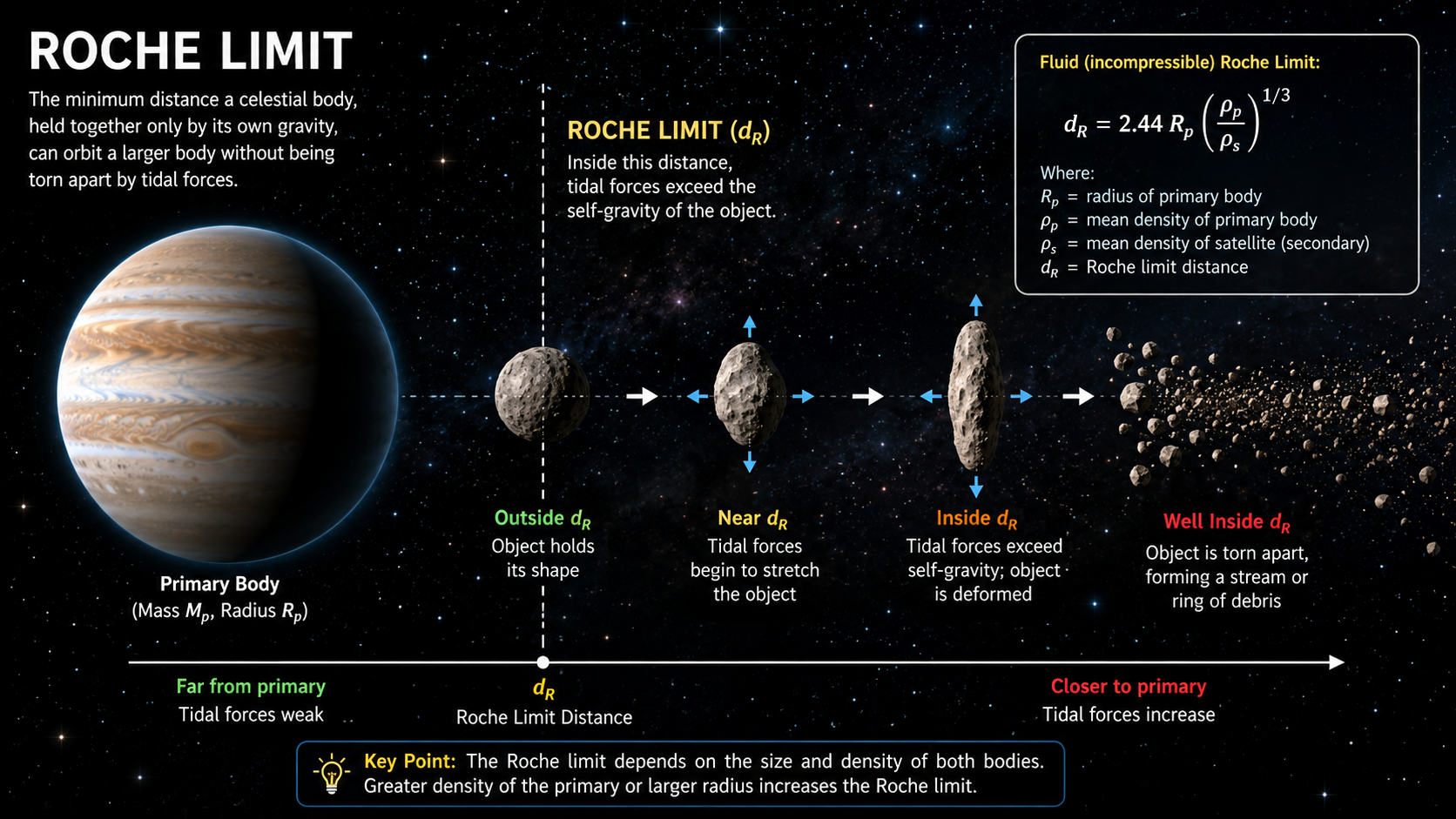
The Roche limit is not a fixed distance applicable to every system. Instead, it depends on the sizes and densities of both the primary body and the orbiting body, as well as the physical properties of the orbiting body. A satellite with a lower density generally has a larger Roche limit because its self-gravity is weaker and therefore more easily overcome by tidal forces. Conversely, a denser satellite can survive closer to the primary because its stronger self-gravity better resists tidal disruption.
Roche Limit Ridgid Body Formula
|
||
| \( d \;\approx\; 1.26 \cdot R_M \cdot \left( \dfrac{ \rho_M }{ \rho_m } \right)^{1/3} \) (Roche Limit) | ||
|
\( d \;=\; R_M \cdot \left( 2 \cdot \dfrac{ \rho_M }{ \rho_m } \right)^{1/3} \) (Roche Limit) \( R_M \;=\; \dfrac{ d }{ \left( 2 \cdot \dfrac{ \rho_M }{ \rho_m } \right)^{1/3} }\) \( \rho_M \;=\; \dfrac{ \rho_m \cdot d^3 }{ 2 \cdot R_M^3 } \) \( \rho_m \;=\; \dfrac{ 2 \cdot \rho_M \cdot R_M^3 }{ d^3 } \) |
||
| System | English | Metric |
| \( d \) = Limit Distance from the Center of the Primary Body | \(mi\) | \(km\) |
| \( R_M \) = Radius of the Primary Body | \(mi\) | \(km\) |
| \( \rho_M \) = Density of Primary Body | \(lbm \;/\; ft^3\) | \(km \;/\; m^3\) |
| \( \rho_m \) = Density of Satellite Body | \(lbm \;/\; ft^3\) | \(km \;/\; m^3\) |
It is important to distinguish the Roche limit from other gravitational boundaries. The Roche limit concerns whether an orbiting body can remain gravitationally intact against tidal forces. It does not determine whether an object remains gravitationally bound to a planet. This question is addressed by concepts such as the Hill sphere or the sphere of gravitational influence. Likewise, crossing the Roche limit does not necessarily mean an object is instantly destroyed. The process of disruption can occur over time and depends on the object's physical properties, orbital trajectory, rotation, and internal structure.
The Roche limit is a basic concept in celestial mechanics because it defines the region around a massive body where tidal forces become strong enough to overcome the self-gravity of an orbiting body. It helps understanding the stability of moons, the origin and maintenance of planetary rings, the tidal breakup of comets and asteroids, and the evolution of close-orbiting celestial systems.
- The fluid limit is roughly twice as large as the rigid one because a fluid body deforms, which amplifies the tidal forces.
- Real bodies lie between these two extremes (most satellites have some tensile strength and viscosity).
- These formulas assume:
- Spherical bodies
- The satellite is much less massive than the primary
- No significant orbital eccentricity or rotation effects (more advanced models exist)
- The Roche limit explains phenomena like planetary rings (material inside the limit cannot coalesce into moons).