Tidal force, also called tide-generating force, is the differential gravitational effect across an extended body caused by the spatial variation in the gravitational field of another body. It arises because gravity follows an inverse-square law, so the attractive force is stronger on the near side of the body and weaker on the far side compared to its center. This difference stretches the body along the line connecting its center to the source of the gravitational field, producing two tidal bulges, one toward the attracting body and one away from it. The concept is explained by the law of universal gravitation. The gravitational force between two point masses is proportional to their masses and inversely proportional to the square of the distance between them. Tidal forces are a residual effect of gravity and occur universally wherever gravitational fields have gradients across finite-sized objects.
Tidal Force Formula |
||
|
\( F_t \;=\; \dfrac{ 2 \cdot G \cdot M \cdot m \cdot R }{ r^3 } \) (Tidal Force) \( G \;=\; \dfrac{ F_t \cdot r^3 }{ 2 \cdot M \cdot m \cdot R } \) \( M \;=\; \dfrac{ F_t \cdot r^3 }{ 2 \cdot G \cdot m \cdot R } \) \( m \;=\; \dfrac{ F_t \cdot r^3 }{ 2 \cdot G \cdot M \cdot R } \) \( R \;=\; \dfrac{ F_t \cdot r^3 }{ 2 \cdot G \cdot M \cdot m } \) \( r \;=\; \left( \dfrac{ 2 \cdot G \cdot M \cdot m \cdot R }{ F_t } \right) ^{ 1/3 } \) |
||
| Symbol | English | Metric |
| \( F_t \) = Tidal Force | \(lbf\) | \(N\) |
| \( G \) = Gravitational Constant | \(lbf-ft^2 \;/\; lbm^2\) | \(N - m^2 \;/\; kg^2\) |
| \( M \) = Mass of the Gravitating Body | \(lbm\) | \(kg\) |
| \( m \) = Mass Experiencing the Tidal Effect | \(lbm\) | \(kg\) |
| \( R \) = Radius of the Affected Body | \(ft\) | \(m\) |
| \( r \) = Distance between te Centers of the Two Bodies | \(ft\) | \(m\) |
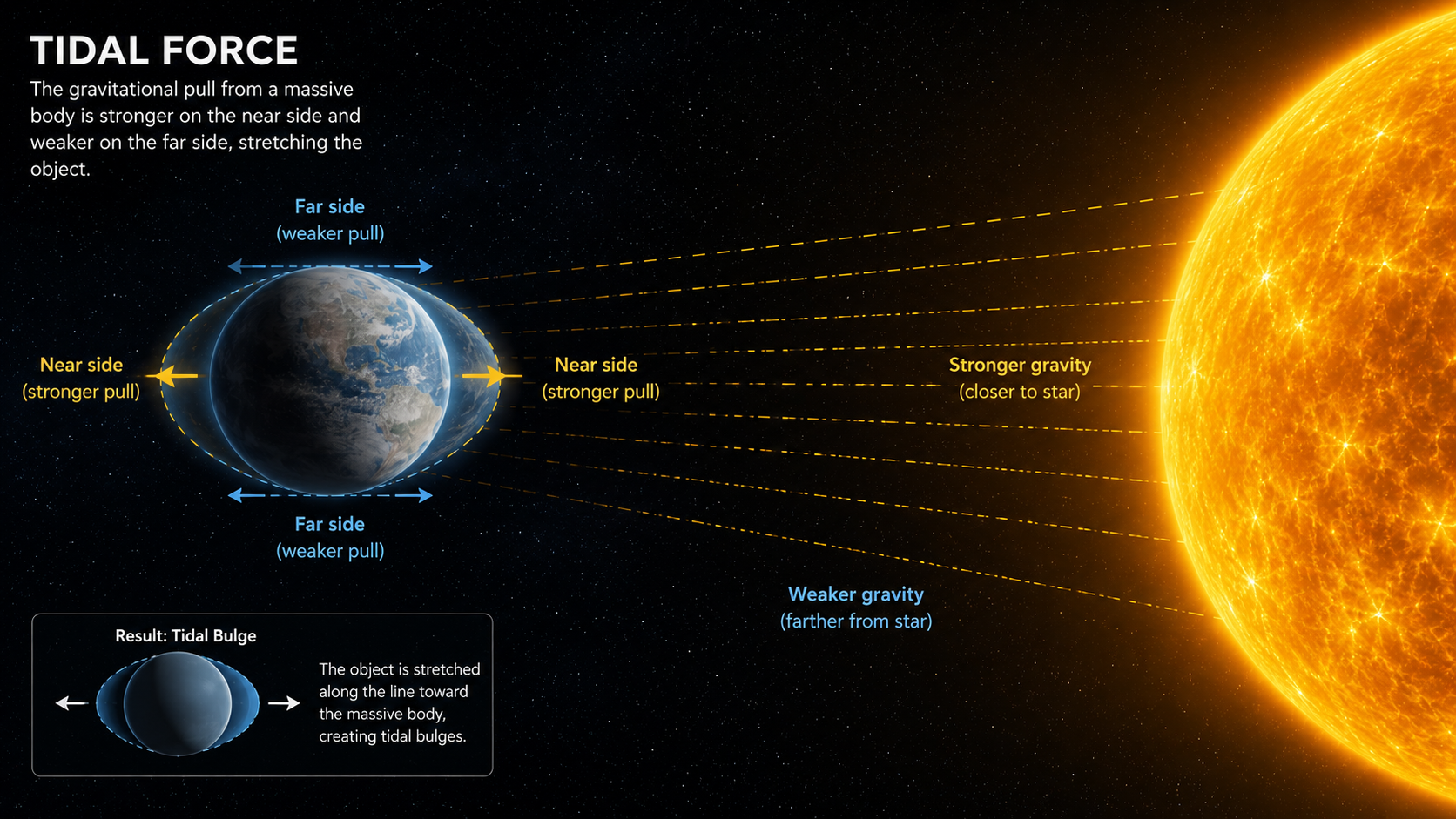
On Earth, the Moon is the primary cause of ocean tides due to its relatively close distance, despite the Sun having far greater mass. The Moon's tidal force is roughly twice that of the Sun. When the Sun, Moon, and Earth align syzygy (pronounced SIZ-uh-jee), their tidal forces reinforce each other, producing spring tides with greater tidal range. When they form a right angle, the forces partially cancel, resulting in neap tides with smaller range. These forces deform Earth's oceans more readily than its solid crust, leading to the periodic rise and fall of sea levels. Similar tidal forces act on other celestial bodies, contributing to phenomena such as the tidal locking of the Moon to Earth and potential disruption of objects that approach too closely to a massive body.