Tidal locking is a gravitational phenomenon in which the rotation period of one celestial body matches its orbital period around a larger body, resulting in the same side of the orbiting body always facing the primary body. This occurs due to tidal forces, which arise from the differential gravitational pull of the larger body across the diameter of the smaller one. These forces deform the orbiting body into a slightly elongated shape, creating tidal bulges aligned roughly with the line connecting the centers of the two bodies. As the smaller body rotates, if its spin rate does not initially match its orbital period, the bulges are dragged out of alignment. The gravitational torque from the primary body on these offset bulges acts to slow or speed up the rotation over time until synchronization is achieved, dissipating energy through internal friction within the body.
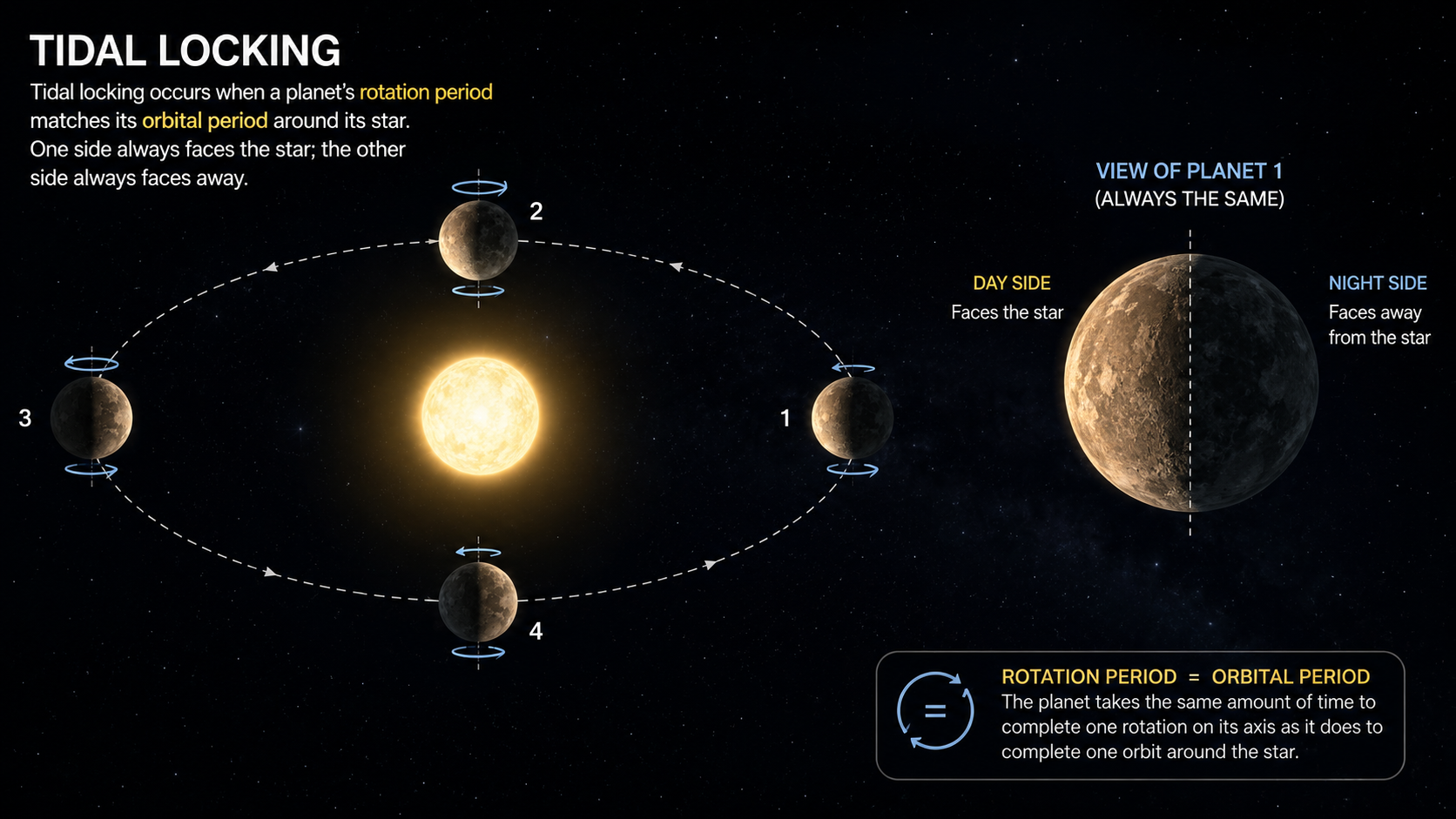 Tidal locking is a gradual process that takes place over millions to billions of years, depending on factors such as the masses involved, their separation distance, and internal structure. In cases where the two bodies have comparable masses and are sufficiently close, mutual tidal locking can occur, where each always presents the same face to the other.