
Oort Cloud is a vast, nearly spherical region of icy objects that surrounds the Solar System at extremely great distances from the Sun. It is named after the Dutch astronomer Jan Oort, who in 1950 proposed that a distant reservoir of cometary bodies existed to explain the observed orbits of many long-period comets. The Oort Cloud is considered the most distant known region associated with the Solar System and is thought to extend far beyond the orbit of the Kuiper Belt. Therefore, the existence of the Oort Cloud is inferred from strong observational evidence, particularly the trajectories and distribution of long period comets that enter the inner Solar System.
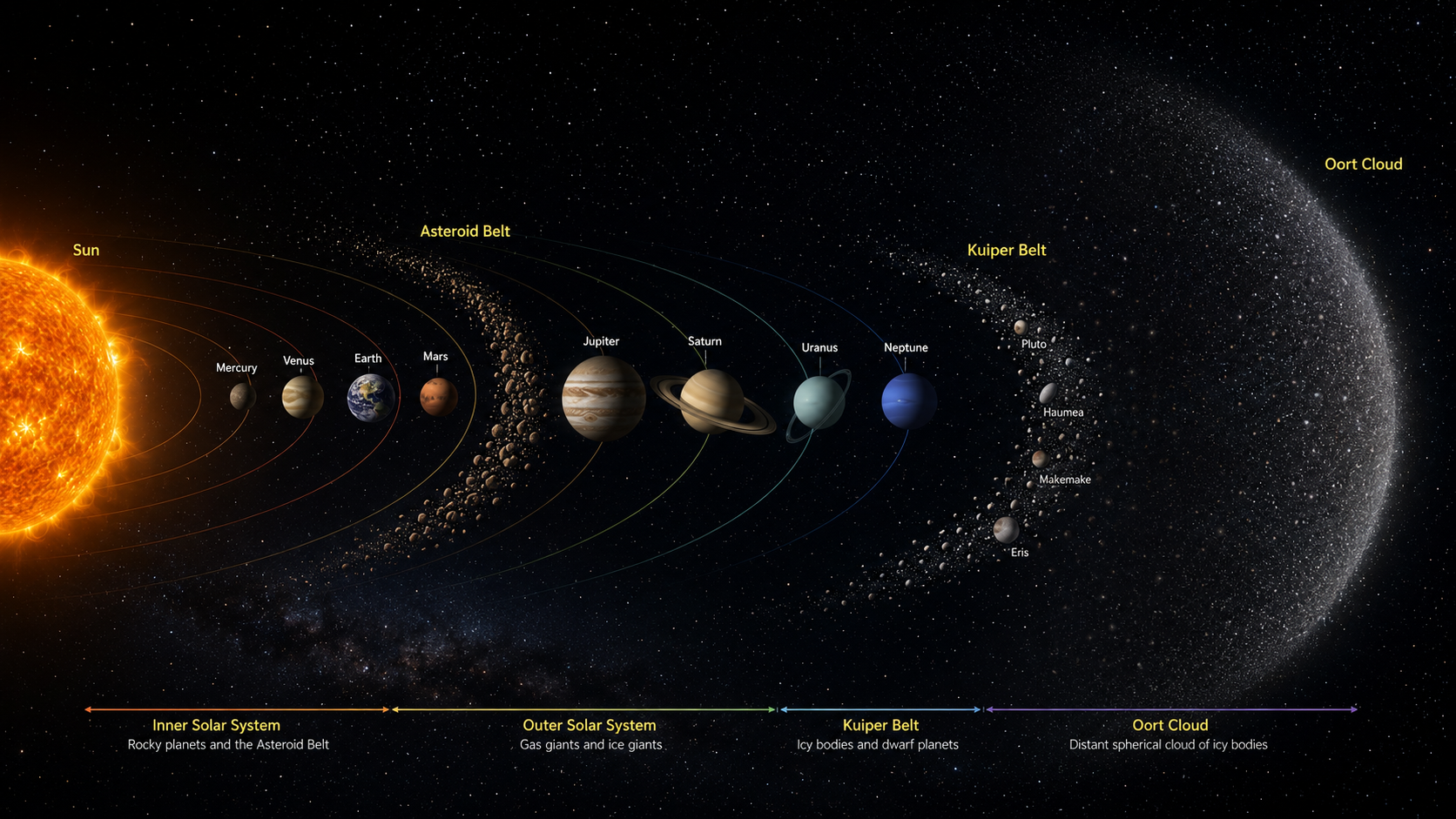 The Oort Cloud is generally divided into two conceptual regions. The inner Oort Cloud, sometimes called the Hills Cloud, is thought to be a more densely populated region located closer to the Sun. The outer Oort Cloud is believed to extend much farther outward and contains objects whose orbits are only weakly bound to the Sun. Exact boundaries remain uncertain because the cloud has not been directly observed. Estimates commonly place the outer portion at distances ranging from several thousand astronomical units (AU) to as much as approximately 100,000 AU or more from the Sun. One astronomical unit is the average distance between Earth and the Sun, about 149.6 million kilometers (92.96 million miles). At such distances, light from the Sun is extremely weak, and orbital periods can span millions of years.
The Oort Cloud is believed to be composed primarily of icy bodies containing varying amounts of water ice, carbon dioxide ice, methane ice, ammonia ice, rocky material, and organic compounds. The Oort Cloud is the presumed source of long-period comets. These comets have orbital periods greater than 200 years and often arrive from all directions in the sky, indicating a roughly spherical source region. Occasionally, gravitational disturbances alter the orbit of an Oort Cloud object, sending it inward toward the Sun. As the object approaches the inner Solar System, solar heating causes volatile materials to sublimate, producing the coma and tail characteristic of a comet. Some of the most famous long period comets are believed to have originated in the Oort Cloud.
Although the Oort Cloud is widely accepted by astronomers and is supported by substantial evidence from comet observations and dynamical modeling, many of its properties remain uncertain because it has not been directly observed. The exact number of objects it contains, its total mass, its precise structure, and its outer extent have not been determined with certainty. Direct observational confirmation of individual Oort Cloud objects remains Not Found.