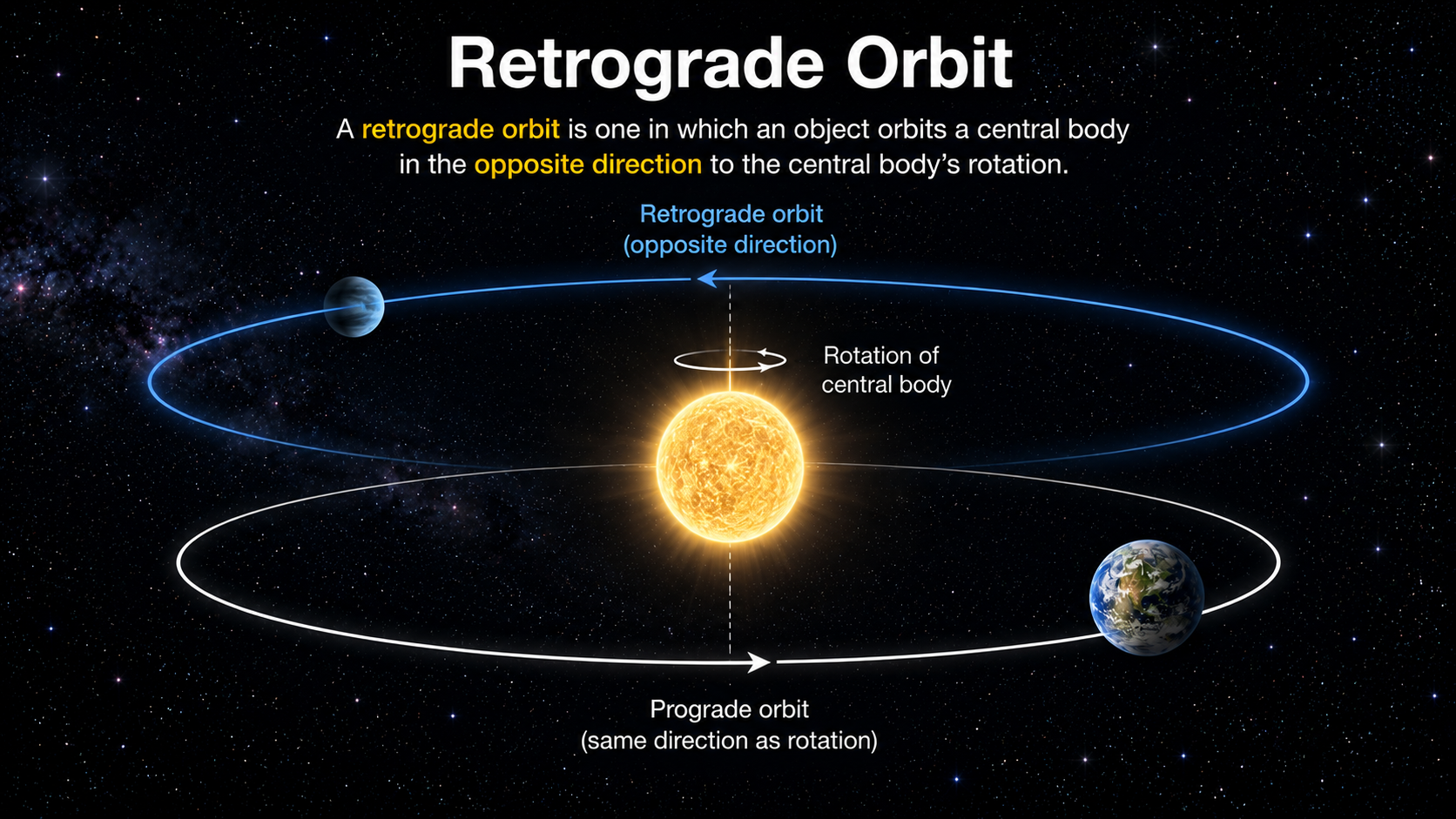
Retrograde orbit is an orbital path in which a smaller body, such as a moon, satellite, or planet, revolves around a larger central body in the direction opposite to the primary's rotation on its axis. Typically viewed from above the north pole of the primary or aligned with the overall angular momentum of the system, most objects in the Solar System follow prograde orbits, moving in the same counterclockwise direction as the Sun's rotation and the vast majority of planetary rotations and orbits. A retrograde orbit, by contrast, has an orbital inclination between 90\(^\circ\) and 180\(^\circ\) relative to the primary's equatorial plane, resulting in clockwise motion when viewed from the same vantage point.
 Retrograde orbits should not be confused with apparent retrograde motion, which is an optical illusion observed from Earth when one planet overtakes another in their respective orbits around the Sun, causing the outer planet to appear to loop backward against the background stars for a period. True retrograde orbits describe the actual direction of motion in inertial space relative to the primary's spin.