Orbital velocity is the constant speed required for an object, such as a satellite, spacecraft, or natural body like a moon, to maintain a stable, closed orbit around a much more massive central body (for example, Earth around the Sun or a satellite around Earth) without falling inward or flying off into space. This velocity arises from the precise balance between the inward gravitational pull of the central body and the outward centrifugal tendency of the orbiting object's motion. This relationship holds under the assumptions of a two-body system, negligible mass of the orbiting object compared to the central body, and negligible external perturbations.
Orbital Velocity Formula |
||
|
\( v \;=\; \sqrt{ \dfrac{ G \cdot M }{ r } } \) (Orbital Velocity) \( G \;=\; \dfrac{ v^2 \cdot r }{ M }\) \( M \;=\; \dfrac{ v^2 \cdot r }{ G }\) \( r \;=\; \dfrac{ G \cdot M }{ v^2 } \) |
||
| Symbol | English | Metric |
| \( v \) = Orbital Velocity | \(ft \;/\; sec\) | \(m \;/\; s\) |
| \( G \) = Universal Gravitational Constant (\(6.674\; x\; 10^{-11} m^3 kg^{-1} s^{-2} \)) | \(lbf-ft^2 \;/\; lbm^2\) | \(N -m^2 \;/\; kg^2\) |
| \( M \) = Mass of the larger Celestial Body | \( lbm \) | \( kg \) |
| \( r \) = Radius of the orbit, measured from the center of mass of the central body to the orbiting body | \( ft \) | \( m \) |
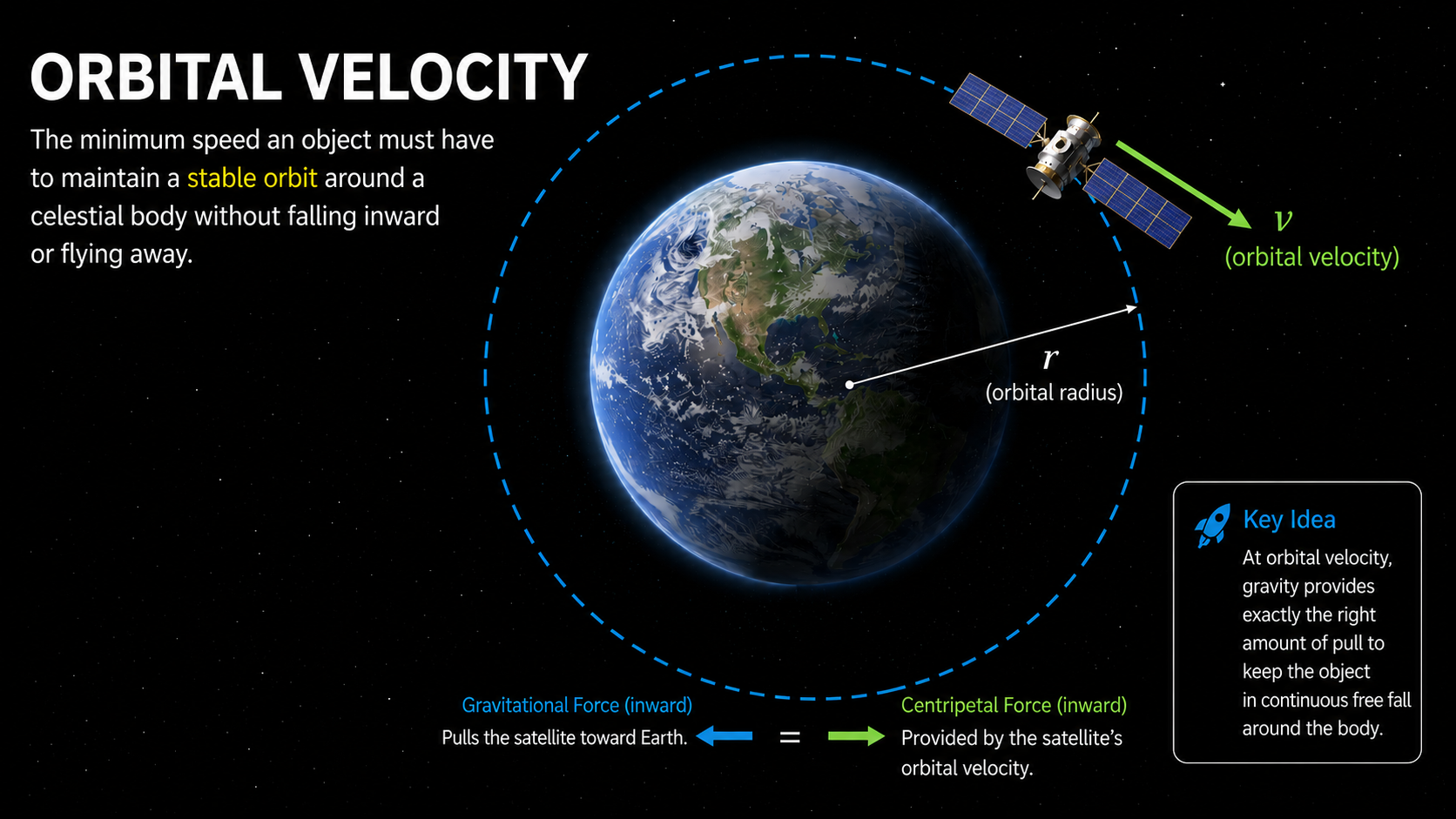
For elliptical orbits, which are more general according to Kepler's laws and Newtonian mechanics, the speed varies along the orbit, it is fastest at perigee (closest point) and slowest at apogee (farthest point). However, the concept of a specific orbital velocity most commonly refers to the circular case or the speed needed at a given altitude to sustain orbit. On Earth, the orbital velocity for a low Earth orbit (approximately 200–2,000 km altitude) is roughly 7.8 km/s (about 28,000 km/h or 17,500 mph). This value decreases with increasing altitude as the gravitational influence weakens with greater distance. Escape velocity, by contrast, is the minimum speed needed to break free of the gravitational field entirely, approximately 11.2 km/s from Earth's surface, which is higher than orbital velocity.