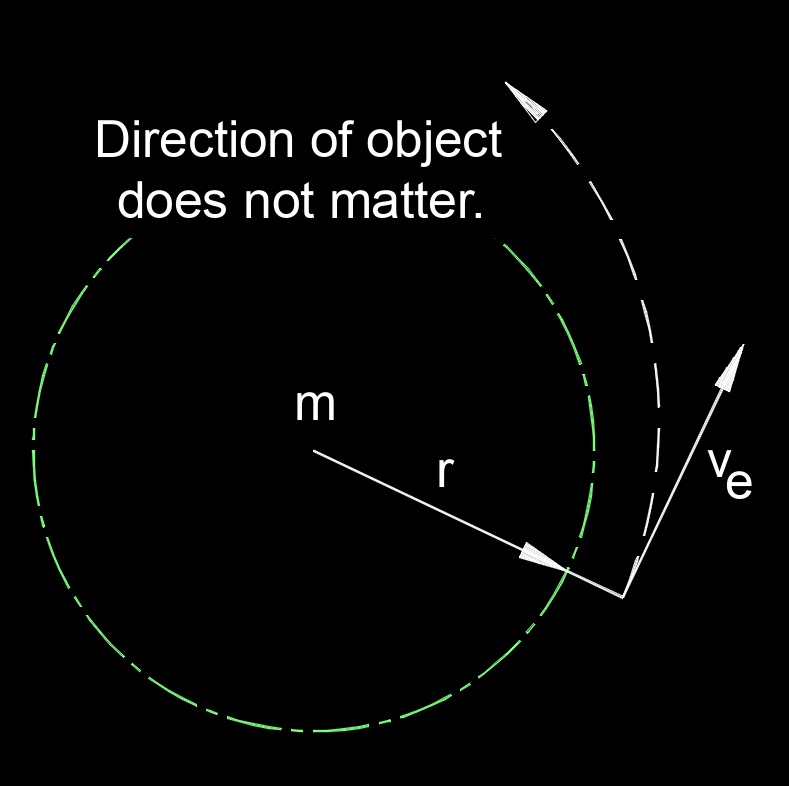
Escape velocity, also called escape speed, is the minimum speed needed for an object to escape from the gravitational attraction of a primary body, such as a planet, moon, or star, without any further propulsion or acceleration. It assumes the object is starting from a given distance from the center of the body and is projected in a way that it will coast away to infinity, where its kinetic energy approaches zero. This concept originates from classical mechanics, specifically the conservation of mechanical energy, where the initial kinetic energy provided to the object exactly balances the gravitational potential energy required to move it from its starting position to an infinite distance away.
Escape Velocity Formula |
||
|
\( v_e \;=\; \sqrt { \dfrac{ 2 \cdot G \cdot M }{ r } }\) (Escape Velocity) \( G \;=\; \dfrac{ v_e^2 \cdot r }{ 2 \cdot M }\) \( M \;=\; \dfrac{ v_e^2 \cdot r }{ 2 \cdot G }\) \( r \;=\; \dfrac{ 2 \cdot G \cdot M }{ v_e^2 }\) |
||
| Symbol | English | Metric |
| \( v_e \) = Escape Velocity | \(ft\;/\;sec\) | \(m\;/\;s\) |
| \( G \) = Universal Gravitational Constant | \(lbf-ft^2\;/\;lbm^2\) | \(N - m^2\;/\;kg^2\) |
| \( M \) = Mass of the larger Celestial Body | \( lbm \) | \( kg \) |
| \( r \) = Radius from the Center of Mass (Planet or Moon) to Start Point | \( ft \) | \( m \) |
At the surface of Earth, ignoring atmospheric resistance, the escape velocity is approximately 11.2 kilometers per second (about 6.96 miles per second or 40,000 kilometers per hour). For the Moon, which has significantly less mass, the surface escape velocity is about 2.38 kilometers per second. The concept applies broadly in celestial mechanics and has implications for planetary atmospheres: bodies with low escape velocities relative to the thermal speeds of gas molecules tend to lose their atmospheres over time. For black holes, inside the event horizon, the escape velocity exceeds the speed of light, preventing anything, including light, from escaping.