Prograde motion is the motion of an object in the same direction as the primary rotational or orbital motion that characterizes the system in which it resides. In the Solar System, prograde motion refers to an object orbiting the Sun in the same direction as most planets, which is counterclockwise when viewed from above the Sun's north pole. It can also describe a moon orbiting its planet in the same direction that the planet rotates, or a planet rotating on its axis in the same direction as its orbital motion around the Sun. Prograde motion is the opposite of retrograde motion.
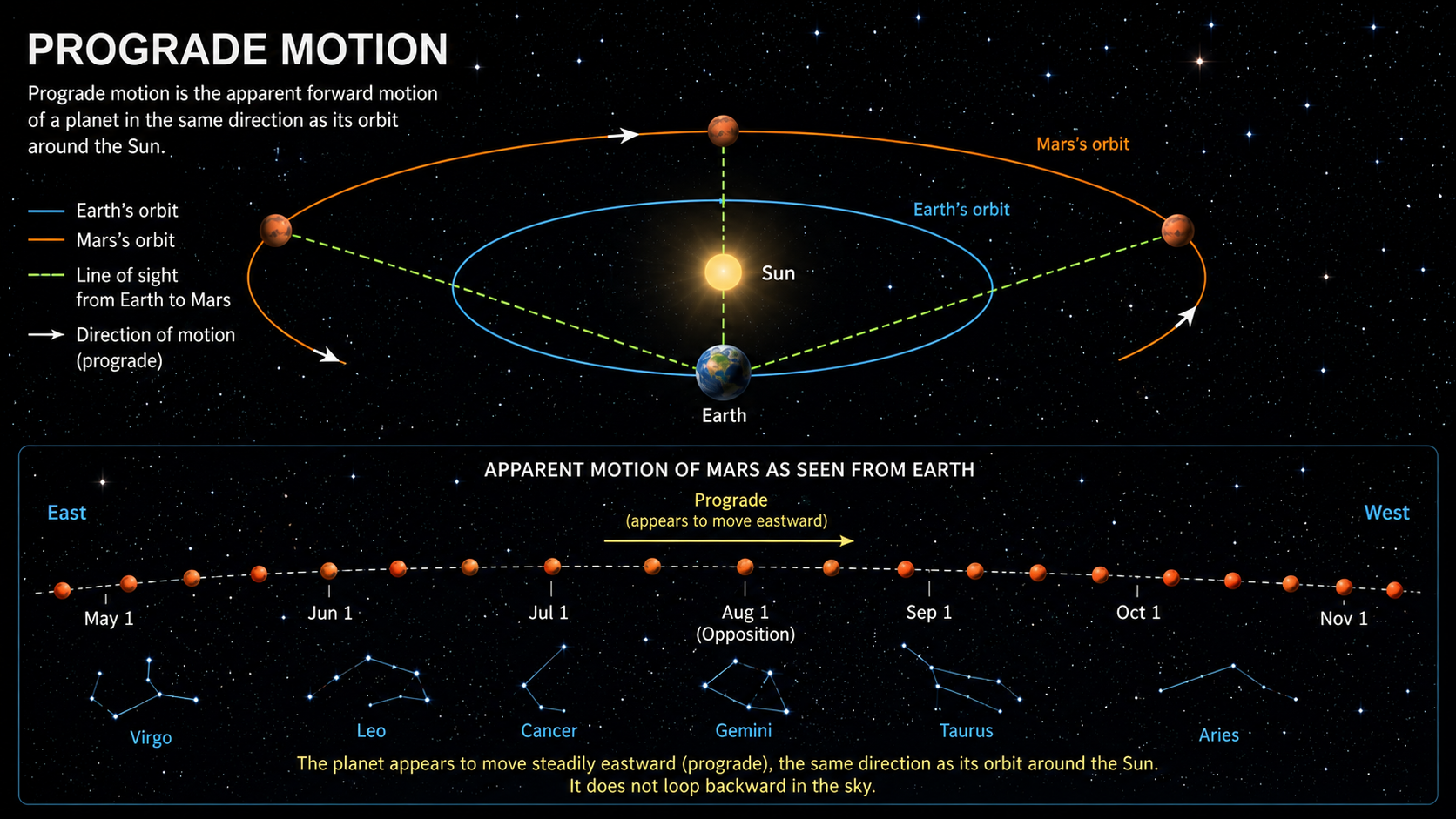 The planets of the Solar System exhibit predominantly prograde motion around the Sun. This common direction of revolution is understood to result from the formation of the Solar System from a rotating cloud of gas and dust. As the cloud contracted under gravity, conservation of angular momentum caused the material to flatten into a rotating disk, from which the planets formed while retaining the disk's overall direction of rotation. Consequently, most planets orbit the Sun in a prograde motion. Likewise, many natural satellites orbit their planets in prograde motion because they formed from circumplanetary disks that rotated in the same direction as their parent planets.
Prograde is also applied to rotational motion. A planet is said to have prograde rotation if it spins about its axis in the same direction as its orbital revolution around the Sun. Most planets in the Solar System have prograde rotation. Prograde motion can also refer to the apparent eastward movement of planets against the background stars over time. This apparent motion reflects the actual orbital motion of planets around the Sun and contrasts with periods of apparent retrograde motion, during which a planet temporarily appears to reverse direction in the sky because of the relative motions and viewing geometry of Earth and the other planet.