
Mercury is the smallest planet in the Solar System and the planet closest to the Sun. It is one of the eight planets that orbit the Sun and is classified as a terrestrial planet, meaning it is composed primarily of rock and metal. Mercury completes one orbit around the Sun in approximately 88 Earth days, which is the shortest orbital period of any planet. Mercury rotates relatively slowly compared to its orbital motion, completing one rotation relative to the stars in about 59 Earth days. Due to the relationship between its rotation and orbit, a solar day on Mercury, the time from one sunrise to the next, is approximately 176 Earth days.
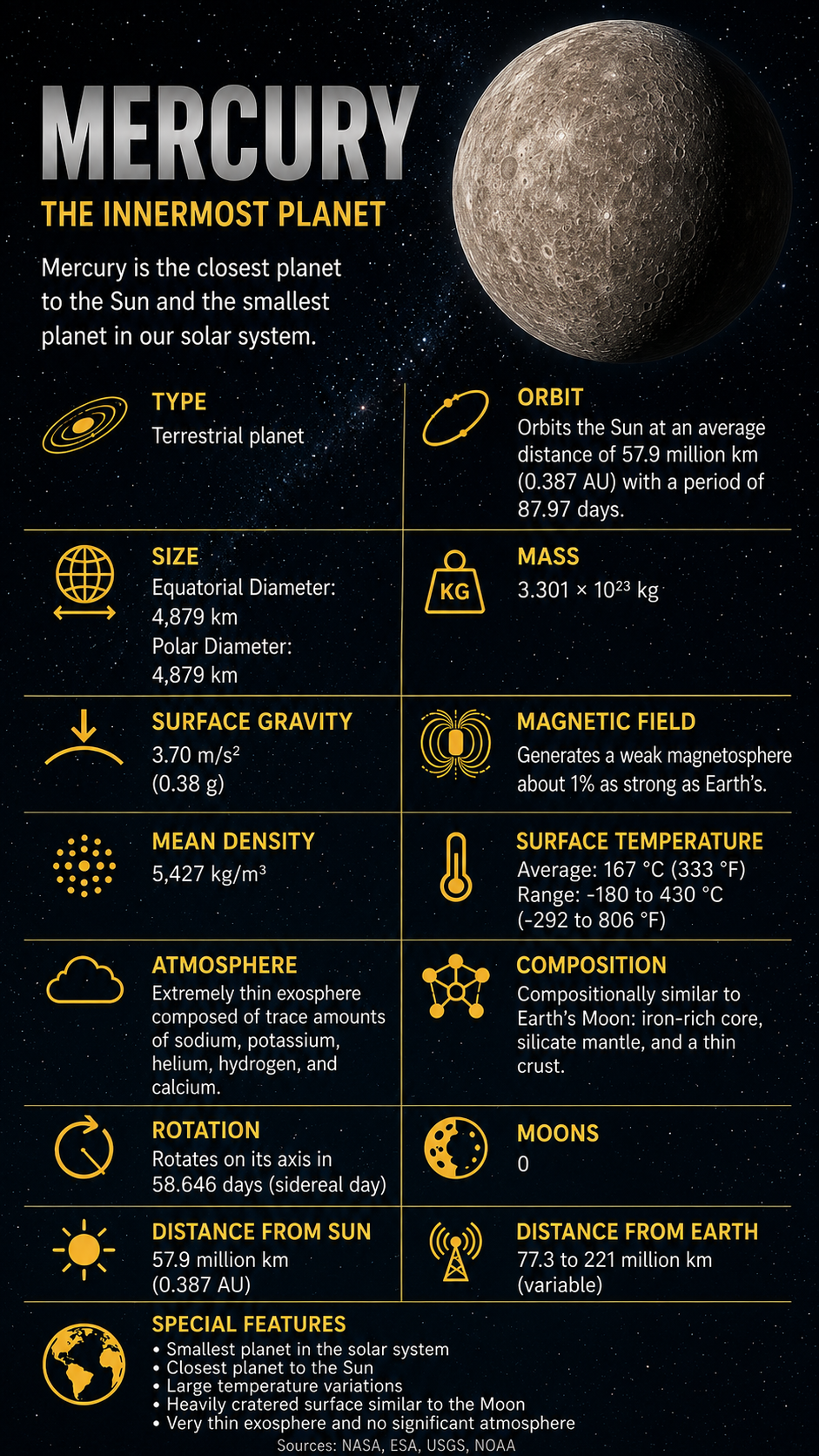
Mercury has a diameter of about 4,879 kilometers (3,032 miles), making it only slightly larger than Earth's Moon. Despite its small size, Mercury is very dense. Much of the planet's interior is occupied by a large metallic core composed primarily of iron. This unusually large core accounts for a significant fraction of the planet's total volume and mass. Surrounding the core is a rocky mantle and crust. Scientific measurements obtained by spacecraft have confirmed that Mercury possesses a global magnetic field, although it is much weaker than Earth's magnetic field.
Mercury has an extremely thin atmosphere, more accurately described as an exosphere. This exosphere contains trace amounts of atoms such as oxygen, sodium, hydrogen, helium, and potassium. Because the exosphere is so tenuous, it cannot retain heat effectively. As a result, Mercury experiences some of the most extreme temperature variations in the Solar System. Daytime temperatures near the equator can exceed 430°C (800°F), while nighttime temperatures can fall below −180°C (−290°F).
Although Mercury is the closest planet to the Sun, it is not the hottest planet. The hottest planet is Venus because its dense atmosphere creates an intense greenhouse effect. Mercury's lack of a substantial atmosphere allows heat to escape rapidly when the Sun is not illuminating the surface.
Mercury has no known natural satellites and no ring system. Observations from Earth have been conducted for centuries, but much of what is known about the planet comes from spacecraft missions.