
Quasar is an extremely luminous active galactic nucleus (AGN). It is sometimes called a quasi-stellar object (QSO). The emission from an AGN is powered by accretion onto a supermassive black hole with a mass ranging from millions to tens of billions of solar masses, surrounded by a gaseous accretion disc. Quasars appear star-like in photographic images due to their compact nature and high luminosity, which is why they were originally called "quasi-stellar radio sources."
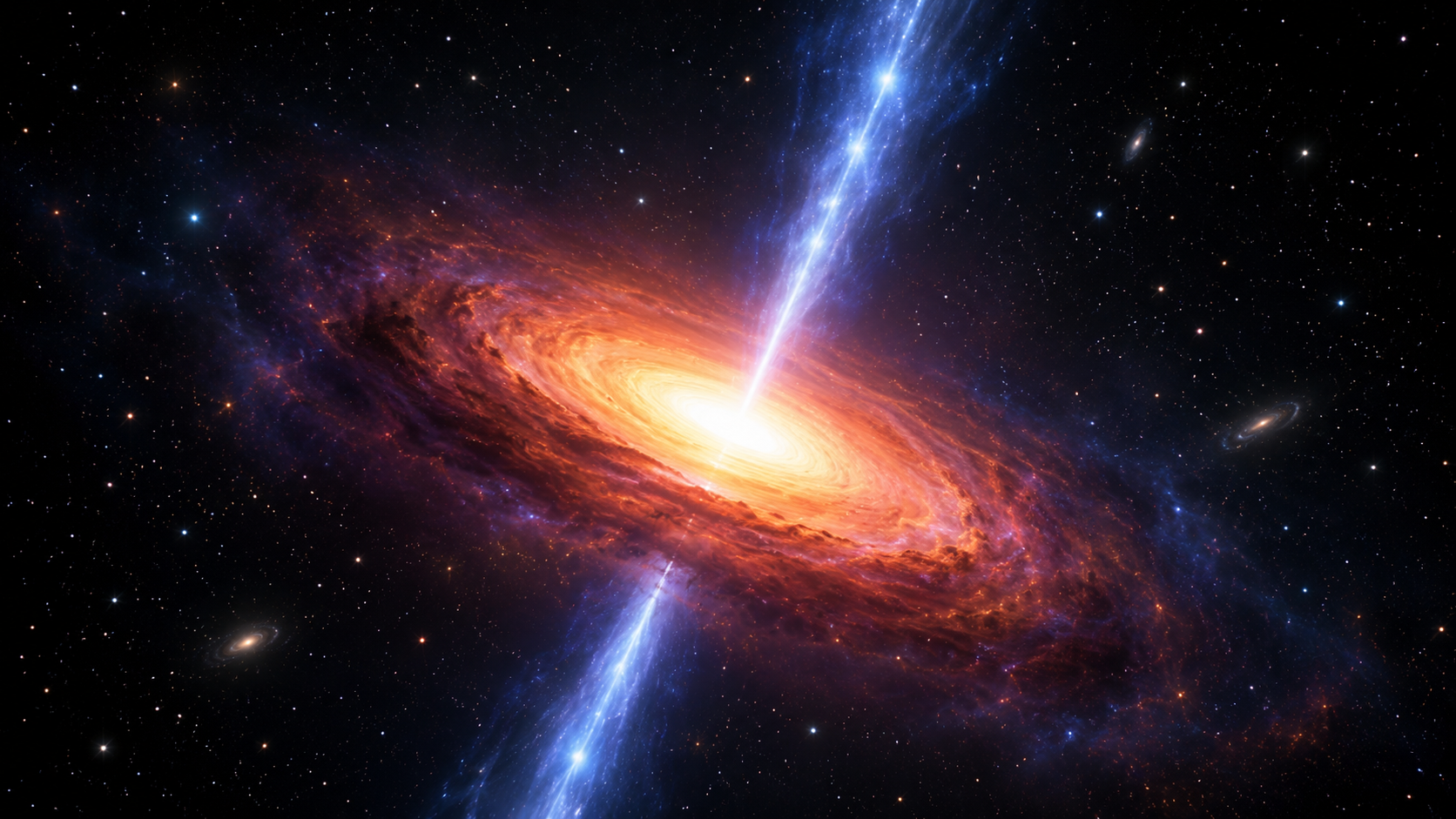 The luminosity of quasars arises from gas and dust spiraling at high velocity into the supermassive black hole at the center of a galaxy, forming a hot accretion disk where friction and other processes release enormous amounts of energy across the electromagnetic spectrum. This can outshine the combined light of all stars in the host galaxy by factors of hundreds or thousands. Some quasars also produce relativistic jets that emit in radio and other wavelengths. Quasars are a particularly luminous subclass of active galactic nuclei; not all AGNs are quasars.
Quasars are observed in the centers of galaxies and provide insights into galaxy evolution, particularly in the early universe, as many known quasars are seen as they existed when the universe was young. Their properties, including variability on short timescales, imply that the emitting region is very compact, consistent with the scale near a supermassive black hole.