
Black hole is a region of spacetime where gravity is so strong that nothing, not even light, can escape from it. This definition arises from Albert Einstein's theory of general relativity. When sufficient mass is compressed within a certain radius, the spacetime curvature becomes so extreme that an event horizon forms. The event horizon is the boundary beyond which the escape velocity exceeds the speed of light, making it a one-way surface for anything that crosses it.
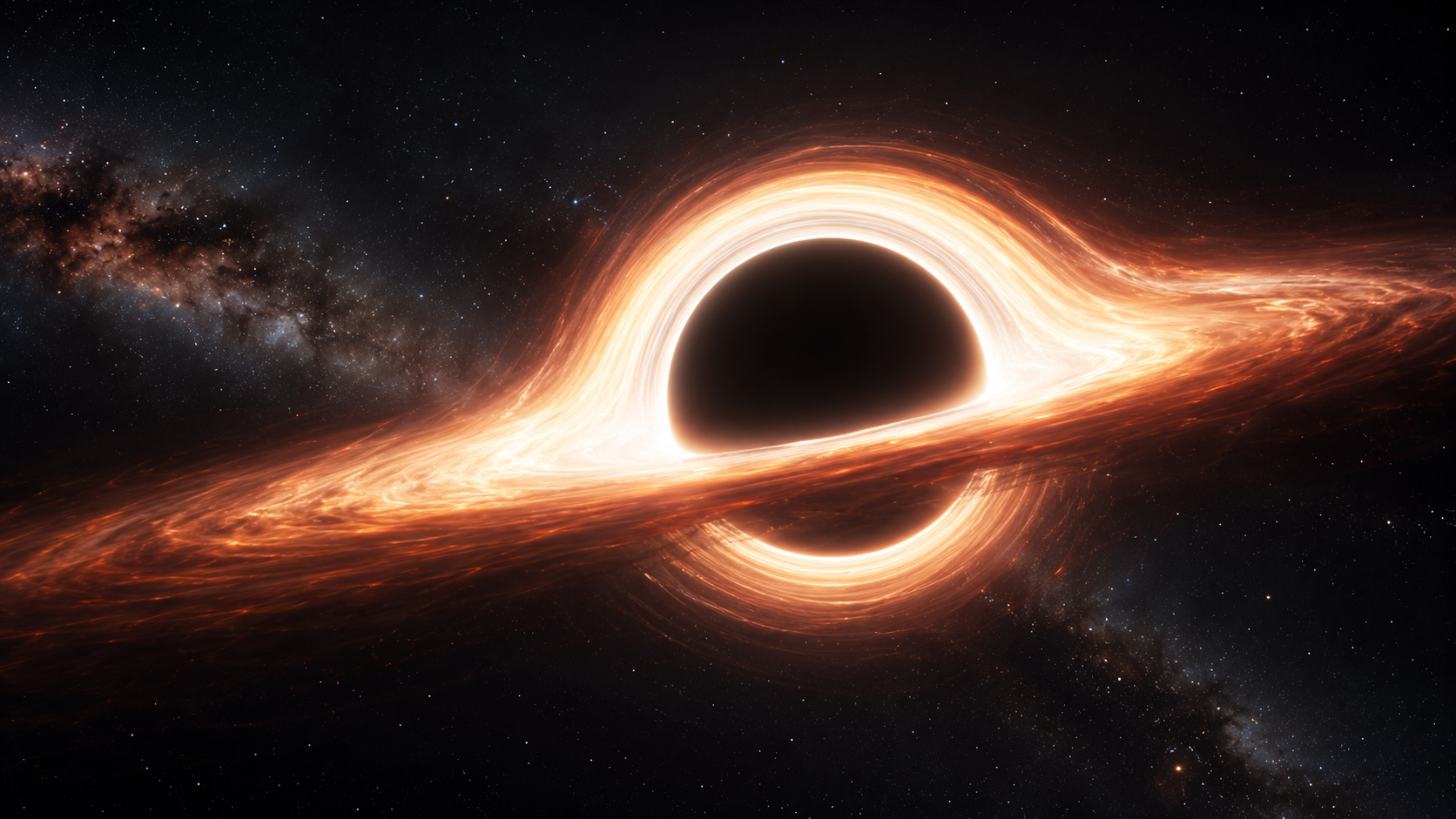 Black holes form primarily through the gravitational collapse of massive stars after they exhaust their nuclear fuel. For stars with cores exceeding roughly three times the mass of the Sun, the remnant collapses beyond the point where neutron degeneracy pressure can support it, leading to a black hole. Supermassive black holes, with masses from hundreds of thousands to billions of solar masses, are observed at the centers of most large galaxies. Stellar-mass black holes, ranging from a few to dozens of solar masses, have been identified through X-ray binaries and gravitational wave detections.
The event horizon is not a physical surface but a mathematical boundary in spacetime. For a non-rotating black hole, its radius is directly proportional to the black hole's mass, approximately 3 kilometers per solar mass. Crossing the event horizon produces no immediate local effects detectable by an infalling observer, but from a distant perspective, time dilation causes infalling objects to appear to slow and asymptotically approach the horizon without crossing it. Inside the event horizon, all paths lead toward the center. At the center lies a gravitational singularity, where general relativity predicts the curvature of spacetime becomes infinite and densities reach extreme values. This singularity represents a point where the classical theory breaks down, but its existence as a prediction of the theory is well-established within general relativity. No information from inside the event horizon can reach the outside universe.
Black holes are detected indirectly through their gravitational effects on surrounding matter, such as accretion disks emitting X-rays, orbital motions of stars, or gravitational waves from mergers. Observations, including those from the Event Horizon Telescope, confirm structures consistent with the predicted shadows and photon rings around black holes. The defining feature remains the presence of an event horizon from which nothing can escape.