
Supernova is a powerful and luminous explosion of a star that occurs during the last evolutionary stages of a massive star or when a white dwarf is triggered into runaway nuclear fusion. The original object either collapses to a neutron star or black hole, or is completely destroyed. The peak optical luminosity of a supernova can be comparable to that of an entire galaxy before it fades over several weeks or months.
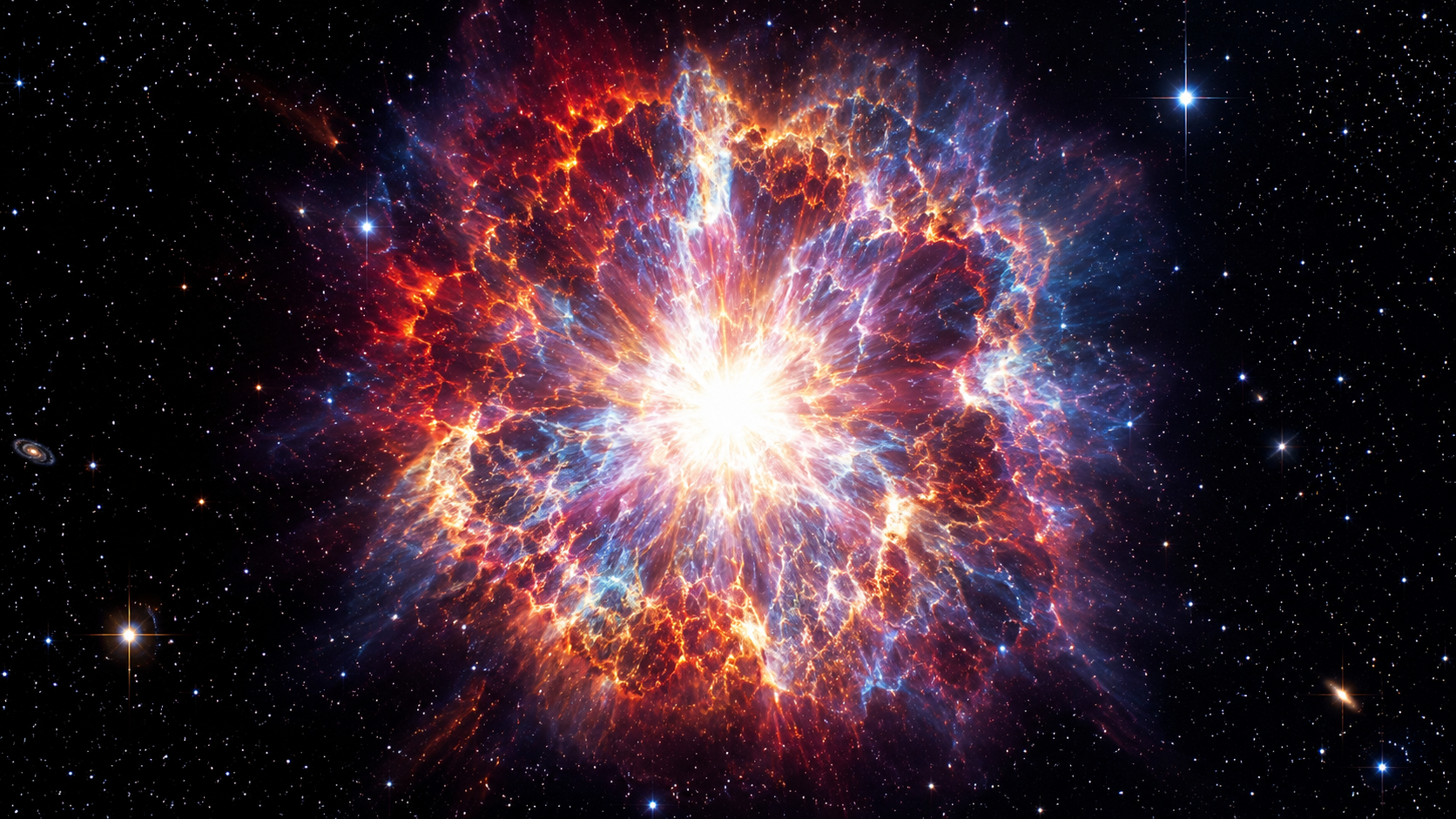 Supernovae are among the most energetic events in the universe. They release enormous amounts of energy, with the explosion ejecting material at high speeds and producing heavy elements through nucleosynthesis. In core-collapse events, the energy is primarily released as neutrinos, with a fraction driving the outward explosion. These explosions play a crucial role in dispersing elements heavier than hydrogen and helium into interstellar space, enriching the material from which new stars and planets form.
The two primary categories -
Core-collapse supernovae (including Types II, Ib, and Ic) - These occur in massive stars (typically >8 solar masses) when the star has fused all its fuel up to iron in the core. Iron fusion doesn't release energy, so the core collapses under gravity, triggering a rebound explosion that ejects the outer layers.
Thermonuclear (Type Ia) supernovae - These happen when a white dwarf in a binary system accretes enough mass from a companion star to reach the Chandrasekhar limit (~1.4 solar masses). This reignites runaway carbon-oxygen fusion, completely disrupting the white dwarf.
These different pathways lead to distinct observational signatures, light curves, and chemical compositions, which astronomers use to classify and study them. Other rare or theoretical variants exist (e.g., pair-instability supernovae in extremely massive stars), but the core-collapse and Type Ia mechanisms account for the vast majority.