
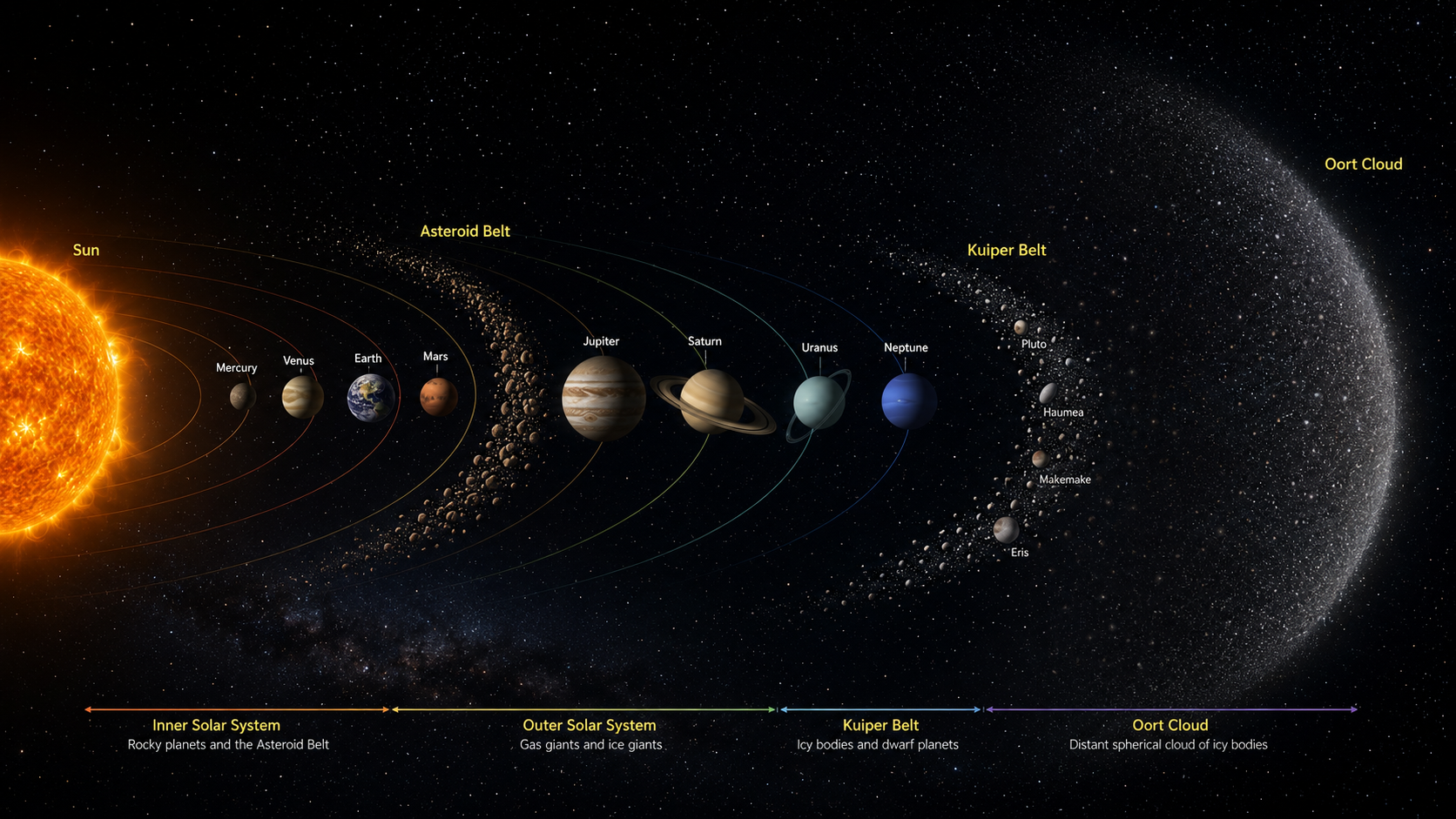
Uranus is the seventh planet from the Sun and is one of the eight recognized planets in the Solar System. It is classified as an ice giant, a category that also includes Neptune. Uranus was the first planet discovered with a telescope. It was identified in 1781 by William Herschel, expanding the known boundaries of the Solar System beyond the planets visible to the unaided eye. The planet is named after Uranus, a deity from ancient Greek mythology.
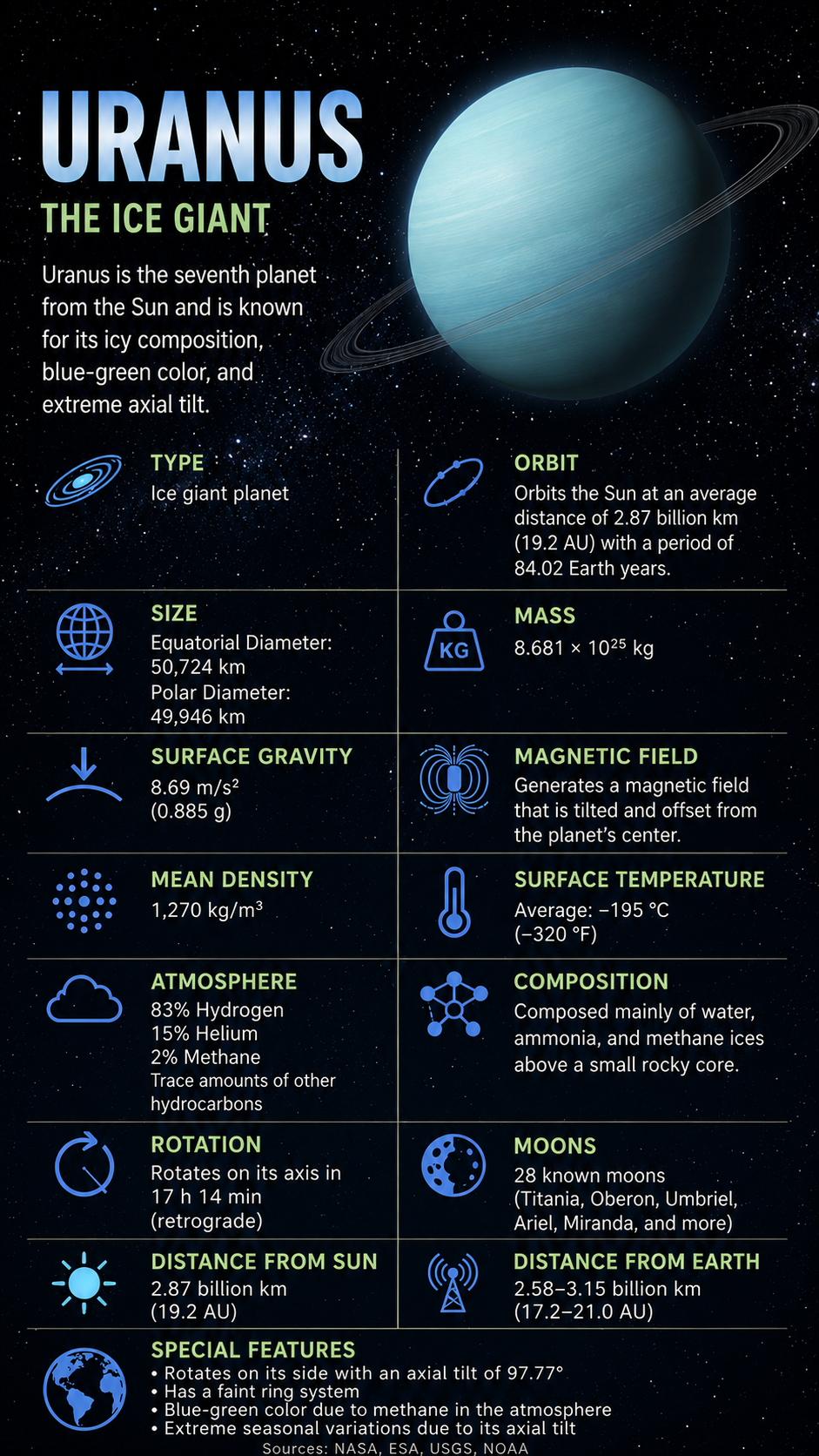
 One of the most distinctive and well-established characteristics of Uranus is its extreme axial tilt. Its rotational axis is tilted by about 98 degrees relative to its orbital plane. As a result, Uranus effectively rotates on its side compared with the other planets. This unusual orientation causes extreme seasonal variations. During parts of its orbit, one pole can face the Sun continuously for many years while the opposite pole remains in darkness, and then the situation reverses as the planet continues its journey around the Sun.
The atmosphere of Uranus is composed primarily of hydrogen and helium, with a smaller amount of methane. The methane absorbs red wavelengths of sunlight and reflects blue-green wavelengths, giving Uranus its characteristic pale cyan or blue-green appearance. Observations have revealed clouds, storms, and atmospheric bands, although these features are generally less visually prominent than those observed on Jupiter or Saturn. Temperatures in Uranus's upper atmosphere are among the coldest measured for any planet in the Solar System, reaching approximately 49 kelvin (−224 °C or −371 °F).
Unlike the terrestrial planets, Uranus does not have a solid surface on which a spacecraft or person could stand. Scientific models indicate that beneath its atmosphere lies a deep mantle consisting largely of water, ammonia, and methane in fluid and high-pressure forms, surrounding a relatively small rocky core. These internal structures are inferred from measurements of the planet's mass, gravity field, magnetic field, and other observational data.
Uranus possesses a complex magnetic field that is both significantly tilted relative to its rotational axis and offset from the planet's center. The exact structure and behavior of this magnetic field have been measured primarily through data collected by the Voyager 2 spacecraft, which conducted the only close flyby of Uranus in January 1986. During that encounter, Voyager 2 provided detailed observations of the planet, its rings, and its moons.
The planet is surrounded by a system of rings. Uranus's rings are much darker and less conspicuous than those of Saturn but are nevertheless well established through telescopic observations and spacecraft measurements. As of current observations, thirteen distinct rings have been identified. These rings consist primarily of relatively dark particles ranging in size from microscopic dust to larger rocky fragments. Uranus also has a large family of natural satellites. Twenty-seven known moons have been confirmed. The five largest moons are Titania, Oberon, Umbriel, Ariel, and Miranda. These moons exhibit a variety of geological features including impact craters, canyons, fault systems, and regions shaped by past internal activity.