Asteroid belt is a vast region of the Solar System located between the orbits of the planets Mars and Jupiter. It contains millions of rocky bodies known as asteroids, along with smaller amounts of dust and debris. These objects orbit the Sun in the same general direction as the planets. The asteroid belt is one of the principal populations of small bodies in the Solar System and represents material that has remained from the early stages of Solar System formation approximately 4.6 billion years ago. The asteroid belt is not a densely packed field of rocks as it is often portrayed in science fiction. The distances between individual asteroids are typically extremely large, often hundreds of thousands to millions of kilometers apart. A spacecraft can travel through the asteroid belt with a very low probability of colliding with an asteroid.
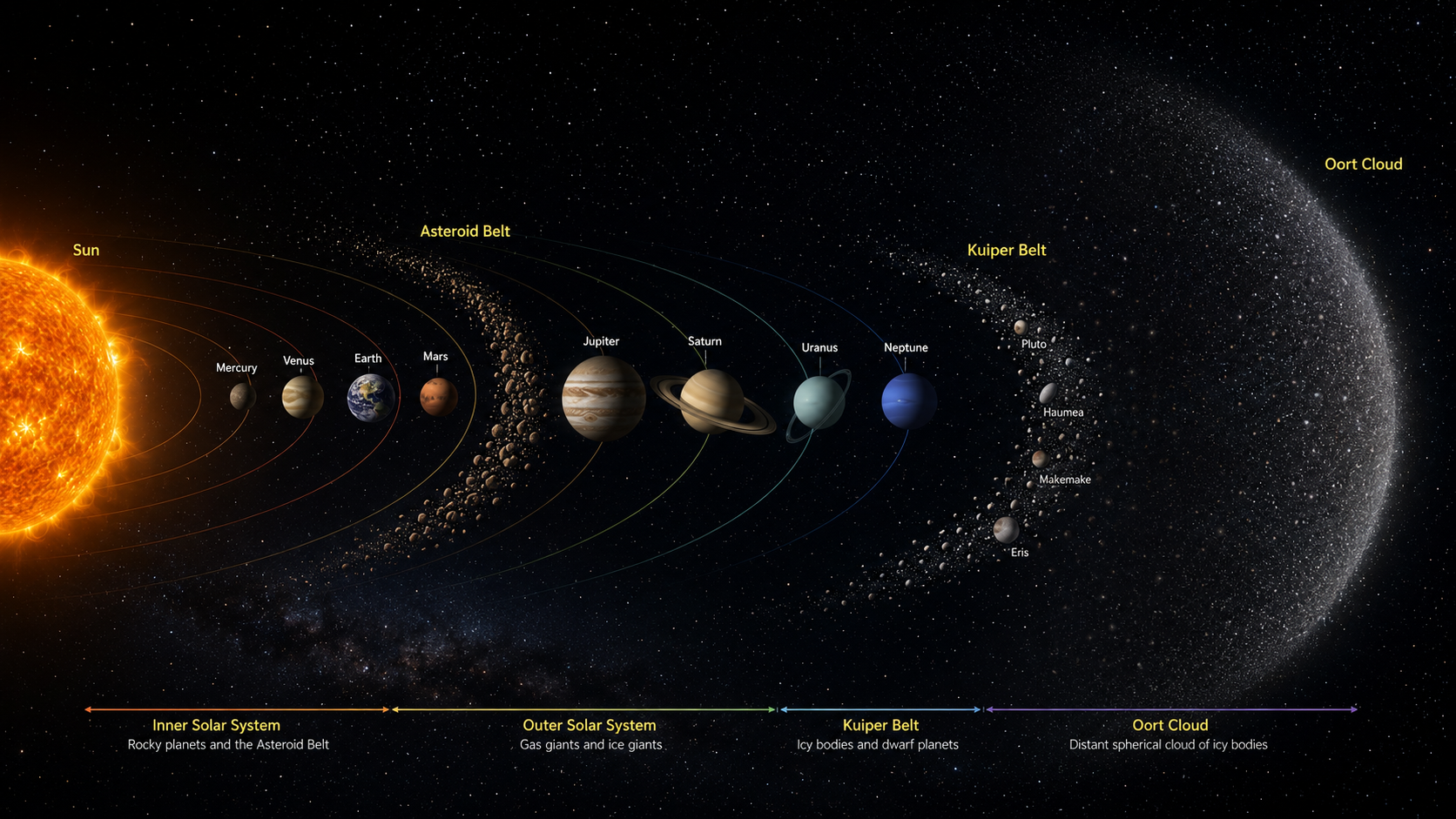 Asteroids within the belt vary greatly in size, composition, shape, and mass. Most are irregularly shaped because they do not possess enough gravity to pull themselves into spheres. The largest object in the asteroid belt is the dwarf planet Ceres, which has a diameter of about 940 kilometers (584 miles). Other major bodies include Vesta, Pallas, and Hygiea. Together, these objects contain a significant fraction of the belt's total mass. Even so, the combined mass of all objects in the asteroid belt is only a small percentage of the mass of Earth's Moon.
Asteroids are commonly classified according to their composition. Carbon-rich asteroids, known as C-type asteroids, are the most abundant. Silicate-rich S-type asteroids are also common, while M-type asteroids contain relatively large amounts of metallic iron and nickel. These compositional differences provide important information about the conditions that existed during the formation of the Solar System. Some asteroids preserve material that has undergone little change since the Solar System's earliest history, making them valuable scientific records of planetary formation processes.
The asteroid belt is dynamically structured rather than uniformly populated. Certain regions contain relatively few asteroids because orbital resonances with Jupiter destabilize objects located there. These gaps, known as Kirkwood gaps, occur where an asteroid's orbital period forms a simple mathematical ratio with Jupiter's orbital period. Over long periods of time, gravitational interactions tend to remove asteroids from these resonant locations. The asteroid belt is also a source of some meteorites that eventually reach Earth. Collisions between asteroids can produce fragments that are later perturbed onto paths crossing the inner Solar System. Some of these fragments enter Earth's atmosphere and survive to reach the surface as meteorites, providing scientists with direct samples of asteroid material for laboratory study.