Solar wind is the continuous flow of electrically charged particles that streams outward from the Sun into space. These particles consist primarily of electrons, protons, and a small number of heavier atomic nuclei. The solar wind originates in the Sun's outer atmosphere, known as the corona, where temperatures reach millions of degrees. At such high temperatures, particles possess enough energy to escape the Sun's gravitational pull and flow outward in all directions through the Solar System.
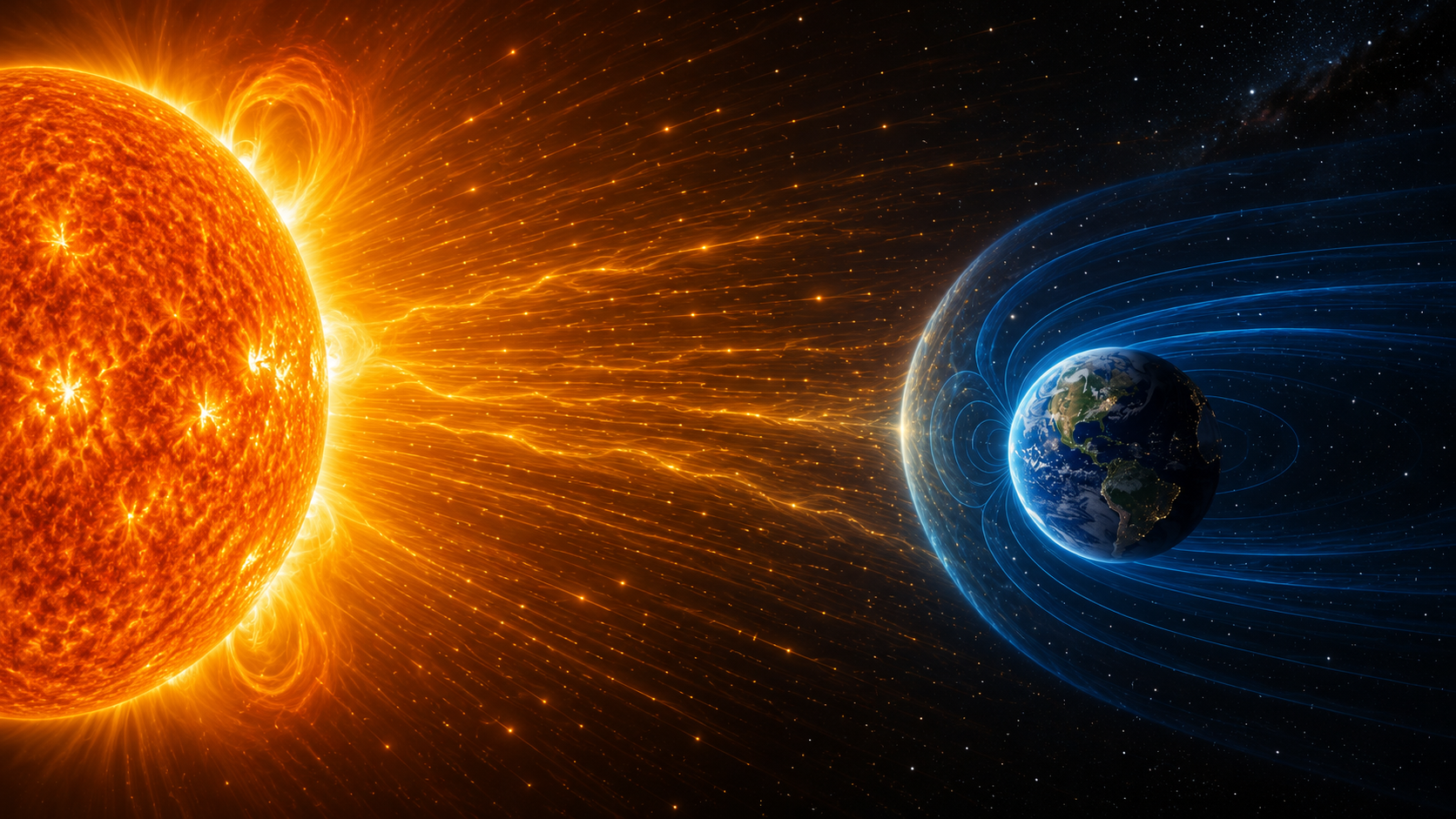 The solar wind is not a true wind like the movement of air in Earth's atmosphere. Instead, it is a plasma, which is a state of matter composed of charged particles. As the plasma travels away from the Sun, it carries part of the Sun's magnetic field with it. This outward flowing magnetic field fills much of the Solar System and is known as the interplanetary magnetic field. The solar wind travels at speeds that typically range from about 300 to 800 kilometers per second (approximately 186 to 497 miles per second), although its speed and density vary depending on solar activity and the region of the Sun from which it originates. Faster solar wind generally comes from regions called coronal holes, where magnetic field lines are open and allow particles to escape more readily.
The solar wind has significant effects throughout the Solar System. It shapes the heliosphere, the vast bubble-like region of space dominated by the Sun's magnetic field and charged particles. When the solar wind encounters planets, moons, comets, and other objects, it can interact with their magnetic fields and atmospheres. At Earth, these interactions can produce auroras, commonly known as the Northern and Southern Lights. Strong disturbances in the solar wind associated with solar eruptions can also affect satellites, radio communications, navigation systems, and electrical power systems. The solar wind extends far beyond the orbit of the outer planets until it eventually slows and interacts with the interstellar medium, the gas and dust that exist between stars. The boundary regions where these interactions occur define the outer limits of the heliosphere.