
White dwarf is a stellar remnant that forms at the end of the life cycle of stars with initial masses up to approximately eight times that of the Sun. Stars like our Sun, after exhausting their nuclear fuel in the core through hydrogen and then helium fusion, undergo significant changes. Near the end of their nuclear burning stage, they expand into red giants, expel most of their outer layers, often forming a planetary nebula, and leave behind the hot, dense core that becomes the white dwarf.
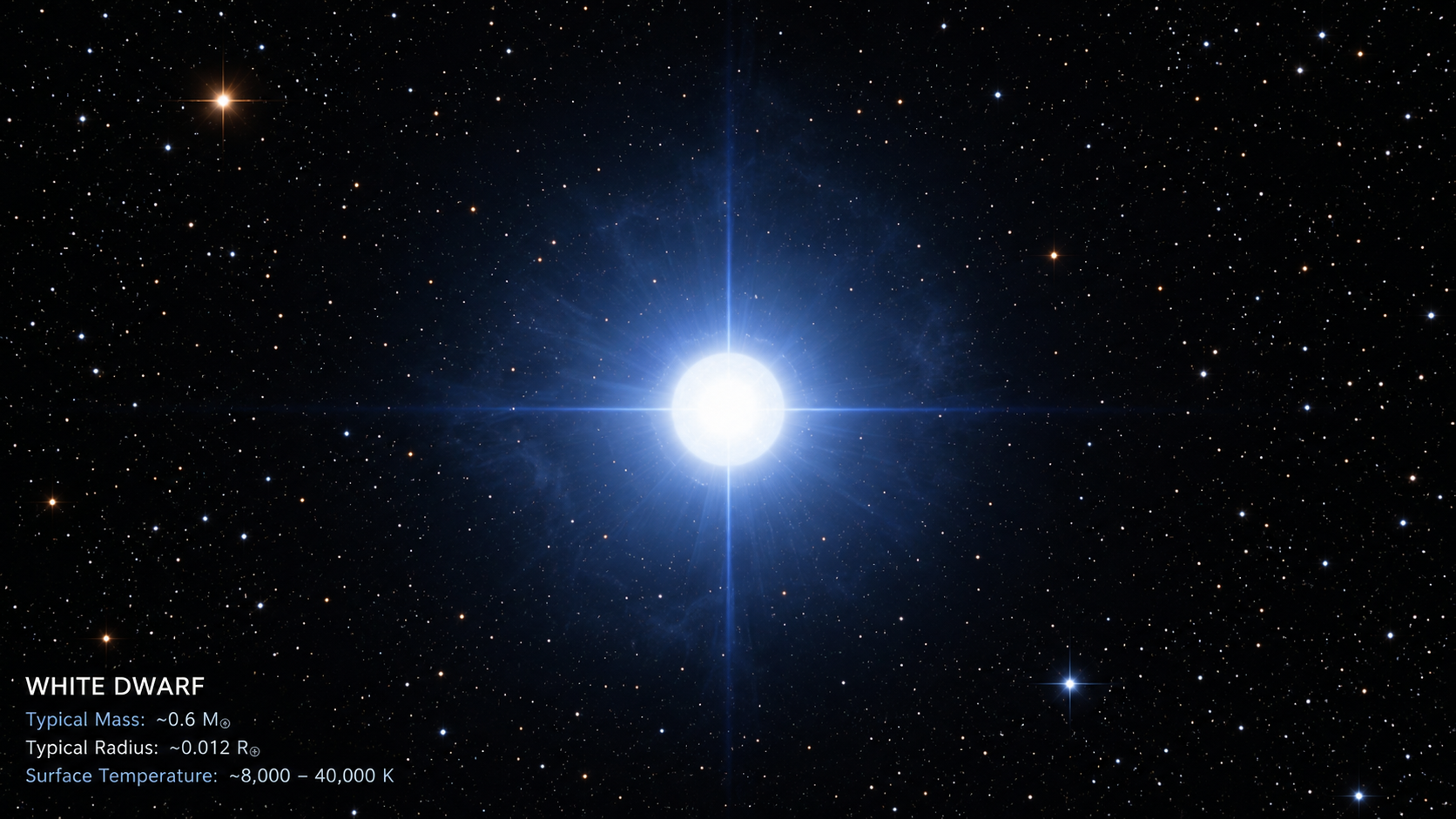 This remnant is extremely compact: a typical white dwarf has a mass comparable to that of the Sun but is compressed into a volume roughly the size of Earth, resulting in densities on the order of 10\(^4\) to 10\(^7\) grams per cubic centimeter, about a million times denser than the Sun on average and vastly denser than ordinary matter like rock or water. The support against further gravitational collapse comes not from ongoing fusion but from electron degeneracy pressure, a quantum mechanical effect arising from the Pauli exclusion principle, which prevents electrons from occupying the same quantum state.
White dwarfs no longer generate energy through nuclear fusion reactions. Instead, they radiate heat from their residual thermal energy, initially at very high surface temperatures exceeding 100,000 Kelvin, cooling gradually over billions of years. Their composition is typically carbon and oxygen for most cases, though some, especially those formed in certain binary systems, may consist primarily of helium. Despite the name "white dwarf," their observed colors can range from blue-white to yellow depending on temperature.