
Waterflooding is a secondary oil recovery technique in which water is injected into an oil-bearing reservoir through one or more designated injection wells in order to displace residual oil toward surrounding production wells while also maintaining or restoring reservoir pressure. This process relies on the physical displacement of oil and any free gas by the injected water, which moves through the pore spaces of the reservoir rock to form a flood front that sweeps the hydrocarbons ahead of it. The water is typically sourced from produced formation water, nearby aquifers, or surface supplies and may undergo treatment to ensure compatibility with the reservoir fluids and rock matrix, thereby minimizing issues such as scaling or clay swelling that could impair injectivity.
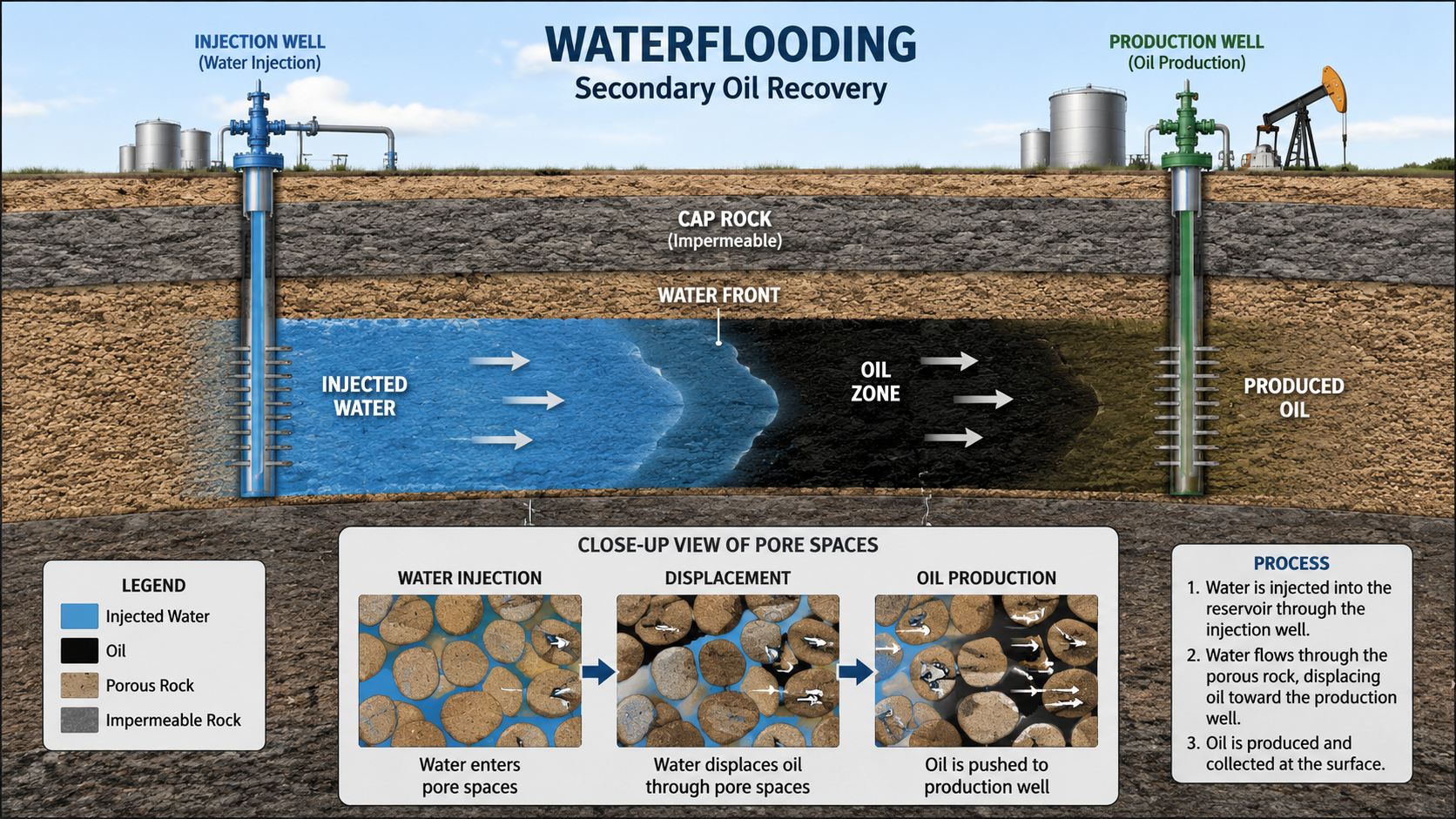 Waterflooding is most often applied after the reservoir’s natural drive mechanisms, such as solution-gas drive, rock and fluid expansion, gravity drainage, or limited aquifer influxh ave been depleted during primary production, at which point reservoir pressure has declined to the point where oil flow rates become uneconomic. However, it can sometimes be initiated earlier in the field’s life to prevent rapid pressure drop or to support reservoirs with weak natural energy. Injection and production wells are spaced and patterned (for example, in regular arrays that optimize areal coverage) to direct the water movement effectively through the reservoir formation. The dual role of pressure maintenance and oil displacement allows continued production from the field by providing the energy needed to move oil to the wellbore, where it is lifted to the surface along with increasing volumes of the injected water as the flood matures.