
Spring potential energy, abbreviated as \(PE_s\), also called elastic potential energy, is the energy stored within a stretched or compressed spring. When a spring is deformed from its equilibrium position, it possesses the ability to restore its original shape or position by exerting a restoring force. This stored energy is referred to as spring potential energy. The spring potential energy is directly proportional to the square of the displacement from the equilibrium position. This means that the potential energy increases as the spring is stretched or compressed further.
Spring Potential Energy formula |
||
|
\( PE_s \;=\; \dfrac{1}{2} \cdot k_s \cdot {l_s}^2 \) (Spring Potential Energy) \( k_s \;=\; \dfrac{ 2 \cdot PE_s }{ l_c^2 }\) \( l_s \;=\; \sqrt{ \dfrac{ 2 \cdot PE_s }{ k_s } } \) |
||
| Symbol | English | Metric |
| \( PE_s \) = Spring Potential Energy | \( lbf-ft \) | \(J \) |
| \( k_s \) = Spring Force Constant | \(lbf\) | \(N\) |
| \( l_s \) = Spring Stretch Length | \(in\) | \(mm\) |
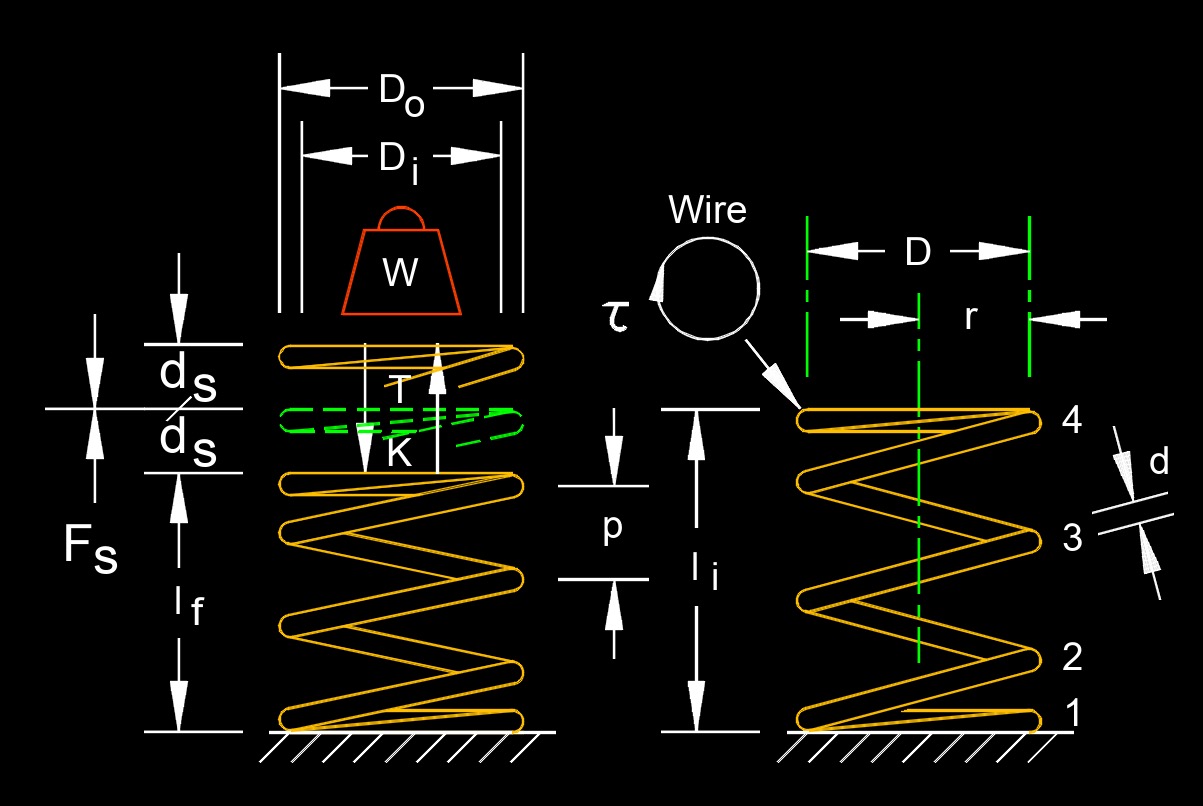
Spring potential energy is a form of potential energy stored in the elastic deformation of the spring. When the spring is released or allowed to return to its equilibrium position, this potential energy is converted back into kinetic energy or other forms of energy, depending on the system. It is commonly utilized in various applications, including mechanical systems, springs in watches, shock absorbers, and other elastic elements.