Hydraulic radius of a partially full pipe is used in open-channel flow analysis to describe the efficiency with which a fluid can flow through a conduit that is not flowing completely full. It is defined as the cross-sectional area of flow divided by the wetted perimeter. The wetted perimeter is the portion of the pipe's internal circumference that is actually in contact with the flowing liquid. In a partially full pipe, only part of the pipe wall is wetted because the upper portion contains air rather than liquid.
Hydraulic Radius of a Partially Full Pipe (Less than Half Full) Formula |
||
|
\( r_h \;=\; \dfrac{ A_c }{ P_w }\) \( A_c \;=\; r_h \cdot P_w \) \( P_w \;=\; \dfrac{ A_c }{ r_h }\) |
||
| Symbol | English | Metric |
| \( r_h \) = hydraulic radius | \( in \) | \( mm \) |
| \( A_c \) = area cross-section of flow | \( in^2 \) | \( mm^2 \) |
| \( P_w \) = wetting perimeter | \( in \) | \(mm \) |
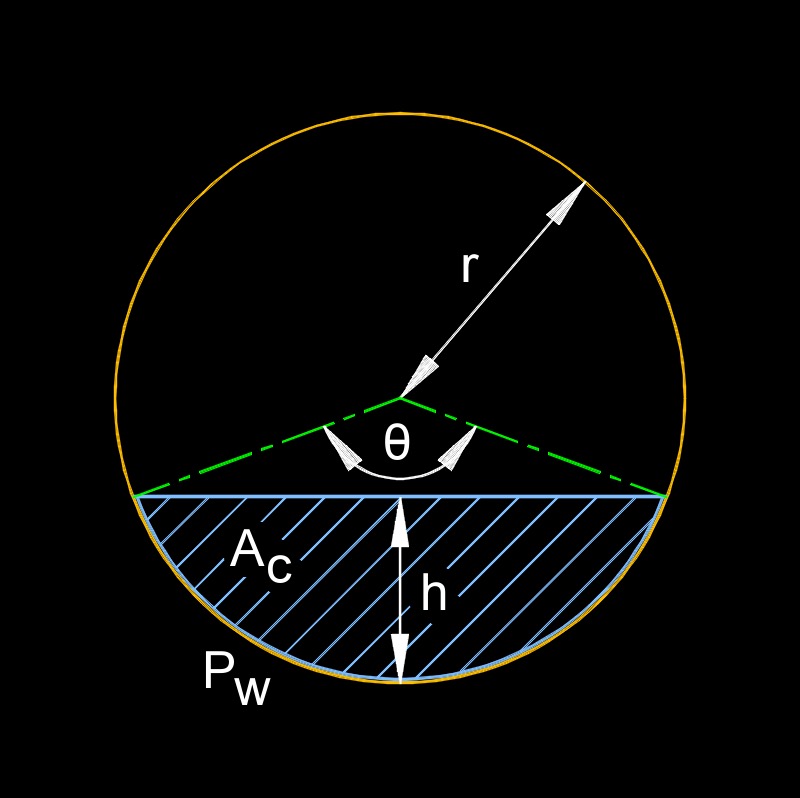 The hydraulic radius is an important because it relates the amount of water being conveyed to the amount of boundary surface creating frictional resistance. A larger hydraulic radius generally indicates more efficient flow because a greater volume of fluid is being carried relative to the wetted surface that produces friction losses. Conversely, a smaller hydraulic radius indicates that a larger proportion of the flowing liquid is in contact with the pipe wall, resulting in greater resistance to flow.