Optics
Laws of Physics, Physics, Optics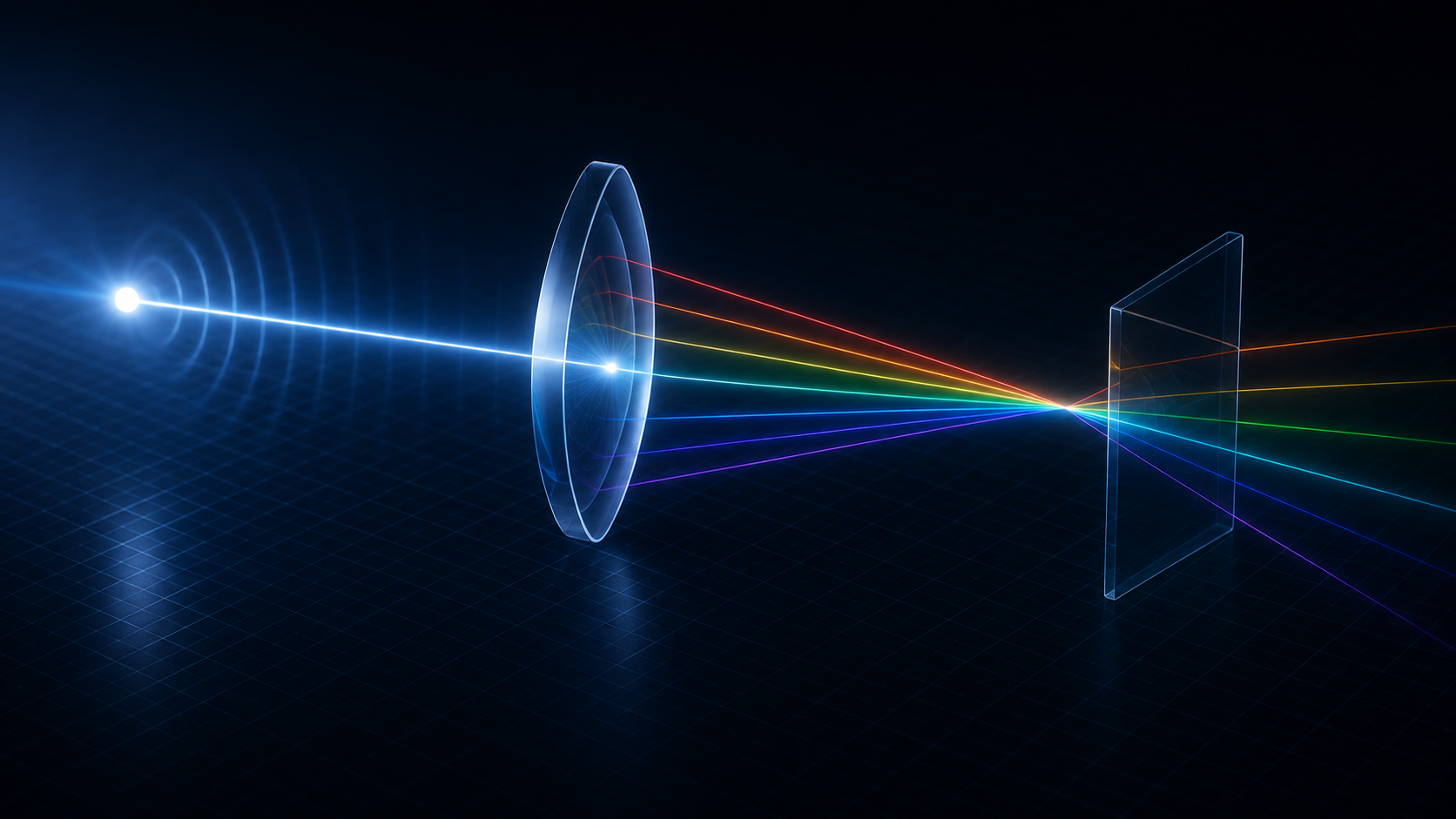 Optics studies the behavior, properties, and interactions of light, understood both as an electromagnetic wave and as a stream of discrete particles called photons. It encompasses how light is generated, how it propagates through different media, how it is detected, and how it interacts with matter. These interactions include well-established phenomena such as reflection, refraction, diffraction, interference, and polarization, all of which are governed by experimentally verified physical laws. Optics is grounded electromagnetic theory, as well as in quantum mechanics when describing light at atomic and subatomic scales.
Optics has a wide range of applications across science and engineering. It is used for the design of imaging systems such as microscopes, telescopes, and cameras, communication technologies like fiber-optic networks, and to measurement techniques including spectroscopy and interferometry. It's also used in the developments in laser technology, photonics, and optical computing. The principles of optics are validated through observation, experimentation, and technological implementation.
| Science |
| Natural Science |
| Physics |
| Classical Physics |
| Optics |
Optics Branches
Geometrical (Ray Optics) - Treats light as rays traveling in straight lines and describes phenomena such as reflection, refraction, and the formation of images by lenses and mirrors using geometric principles.
Physical (Wave Optics) - Studies light as an electromagnetic wave and explains phenomena including interference, diffraction, polarization, and scattering that cannot be fully accounted for by ray approximations.
Quantum - Examines the quantum nature of light and its interactions with matter at the photon level, including phenomena related to the particle-like behavior of light.