
Matter Physics
Matter, Laws of Physics, Physics, Matter Physics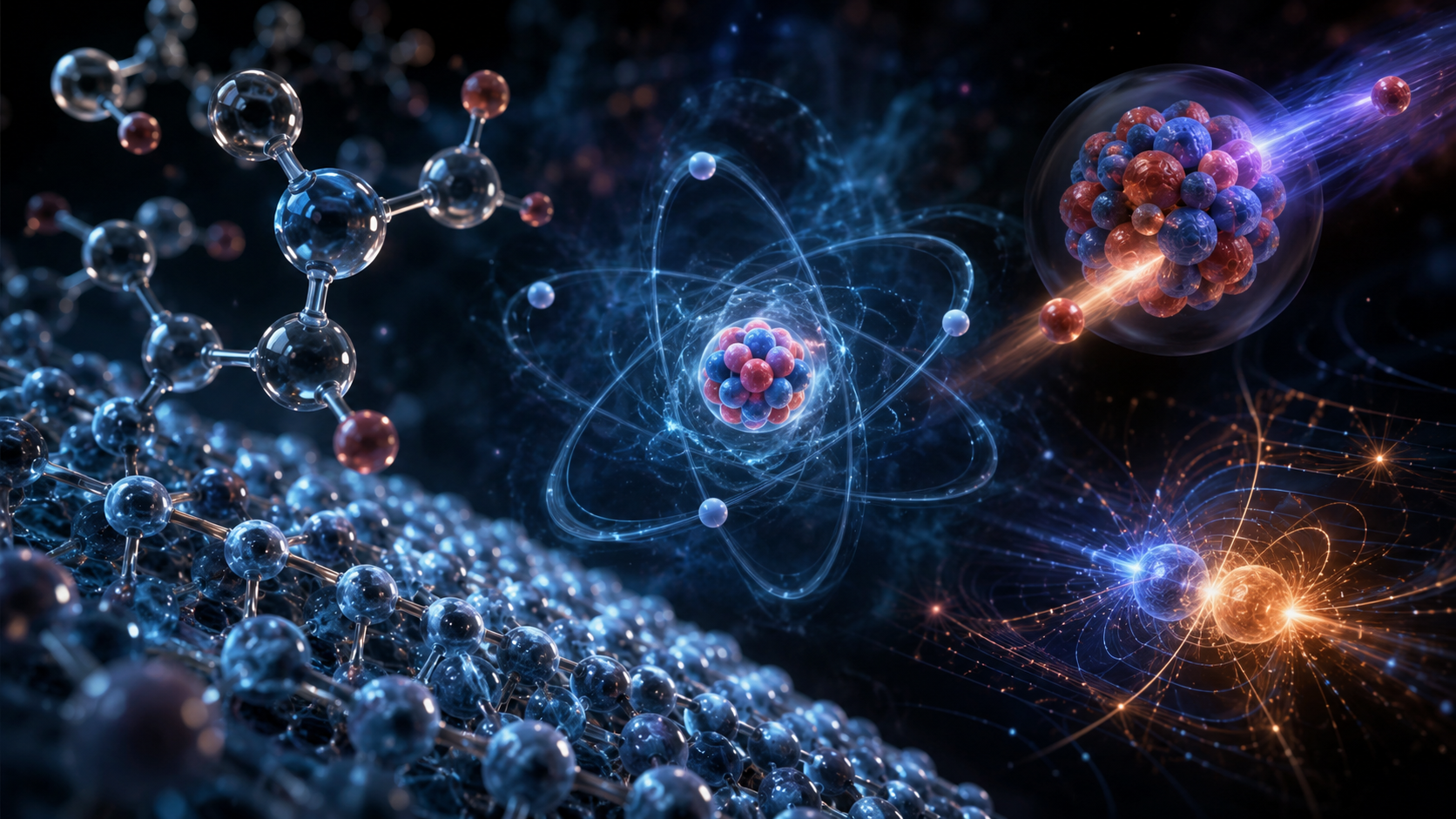 Matter physics is defined as anything that has mass and occupies space by having volume. This is fundamental in physical sciences and forms the basis for describing the material universe. Matter includes ordinary substances such as solid, liquid, gas, and plasma, as well as the particles and fields that compose physical objects. The concept is used throughout classical physics, chemistry, and modern physics to distinguish physical substance from purely abstract quantities such as mathematical constructs or certain forms of energy.
Matter is composed of atoms and subatomic particles. Atoms consist of nuclei containing protons and neutrons, surrounded by electrons. Protons and neutrons themselves are made of more particles called quarks. According to particle physics, matter particles are primarily classified as fermions, which include quarks and leptons. Electrons are leptons, while protons and neutrons are composite particles built from quarks. These particles interact through the four forces of nature, gravity, electromagnetism, strong nuclear force, and weak nuclear force.
| Science |
| Natural Science |
| Physics |
| Modern Physics |
| Matter Physics |
Matter was traditionally understood as a continuous substance with properties such as mass, density, inertia, and momentum. Inertia is the tendency of matter to resist changes in motion, a principle formalized in Newton’s laws of motion. Matter can exist in several physical states depending on temperature and pressure. The states are solid, liquid, gas, and plasma. In solids, particles are closely packed with fixed structure. In liquids, particles remain close together but can flow. In gases, particles move freely and occupy available volume. In plasmas, atoms become ionized, producing electrically charged particles.
The study of matter spans multiple branches of physics, such as classical mechanics, thermodynamics, condensed matter physics, and particle physics. Each branch examines matter at different scales and under different conditions.