Particle Physics
Laws of Physics, Physics, Particle Physics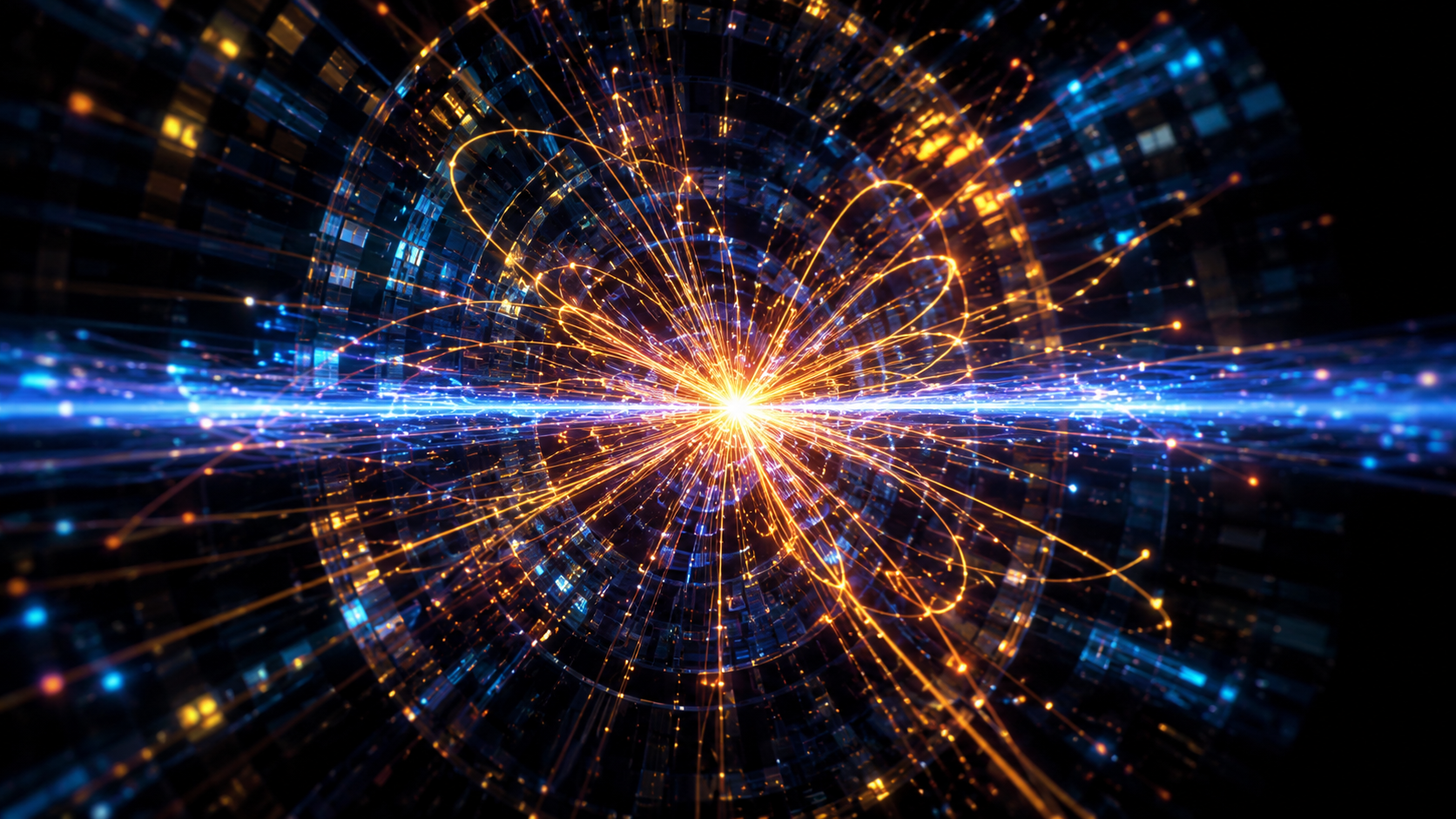 Particle physics studies the most fundamental known component of matter and energy, and the interactions between them. Its purpose is to determine what the universe is made of at the smallest observable scales and to understand the laws governing those components. The field investigates particles that are not composed of smaller known parts, called elementary particles, as well as the forces through which those particles interact. Particle physics is sometimes called high-energy physics because many of the particles and interactions are studied using extremely high energies produced in particle accelerators.
Particle physics is based primarily on the framework known as the Standard Model of particle physics. The Standard Model classifies elementary particles into two major categories: fermions and bosons. Fermions are the particles that make up matter. They include quarks and leptons. Quarks combine to form composite particles such as protons and neutrons, which in turn form atomic nuclei. Leptons include electrons, muons, tau particles, and neutrinos. Bosons are particles associated with the fundamental forces. The photon mediates the electromagnetic force, gluons mediate the strong nuclear force, and the W and Z bosons mediate the weak nuclear force.
| Science |
| Natural Science |
| Physics |
| Modern Physics |
| Particle Physics |
Particle physics studies three of the four currently recognized fundamental forces of nature within the Standard Model framework: the electromagnetic force, the weak nuclear force, and the strong nuclear force. Gravity is not successfully incorporated into the Standard Model using currently established theories. The attempt to unify gravity with quantum mechanics remains one of the major unresolved problems in theoretical physics. Although the Standard Model has been experimentally successful across a wide range of measurements, it is not considered a complete theory of fundamental physics. It does not explain dark matter, dark energy, or the observed dominance of matter over antimatter in the universe, and it does not include a quantum theory of gravity.