Terminal velocity, abbreviated as \(v_t\), is the constant maximum velocity an object reaches when falling through a fluid, such as air or water, once the forces acting on it become balanced. As an object falls, gravity accelerates it downward, but fluid resistance (drag) increases with speed.
Terminal Velocity formula |
||
|
\( v_t \;=\; \sqrt { \dfrac{ 2 \cdot m \cdot g }{ C_d \cdot \rho \cdot A } }\) (Terminal Velocity) \( m \;=\; \dfrac{ v_t^2 \cdot C_d \cdot \rho \cdot A }{ 2 \cdot g }\) \( g \;=\; \dfrac{ v_t^2 \cdot C_d \cdot \rho \cdot A }{ 2 \cdot m }\) \( C_d \;=\; \dfrac{ 2 \cdot m \cdot g }{ v_t^2 \cdot \rho \cdot A }\) \( \rho \;=\; \dfrac{ 2 \cdot m \cdot g }{ v_t^2 \cdot C_d \cdot A }\) \( A \;=\; \dfrac{ 2 \cdot m \cdot g }{ v_t^2 \cdot C_d \cdot \rho }\) |
||
| Symbol | English | Metric |
| \( v_t \) = Terminal Velocity (maximum falling speed) | \(ft \;/\; sec\) | \(m \;/\; s\) |
| \( m \) = Mass | \(lbm\) | \(kg\) |
| \( g \) = Gravitational Acceleration | \(ft \;/\; sec^2\) | \(m \;/\; s^2\) |
| \( C_d \) = Drag Coefficient | \(dimensionless\) | \(dimensionless\) |
| \( \rho \) (Greek symbol rho) = Fluid Density | \(lbm \;/\; ft^3\) | \(kg \;/\; m^3\) |
| \( A \) = Object Area | \(ft^2\) | \(m^2\) |
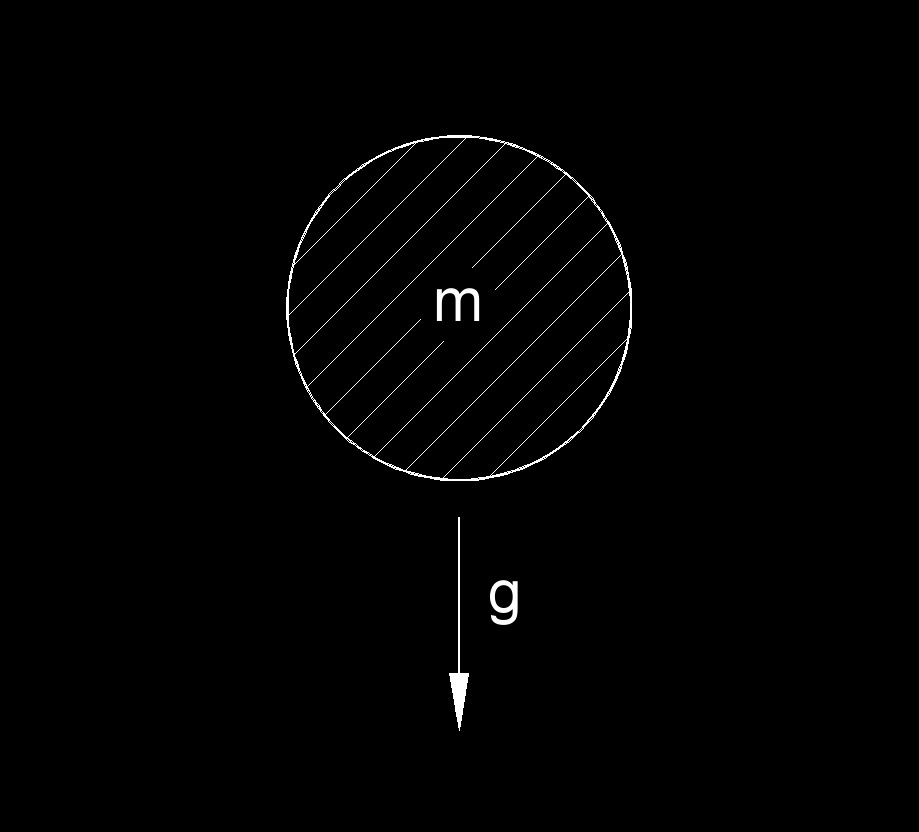 Eventually, the upward drag force becomes equal to the downward gravitational force. At this moment, the net force on the object becomes zero, causing acceleration to stop. The object then continues falling at a constant speed, known as terminal velocity. This velocity depends on factors such as the object’s mass, shape, surface area, and the density of the fluid it moves through. Terminal velocity is an important concept in physics, aerodynamics, and engineering because it helps describe how objects behave when they fall over long distances through a resisting medium.