Water pressure loss through piping is the reduction in water pressure that occurs as water flows through a pipe or piping system. This pressure loss is primarily caused by friction between the moving water and the inside wall of the pipe, but it can also result from fittings and components such as elbows, tees, valves, reducers, entrances, and exits. The magnitude of the loss depends on factors including the water velocity or flow rate, pipe inside diameter, pipe length, pipe-wall roughness, water properties, viscosity of the fluid, and the type and number of fittings.
Water Pressure Loss Through Piping formula |
||
|
\( p_l \;=\; \dfrac{ \mu \cdot L \cdot v_w^2 \cdot \rho \cdot SG }{ 24 \cdot d \cdot g } \) (Water Pressure Poss Through Piping) \( \mu \;=\; \dfrac{ 24 \cdot d \cdot g \cdot p_l }{ L \cdot v_w^2 \cdot \rho \cdot SG } \) \( L \;=\; \dfrac{ 24 \cdot d \cdot g \cdot p_l }{ \mu \cdot v_w^2 \cdot \rho \cdot SG } \) \( v_w \;=\; \sqrt{ \dfrac{ 24 \cdot d \cdot g \cdot p_l }{ \mu \cdot L \cdot \rho \cdot SG } }\) \( \rho \;=\; \dfrac{ 24 \cdot d \cdot g \cdot p_l }{ \mu \cdot L \cdot v_w^2 \cdot SG } \) \( SG \;=\; \dfrac{ 24 \cdot d \cdot g \cdot p_l }{ \mu \cdot L \cdot v_w^2 \cdot \rho } \) \( d \;=\; \dfrac{ \mu \cdot L \cdot v_w^2 \cdot \rho \cdot SG }{ 24 \cdot p_l \cdot g } \) \( g \;=\; \dfrac{ \mu \cdot L \cdot v_w^2 \cdot \rho \cdot SG }{ 24 \cdot p_l \cdot d } \) |
||
| Symbol | English | Metric |
| \(\ p_l \) = Water Pressure Loss | \(psi\) | - |
| \( \mu \) (Greek symbol mu) = Water Friction Coefficient | \(dimensionless\) | - |
| \( L \) = Pipe Length | \(ft\) | - |
| \( v_w \) = Water Velocity | \(ft\;/\;sec\) | - |
| \( \rho \) (Greek symbol rho) = Water Density | \(lb\;/\;ft^3\) | - |
| \( SG \) = Water Specific Gravity | \(dimensionless\) | - |
| \( d \) = Pipe Inside Diameter | \(in\) | - |
| \( g \) = Gravitational Acceleration | \(ft\;/\;sec^2\) | - |
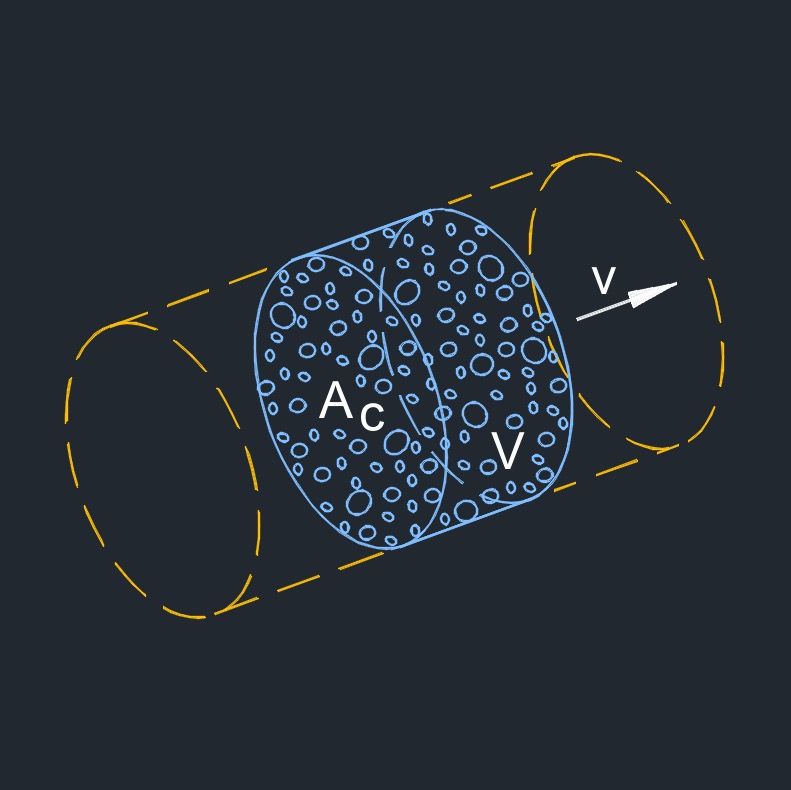
For a straight pipe, pressure loss is commonly evaluated using the Darcy–Weisbach equation, in which the frictional head loss is proportional to pipe length and the square of flow velocity and inversely related to pipe diameter. The friction factor accounts for the effects of Reynolds number and pipe roughness. Pressure loss can also be expressed as an equivalent pressure difference by multiplying the head loss by the fluid density and gravitational acceleration. In practical piping design, minimizing pressure loss generally involves selecting an adequate pipe diameter, controlling flow velocity, and accounting for both straight-pipe friction and local losses from fittings and valves.
In engineering terms, water pressure loss through piping is the pressure difference between two locations in a piping system caused by hydraulic resistance to flow. It is important when sizing pipes, selecting pumps, determining available pressure at downstream equipment, and verifying that a water distribution system can deliver the required flow at the required pressure.